The great bond-market repricing: Why deficits, geopolitics and AI are driving long-term yields higher

The biggest move in financial markets right now may be happening in an asset class that many equity and FX investors rarely watch closely: government bonds.
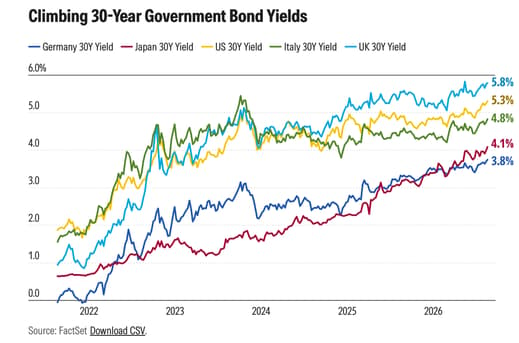
Long-term yields have surged across the United States, Europe, the UK and Japan, with several benchmarks reaching levels not seen for more than a decade. The US 30-year Treasury yield, for instance, briefly climbed to 5.337%, its highest level since 2007, before retreating after the US Treasury announced an expansion of its long-term bond buyback programme.
Source: MorningStar
The move matters far beyond fixed income. Government bonds effectively set the benchmark price of money across the global economy. Their yields influence mortgage rates, corporate borrowing costs, government financing, equity valuations, currencies and the discount rates investors use to value future earnings.
So why are investors demanding more compensation to hold long-term debt?
The answer is not simply inflation. A more important story is emerging around the competition for capital. Governments are running large deficits and issuing more debt, geopolitical tensions are increasing defence and energy spending, Japan’s return as a higher-yielding market could reduce the pool of capital flowing overseas, and the artificial-intelligence boom is transforming Big Tech into a major borrower.
Together, these forces are creating one of the most important bond-market repricings in years.
Why the bond market matters far beyond bonds
A bond is essentially a loan. Investors provide capital to a government or company in exchange for interest payments and the repayment of principal at maturity. Because bond prices and yields move in opposite directions, selling pressure pushes prices down and yields higher. The longer the maturity, the more sensitive a bond generally is to changes in required returns.
A US 10-year or 30-year Treasury yield is not merely a number followed by fixed-income traders. It acts as a reference point for the broader cost of capital. When Treasury yields rise, corporate borrowing becomes more expensive, mortgage rates can increase and the discount rate applied to future corporate earnings rises. That can be particularly painful for growth and technology stocks, where a larger portion of valuations depends on cash flows expected many years into the future. The bond market can therefore affect investors who own no bonds at all.
The current move is especially significant because the pressure is concentrated at the long end of yield curves. The US 30-year Treasury yield has risen from below 5% at the end of June to above 5.3%, suggesting that investors are looking beyond the Federal Reserve’s next policy decision. Long-term yields reflect far more than expected central-bank rates. They incorporate inflation expectations, economic growth, fiscal policy, government debt issuance and the premium investors demand for holding duration.
And several of these forces are currently pushing in the same direction.
Governments are competing for a finite pool of capital
Total US government debt has now exceeded $40 trillion, while persistent fiscal deficits mean the Treasury must continue issuing enormous amounts of debt. The challenge is not simply the size of the existing debt stock, but the amount of new borrowing required while interest payments themselves are becoming an increasingly important component of government spending.
This creates a fundamental supply-demand problem.
The Treasury needs to sell more securities. Investors, meanwhile, can demand higher yields if they believe the supply of long-duration debt is becoming excessive or if they require greater compensation for fiscal and inflation uncertainty.
Europe is confronting a similar problem, although the dynamics differ across countries. Germany’s 30-year Bund yield has climbed to levels last associated with the eurozone’s sovereign-debt crisis era. France faces an even more difficult combination of weak growth, high debt and persistent fiscal deficits. The European Commission forecasts France’s government deficit at 5.1% of GDP in 2026 and 5.7% in 2027, while public debt is projected to rise from 115.6% of GDP in 2025 to more than 120% by 2027.
That creates a potentially self-reinforcing cycle. Higher yields increase refinancing costs, higher interest payments make fiscal consolidation harder, larger deficits require additional borrowing and increased bond supply can encourage investors to keep demanding higher yields.
Defence spending is adding another layer. Europe’s geopolitical environment has changed fundamentally since Russia’s invasion of Ukraine, while tensions in the Middle East are increasing pressure on governments to spend more on defence, energy security and strategic infrastructure.
The UK faces its own fiscal challenge. Public-sector net borrowing reached £57.6 billion in the financial year to June 2026, while public-sector net debt approached £3 trillion. The 30-year gilt yield reached around 5.86% on August 18. The UK illustrates an important point: long-term yields can remain elevated even when inflation is not the only concern. Investors are also pricing the amount of debt that needs to be absorbed, fiscal credibility and the compensation required to lend money for several decades.
Japan may be the most consequential piece of the global puzzle. For decades, Japanese government bonds were associated with exceptionally low yields, while the Bank of Japan’s ultra-loose monetary policy encouraged domestic investors to seek returns overseas. That regime is changing. Japan’s 10-year government bond yield reached 2.945% on August 18, its highest level since 1996, while the 30-year yield reached 4.115%. With government debt above 200% of GDP, higher yields create a particularly difficult policy equation: inflation can justify tighter monetary policy, but tighter financial conditions increase the government’s debt-servicing burden.
Japan’s importance extends beyond its own bond market. It remains the largest foreign holder of US Treasuries, although its holdings fell 2.3% in June to $1.116 trillion. If Japanese bonds offer increasingly attractive returns at home, Japanese investors may have less incentive to allocate capital to US Treasuries and other foreign bonds. That does not imply a sudden liquidation of Treasury holdings. But when US debt issuance is rising at the same time, even a marginal reduction in foreign demand can influence the price investors require to hold long-duration US debt.
Geopolitics is adding inflation risk—but it is not the whole story
Geopolitical tensions are making the bond-market equation even more complicated. The conflict involving Iran and the Middle East has pushed energy prices higher, forcing investors to reassess the inflation outlook. A sustained increase in oil prices can raise headline inflation and increase costs throughout the economy.
The impact, however, differs considerably between economies. The US is relatively insulated by its position as a major oil and natural-gas producer. Europe, the UK and Japan are more exposed to imported energy prices. For these economies, higher energy costs can create an uncomfortable combination of weaker growth and higher inflation, complicating central-bank decisions and potentially increasing the inflation premium demanded by bond investors.
But inflation alone does not explain the current US long-bond sell-off. Inflation expectations have not risen sufficiently to account for the entire increase in nominal yields. The broader issue is the amount of capital that governments—and increasingly corporations—need to raise.
That distinction became particularly clear on August 19, when the US Treasury announced that it would at least double the size of its buyback operations for longer-dated nominal coupon securities. The maximum size will rise from $2 billion to at least $4 billion per operation from September 9 through November 4.
The announcement briefly helped push the 30-year Treasury yield almost 10 basis points lower from its intraday peak. But Treasury buybacks are a liquidity measure, not a solution to the fiscal problem. They can improve the functioning of the secondary market and support demand for older securities, but they cannot eliminate the need to finance persistent deficits or reduce the amount of new debt the government ultimately needs to issue.
The intervention may therefore slow the sell-off without reversing its structural drivers. And governments are not the only borrowers competing for capital.
The AI boom is turning Big Tech into a major bond-market borrower
The next stage of the bond-market story may be the most surprising: artificial intelligence is becoming a fixed-income story. The first phase of the AI boom was dominated by equities. Investors focused on Nvidia, Microsoft, Alphabet, Amazon, Meta and other companies expected to benefit from AI-driven productivity and new revenue opportunities.
But building the AI economy requires enormous physical investment. Data centres, GPUs, networking infrastructure, cooling systems, semiconductor capacity and electricity generation all require billions of dollars of upfront capital. That means some of the world’s largest technology companies are increasingly competing with governments for bond-market capital.
Goldman Sachs expected around $322 billion of AI-related debt across investment-grade, high-yield and leveraged-loan markets in 2026. By late July, the total was already approaching $500 billion. This is a significant shift because Big Tech has traditionally been viewed as a source of cash rather than a major consumer of debt-market capacity.
The scale of the investment required to build AI infrastructure is changing that. Alphabet provides an illustration. The yield on its ultra-long 2075 bond rose sharply during July and August, highlighting how the cost of long-term capital is moving even for exceptionally strong corporate borrowers.
The mechanism is straightforward: more debt issuance means more securities competing for investor demand. If demand does not increase at the same pace, prices fall and yields rise. The AI build-out therefore adds another layer to the global supply shock.
Governments need to issue more bonds to finance deficits, defence and infrastructure. Technology companies need to issue more debt to finance data centres and AI infrastructure. At the same time, Japan’s higher domestic yields could reduce the incentive for Japanese investors to buy foreign bonds.
The result is a growing competition for capital. This is why the current bond-market move could prove more structural than a conventional inflation-driven sell-off. Central banks can influence short-term interest rates, and the Treasury can temporarily improve liquidity through buybacks. Neither can determine how much capital the global economy ultimately needs to finance government spending and the AI investment boom.
For investors, the key variable to watch may therefore not be the next inflation print or central-bank meeting, but the relationship between global debt supply, private investment demand and the amount of capital available to finance both.
If government deficits remain elevated, geopolitical spending increases and AI infrastructure investment continues at its current pace, long-term yields could remain under pressure even if central banks begin cutting short-term rates.
That would have major implications across asset classes. Higher long-term yields would increase the cost of corporate financing, challenge equity valuations and potentially reshape capital flows between the US, Europe and Japan. The bond market may therefore be signalling something bigger than a temporary rise in yields. It may be repricing the long-term cost of capital for the global economy.
Stay up to date with what's moving and shaking on the world's markets and never miss another important headline again! Check ActivTrades daily news and analyses here.
Author

Carolane de Palmas
ActivTrades
Carolane graduated with a Masters in Corporate Finance & Financial Markets and got the AMF Certification (Financial Markets Regulator in France). Afterward, she became an independent trader, investing mostly in European and American stocks/indices.