The golden reckoning

The world’s balance sheet is quietly rewriting itself. For decades, the dollar reigned as the unquestioned denominator of wealth — the language through which central banks spoke to one another. But now, gold is starting to speak louder. The silent metal, long mocked as an anachronism of empires past, has clawed its way back into the modern reserve hierarchy — and it’s beginning to look less like a relic and more like a regime change.
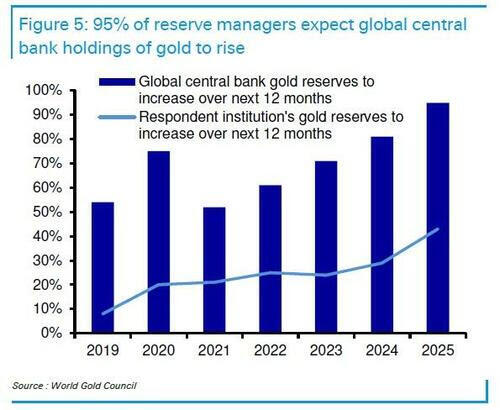
What began as a slow redistribution of faith has become a full-scale migration of trust. Central banks, spooked by sanctions, deficits, and the weaponization of currency, have been quietly restocking their vaults like traders sensing an approaching storm. They’re not speculating on yield — they’re hedging against vulnerability. Every ton of bullion added is a vote against the old order of dollar dominance, and those votes are piling up faster than anyone expected.
The numbers tell their own parable. Gold’s share of global FX reserves has surged from a modest 24% to a commanding 30% in a matter of months, while the dollar’s portion has slipped toward 40%. That’s not just a market fluctuation — it’s the tectonic movement of the monetary plates beneath the surface.
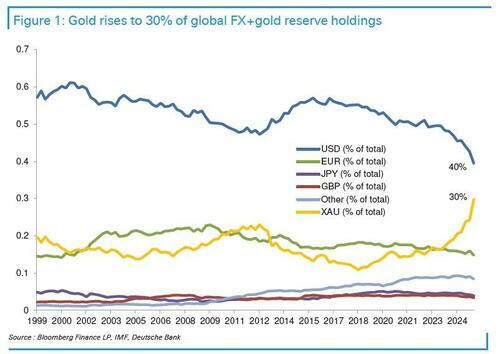
At the current rate, the crossover point — where gold overtakes the greenback as the world’s largest reserve asset — would require a price north of $5,800 an ounce.
Indeed, according to recent Deutsche Bank estimates, the tipping point lies just shy of $5,800 per ounce. At that level, gold and the U.S. dollar would each represent roughly 36% of total global reserve holdings — a moment not of coincidence, but of symmetry, where the old world of credit and the new world of collateral finally meet eye to eye.
The deeper shift isn’t about valuation — it’s about validation. Gold has reasserted itself as the only asset without a counterparty, the ultimate “no one’s liability” instrument. In a system saturated with IOUs, that quality now matters more than ever. The post-Bretton Woods generation built a world on credit and trust; the post-Ukraine world is rebuilding it on custody and collateral. What looks like a rally in gold is, in essence, a repricing of sovereignty.
This isn’t a scoreboard for assets, nor a beauty contest between metals and money. What’s unfolding is a structural recalibration of how central banks measure real-world liquidity. Many confuse gold’s share of total central bank assets with its share of reserves — but those are entirely different universes.
Most central bank balance sheets are stuffed with home-denominated securities — euro paper for the ECB, Treasuries for the Fed — which tell you little about external firepower. The more meaningful lens is the ratio of gold to foreign-exchange reserves, the assets actually deployable when defending a currency.
Here, the numbers are striking. The ECB’s gold share of FX plus gold reserves stood near 80% at the end of September (and closer to 83% if you mark bullion to $4,350/oz). Yet on the ECB’s total balance sheet, that gold accounted for only 18%. The distinction is similar in the United States: gold represents roughly 96% of FX reserves, but only 15% of total assets.
As Deutsche Bank notes, this gap underscores why reserve managers increasingly benchmark their holdings against gold + FX reserves rather than total assets. Those are the only war-chest resources that can actually be mobilized in defense of a national currency — and in that context, the metal’s relevance grows every month.
Markets tend to lag these kinds of awakenings. Traders chase stories; institutions chase insurance. But eventually, those worlds converge — and when they do, it’s usually violent. A world where gold represents a third of all official reserves isn’t one where the dollar collapses overnight. It’s one where confidence fractures gradually, then suddenly. Every basis point trimmed from U.S. reserve share, every ounce bought by a reserve manager in Singapore or Riyadh, is part of a single, collective trade — out of paper promises, into tangible trust.
We’re witnessing not just a bull market in gold, but a bear market in belief. The dollar’s prestige was never about its color — it was about its credibility. Once that begins to tarnish, the world starts reaching for something it can hold, not just something it can quote. Gold above $6,000 isn’t a fantasy figure; it’s what the ledger looks like when faith gets repriced in ounces instead of narratives.
The alchemists of the modern era aren’t turning lead into gold — they’re turning policy risk into metal. And as central banks keep voting with their balance sheets, they’re telling us something that every trader already feels deep down: the real reserve asset of the future might not be a currency at all, but the oldest hedge in human history.
Author

Stephen Innes
SPI Asset Management
With more than 25 years of experience, Stephen has a deep-seated knowledge of G10 and Asian currency markets as well as precious metal and oil markets.