The first effects of the Trump tariffs are measurable, and they are massive

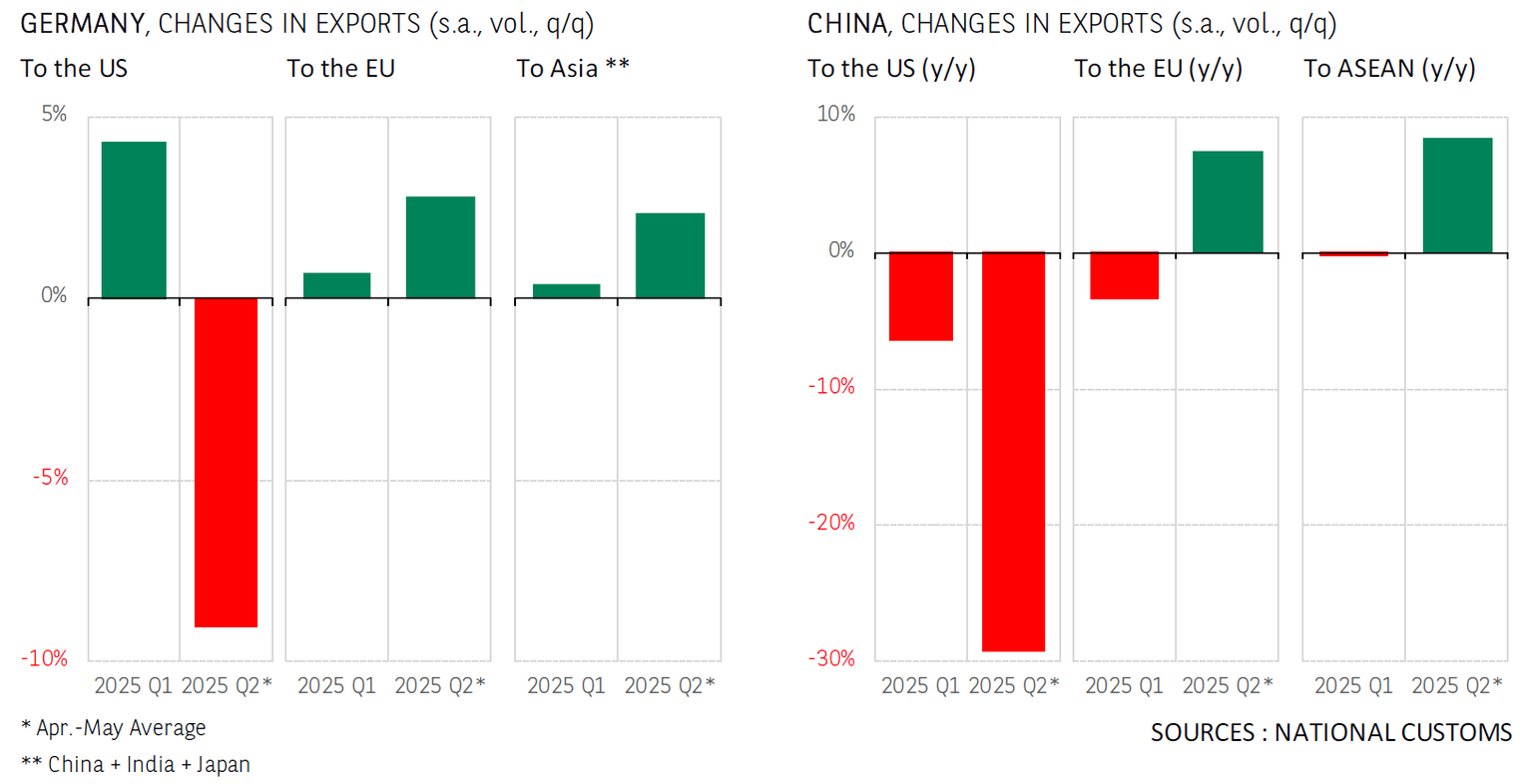
This time, these are not estimates based on models, but actual data provided by customs authorities. Partially available until the second quarter of 2025 in both China and Germany, they show a dramatic drop in exports to the United States in the wake of the tariffs imposed by the Trump administration, as well as the remarkable ability of international trade to redeploy when it is hindered in one area.
US tariff increase: First repercussions
Rapid reorientation of Chinese trade
Let's first look at China, one of the first countries targeted by the US tariff offensive. In February, the White House imposed a 10% surcharge, which led to an immediate drop in Chinese sales to the United States. Although March saw a rebound (in anticipation of "Liberation Day" and an even heavier bill), the first quarter (Q1) already bore the marks of the trade conflict between Beijing and Washington.
What followed was worse. In Q2, Chinese exports to the United States plunged, by around 28% quarter-on-quarter (QoQ) according to our calculations (see right-hand side of the chart and our June EcoPerspectives). However, China managed to redeploy almost in real time to most of its other major markets: in Q2 2025, its sales to the European Union (EU) and ASEAN rebounded strongly. Overall, despite suffering one of the worst tariff shocks in its history, Beijing managed to slightly increase its export volume in the second quarter.
Germany is returning to its roots
Like all EU countries, Germany was taxed later and less heavily than China. It therefore had the opportunity to deliver to the United States in advance (increase in exports in Q1) before suffering the effects of US policy (decline in exports in Q2). At the end of spring, German sales to the United States were nearly 10% below their end-2024 level; however, they redeployed at the same time, notably to the benefit of the EU (see left-hand side of the chart).
Trade flows appear to be highly sensitive to price shocks caused by US policy, with sensitivity close to unity for China: the effective surcharge (taking exemptions into account) of nearly 25% applied to its goods leads to a decline of the same magnitude in its sales to the US. With lower trade volumes and the possibility of supply shortages on its domestic market, Washington will find it difficult to achieve its customs revenue targets. While the risk of inflation has not yet materialised, it remains very real.
Author
BNP Paribas Team
BNP Paribas
BNP Paribas Economic Research Department is a worldwide function, part of Corporate and Investment Banking, at the service of both the Bank and its customers.