The cost of negative interest rates has grown steadily due to sharp increases in excess reserves

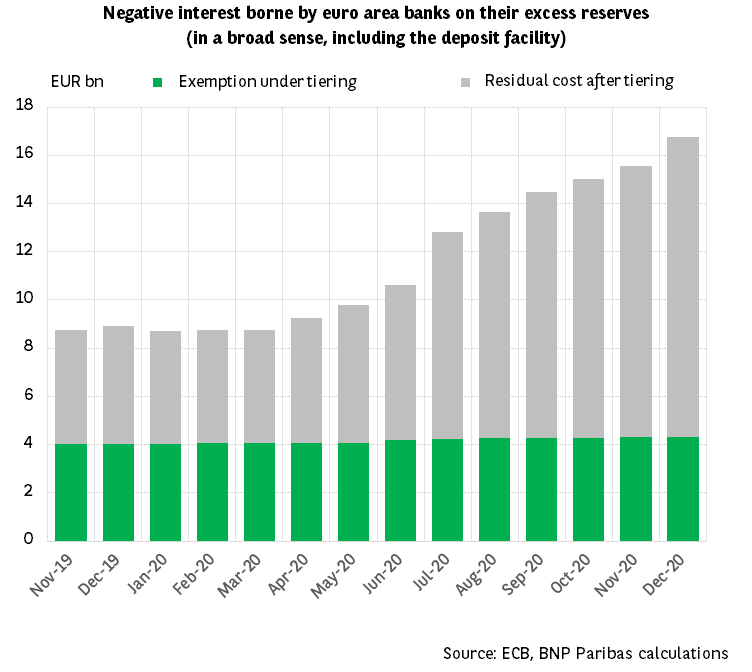
In force since 30 October 2019, tiering seeks to limit the cost of negative interest rates (-0.5%) for eurozone banks by excluding part of excess reserves from the charge[1]. This approach saved eurozone banks a charge of EUR 4.3 billion in December 2020, leaving a residual charge of EUR 9.8 billion. The cost of negative interest rates has nevertheless grown steadily since April 2020, and particularly in the second quarter of 2020, due to sharp increases in excess reserves. These increases result in part from the expansion of outstanding Targeted Longer-Term Refinancing Operations (TLTRO III), the terms of which were temporarily relaxed (from June 2020 to June 2021) in response to the Covid-19 pandemic. As a function of trends in the borrowing bank’s lending to the private non-financial sector, these conditions will be at best lower (-1%) or at worst equal to (-0.5%) the negative rate applied to excess reserves, thus enabling banks to offset the cost of negative interest rates on their deposits[2].
This said, a substantial share of excess reserves finds its counterparty in Pandemic Emergency Longer-Term Refinancing Operations (PELTRO, -0.25%) or even more frequently in other banking resources where it results from Eurosystem asset purchasing (quantitative easing). Although, given trends in lending to the private sector, the annual interest received by banks as a result of their refinancing is likely to be closer to the upper limit of the range (EUR 15 billion) than the lower limit (EUR 8 billion), and will thus offset the cost of negative interest rates on excess reserves (EUR 13 billion annually) between June 2020 and June 2021, things could be different once the exceptional TLTRO III terms come to an end in June 2021.
[1] Up to six times the amount of their minimum reserve requirement.
[2] The only interest flows captured are those paid and received directly as part of commercial banks’operations with the Eurosystem. They do not take into account the broader negative effects on global interest margins. Furthermore, national banking systems may show a position different from that described for the euro area banking system as a whole.
Author
BNP Paribas Team
BNP Paribas
BNP Paribas Economic Research Department is a worldwide function, part of Corporate and Investment Banking, at the service of both the Bank and its customers.