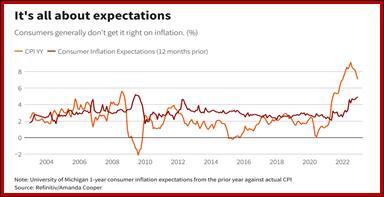
The consumer believes inflation is coming down, but is this really true?

Outlook: The new data in the US today is GDP, the Chicago Fed and the usual initial jobless claims. Tomorrow it’s core PCE, personal consumption and spending, and the Conference Board leading indicators.
Normally this array of fresh info would be interesting and market-moving, but the markets are only thinly populated these days and may brush off everything out of fear of no exit. GDP in particular is boring–it’s the final for Q3 and likely to be the same 2.9%.
The important information is likely that the consumer believes inflation is coming down. Reuters reports “Market-based inflation expectations show that on a five-year horizon, investors see inflation back at around 2.3%, whereas back in the summer, that rate was closer to 3.5%.” Further, the final reading of the core PCE index “is expected to show price pressures accelerated at a rate of 4.6% in the third quarter, in line with a second reading from late November. Sure, it's down from the 4.7% in Q2 and it's the third and final reading of what happened months ago now. But at 4.6%, it's still more than twice the central bank's 2% target…”
But never mind. Consumers almost never get it right. See the chart from Reuters.
Finally, if we are not getting any action in the majors, the correct tactic is to look at the crosses. We saw EUR/GBP spike back in Sept and it appears to be in the process of spiking again today. But it’s halfway into the cloud and overbought on the Schaff, so don’t count on it.

But if you want to attend to the most likely action in FX, it has to be the UK (not Japan!). The lack of management capability in government has become all too obvious–again. Historically, the UK government screws up in dealing with colonies, minorities, coal miners, teachers, unions, and anyone else who doesn’t go along with its own particular (stuffy, self-important, myopic) worldview. This time its public sectors workers, and while the nurses and ambulance services are certainly important, what seems structurally most appalling is the near-death experience of the Royal Mail.
Benjamin Franklin founded what became the US Postal Service and said the ability to communicate freely is a right in a democracy and deserves federal government funding. By Franklin’s standards, the Royal Mail should never have been privatized in the first place. Now, according to the FT, “Management at Royal Mail have told staff that neither the government nor regulator will ride to the rescue of the struggling 506-year-old former monopoly in a last-ditch attempt to convince postal workers to end their strike action over the Christmas period.
“’We are now fighting for the life of this business’”, workers were told in a letter sent to them last week that was signed by chief executive Simon Thompson and eight other senior managers.
Staff at the former state-owned company, which is struggling to keep up with rival delivery services, first voted for industrial action five months ago in a dispute over pay and working practices. The CWU union has stepped up industrial action with a series of strikes this month with postal workers set to stage another 48-hour walkout on Friday.”
This is government mismanagement at its most obvious. In the US we live in a glass house and shouldn’t be throwing stones, considering the Postmaster General removed mailboxes ahead of elections and other shenanigans. We are still not getting all our mail on time all the time. But privatize the post office? It’s dumb, and dangerous. Anglophiles weep.
Happy holidays to all. Stop trading!
Tidbit: We tend to brush off the weather (except tsunamis and hurricanes), but today the news is everywhere–the US is getting a “major storm system, which the National Weather Service is calling a ‘once in a generation type event,’” according to Bloomberg. “More than 100 million people are currently under winter weather and wind chill alerts as record-breaking temperature drops are being observed.
“Denver International Airport saw a 37-degree drop in temperature over one hour Wednesday, which officials said is the biggest ever drop recorded at that location. That same day, Cheyenne, Wyoming, also saw a 30-degree drop in temperature in just 10 minutes. Governors in Georgia, Oklahoma and Kentucky have each declared a state emergency, as other state leaders activate emergency response operations. Major cities in the South -- including Nashville, Memphis, Birmingham, Alabama, and Jackson, Mississippi -- are all expected to see snow today.” Snow in Mississippi!
Note to Readers: Because markets will be thin and squirrelly around Christmas, there will be no reports on Friday, Dec 23 and Monday, Dec 26, a holiday in London.
This is an excerpt from “The Rockefeller Morning Briefing,” which is far larger (about 10 pages). The Briefing has been published every day for over 25 years and represents experienced analysis and insight. The report offers deep background and is not intended to guide FX trading. Rockefeller produces other reports (in spot and futures) for trading purposes.
To get a two-week trial of the full reports plus traders advice for only $3.95. Click here!
This is an excerpt from “The Rockefeller Morning Briefing,” which is far larger (about 10 pages). The Briefing has been published every day for over 25 years and represents experienced analysis and insight. The report offers deep background and is not intended to guide FX trading. Rockefeller produces other reports (in spot and futures) for trading purposes.
To get a two-week trial of the full reports plus traders advice for only $3.95. Click here!
Author

Barbara Rockefeller
Rockefeller Treasury Services, Inc.
Experience Before founding Rockefeller Treasury, Barbara worked at Citibank and other banks as a risk manager, new product developer (Cititrend), FX trader, advisor and loan officer. Miss Rockefeller is engaged to perform FX-relat