The Canadian Dollar keeps sliding as the rate gap with the US widens
- USD/CAD grinds up to 1.4150, its highest since mid-July, as US yields pull away.
- Loonie down in 12 of 13 sessions since Canada's counter-tariffs began.
- Fed at 3.75-4.00%, BoC at 2.25%, both deciding October 28.

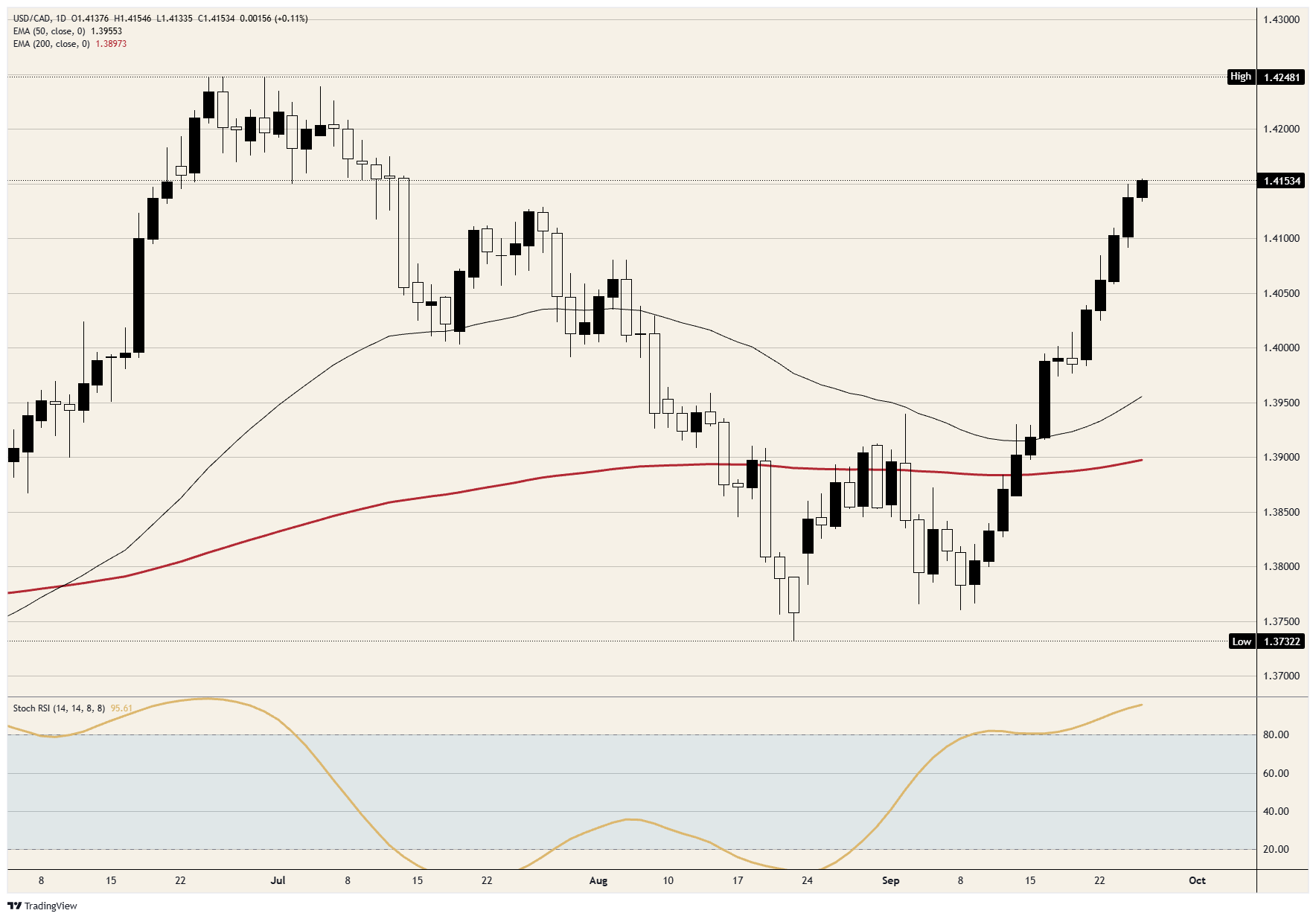
Twelve of the last 13 sessions have gone against the Loonie, and the run started the day after Canada's counter-tariffs on CAD $27.6 billion of US goods took effect on September 8. USD/CAD trades near 1.4150, its highest since mid-July, and is on track for a fifth straight higher session.
The climb has taken back more than four-fifths of the slide from the late-June high to the August low, though Friday is the narrowest session of the run, and the pair is heading for a third straight weekly gain. Ottawa aimed its tariffs at American steel, dairy and electronics, and so far they have been easier on those industries than on the Loonie.
Brent up more than 15% in September and the Loonie down
Crude Oil is Canada's largest export, so a Brent rally of more than 15% in September should have lifted the Loonie. It fell instead. West Texas Intermediate (WTI) Crude Oil dropped toward $92.00 on Friday on Iran's Hormuz proposal, and USD/CAD rose again.
That rules out the usual reading of the currency as an oil trade, at least for this run. Oil may still matter to the Loonie, though it has fallen on a rising price and on a falling one in the same month.
The BoC goes first on October 28, at 13:45 GMT
The Fed raised its rate to 3.75-4.00% on September 16, and the Bank of Canada (BoC) has held at 2.25% for seven straight meetings, most recently on September 2. Canada's 10-year yield fell to about 3.95% on Friday and the US 10-year rose toward 5.2%, a gap of about 1.25 points. Money earns more in US bonds, and buying them means buying US Dollars first.
Tariffs leave the BoC with a case for either move. US tariffs of 50% on goods making up 5.5% of Canada's exports to the US took effect on August 22, and BoC Governor Macklem has warned they could hold fourth-quarter growth under 1%. He also said on September 2 that the risk of higher inflation had increased, and Scotiabank has forecast hikes starting in the fourth quarter.
The labour numbers are the case for waiting. Canada lost 42K jobs in August against a forecast gain, and wages grew 2.0% YoY, the slowest since 2017 outside the pandemic years. Second-quarter growth ran at a 3.3% annualized pace, which is the figure a hike would have to lean on.
Both central banks decide on October 28, the BoC at 13:45 GMT and the Fed at 18:00 GMT. A quarter-point BoC hike would take the policy gap from more than 1.5 points to more than 1.25, and the Fed could put the quarter back the same day.
Technical levels
Resistance: 1.4150 has capped USD/CAD three times on Friday, with the session high just above it. 1.4200 is where the pair traded through late June and early July, and the late-June high near 1.4250 is the top of the range it fell from.
Support: Thursday's low near 1.4100 is the first floor. Below it, 1.4000 is where the run paused for two sessions on September 17 and 18.
Bias: Lean long USD/CAD while 1.4000 holds on a closing basis, looking for 1.4200 and then 1.4250. With the daily Stochastic Relative Strength Index (Stoch RSI) near 96 and as stretched as it gets, a dip toward 1.4100 would fit inside the trade. Wrong on a daily close under 1.4000.
USD/CAD daily chart
Canadian Dollar FAQs
The key factors driving the Canadian Dollar (CAD) are the level of interest rates set by the Bank of Canada (BoC), the price of Oil, Canada’s largest export, the health of its economy, inflation and the Trade Balance, which is the difference between the value of Canada’s exports versus its imports. Other factors include market sentiment – whether investors are taking on more risky assets (risk-on) or seeking safe-havens (risk-off) – with risk-on being CAD-positive. As its largest trading partner, the health of the US economy is also a key factor influencing the Canadian Dollar.
The Bank of Canada (BoC) has a significant influence on the Canadian Dollar by setting the level of interest rates that banks can lend to one another. This influences the level of interest rates for everyone. The main goal of the BoC is to maintain inflation at 1-3% by adjusting interest rates up or down. Relatively higher interest rates tend to be positive for the CAD. The Bank of Canada can also use quantitative easing and tightening to influence credit conditions, with the former CAD-negative and the latter CAD-positive.
The price of Oil is a key factor impacting the value of the Canadian Dollar. Petroleum is Canada’s biggest export, so Oil price tends to have an immediate impact on the CAD value. Generally, if Oil price rises CAD also goes up, as aggregate demand for the currency increases. The opposite is the case if the price of Oil falls. Higher Oil prices also tend to result in a greater likelihood of a positive Trade Balance, which is also supportive of the CAD.
While inflation had always traditionally been thought of as a negative factor for a currency since it lowers the value of money, the opposite has actually been the case in modern times with the relaxation of cross-border capital controls. Higher inflation tends to lead central banks to put up interest rates which attracts more capital inflows from global investors seeking a lucrative place to keep their money. This increases demand for the local currency, which in Canada’s case is the Canadian Dollar.
Macroeconomic data releases gauge the health of the economy and can have an impact on the Canadian Dollar. Indicators such as GDP, Manufacturing and Services PMIs, employment, and consumer sentiment surveys can all influence the direction of the CAD. A strong economy is good for the Canadian Dollar. Not only does it attract more foreign investment but it may encourage the Bank of Canada to put up interest rates, leading to a stronger currency. If economic data is weak, however, the CAD is likely to fall.
Author

Joshua Gibson
FXStreet
Joshua joins the FXStreet team as an Economics and Finance double major from Vancouver Island University with twelve years' experience as an independent trader focusing on technical analysis.















