EUR/USD Weekly Forecast: The Dollar takes back control
- EUR/USD has closed its third consecutive week of losses.
- The pair’s strong pullback has exclusively followed USD gains.
- Germany, Eurozone inflation, and US NFP will rule the sentiment next week.

The single currency has remained well on the defensive for the third week in a row, prompting EUR/USD to challenge the 1.1360 region for the first time since late July. Indeed, the pair has traded with gains only on Friday, while reversing two consecutive advances when it comes to the monthly chart.
Indeed, spot has given away nearly 4 cents since its top just past 1.1700 in August, coming under increasing selling pressure in tandem with the marked recovery in the US Dollar (USD).
On the latter, the Greenback has found renewed support following expectations for further tightening by the Federal Reserve (Fed) in the second half of the year. Furthermore, this view has been gathering strong momentum since the latest FOMC meeting, alongside hawkish comments from Fed officials, who continue to regard inflation as the main issue to be addressed as soon as possible.
No news… no good news
On the geopolitical front, there was no relevant news other than the usual boring back-and-forth between the US-Iran-Hormuz trifecta, with no apparent solution, diplomatic or not, to the persistent effervescence in the region.
On top of that, fresh concerns involving Russia have done nothing but aggravate the landscape while promoting the flight-to-safety mood and propping up the demand for the safe-haven space, aka the US Dollar.
Energy prices, the other suspect
As a direct consequence of the above, crude Oil prices have been on the (strong) rise, with European prices at the pump extending their uptrend, while forecasts for gas prices have been updating almost on a weekly basis.
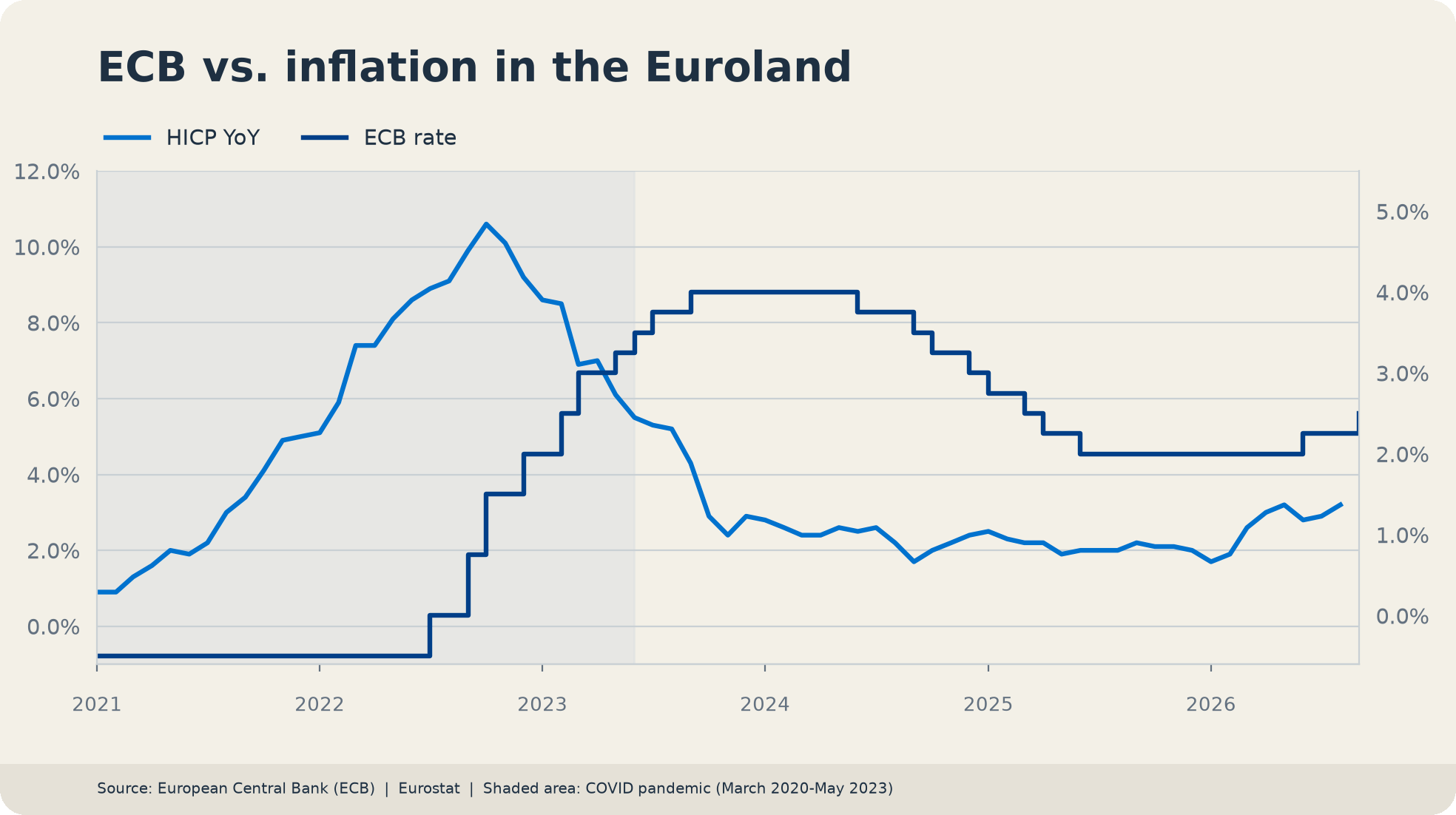
The European Union’s status as an energy importer has kept inflation concerns in the bloc alive, allowing the spectre of second-round effects to loom over European Central Bank officials and reigniting speculation about potential extra rate hikes by the central bank in the coming months.
So far, market participants are pencilling in roughly 33 basis points of tightening by the ECB by year-end, while the decision on the October 29 meeting is expected to be a close call.
ECB officials flag higher inflation risks but limited wage pressure
Executive Board member Philip Lane said the European economy should continue to grow at a steady but moderate pace, provided the energy shock does not intensify. He warned that a second wave of energy-price increases would push inflation higher before it begins to decline towards the target from mid-2027.
Lane nevertheless noted that the ECB is not seeing a significant wage response to the energy shock, suggesting that second-round effects on underlying inflation remain limited (for now). This allows the bank to acknowledge renewed price risks without signalling an immediate policy tightening.
In addition, Bundesbank President Joachim Nagel said Oil prices have become increasingly relevant to the ECB’s assessment over the past four years, although they are not the only indicator guiding policy. He also said he was not particularly concerned about labour-market developments.
Nagel noted that rates remain in neutral territory but acknowledged that the ECB may eventually need to move into mildly restrictive territory.
Overall, the remarks were cautiously hawkish on inflation but remained conditional and offered no signal of an imminent policy move.
Shorts retreat as bearish pressure eases
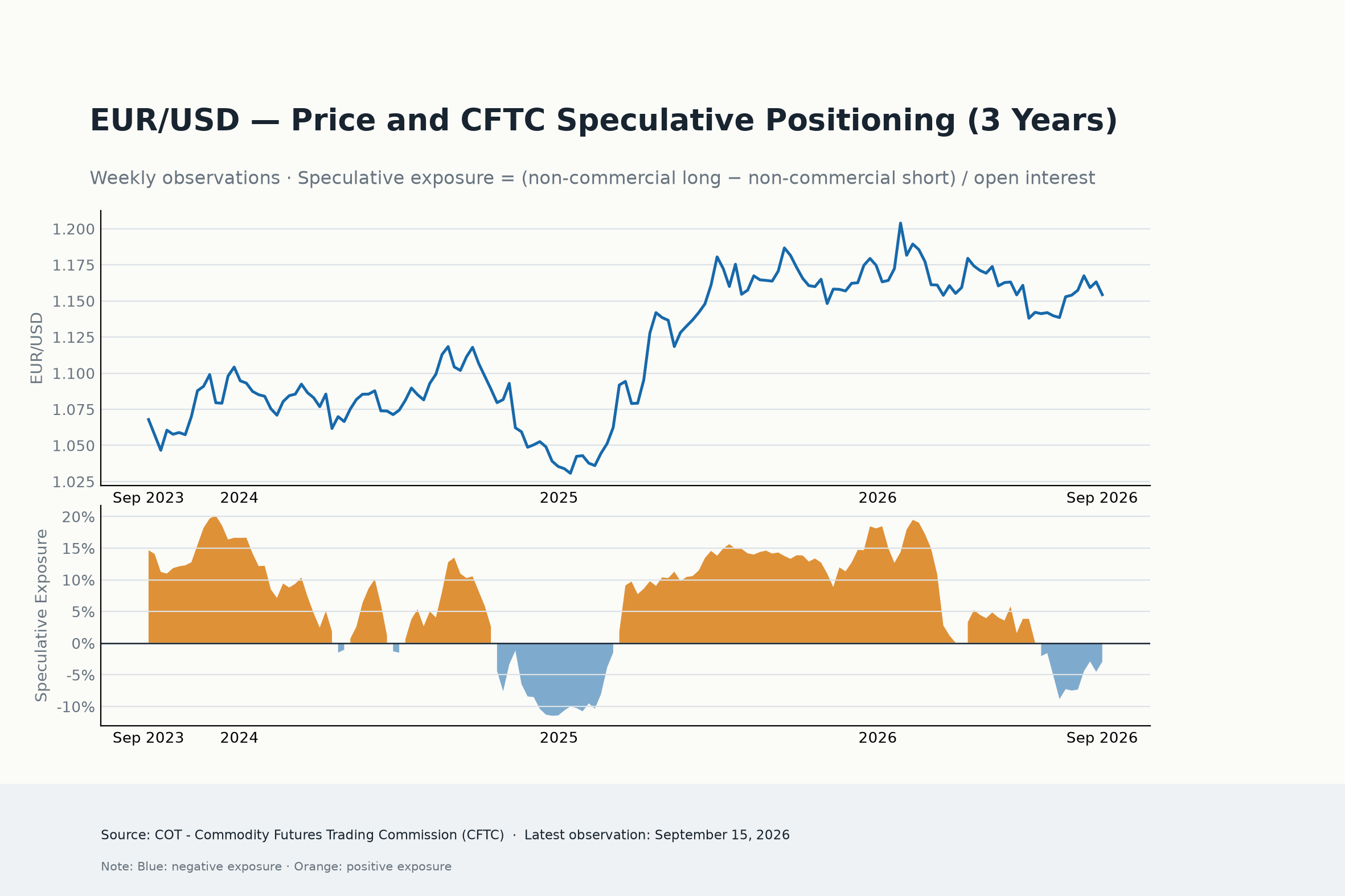
The speculative bearish positioning in the Euro (EUR) eased sharply in the week ending September 15 following the latest Commodity Futures Trading Commission (CFTC) report. Indeed, net shorts were trimmed to nearly 27K contracts, reversing much of the previous week’s deterioration. The 4-week change also increased to nearly 32.1K contracts, confirming that the broader positioning trend is becoming significantly less negative.
Additionally, open interest declined to roughly 920K contracts. The move looks more like a function of short covering and unwinding of bearish exposure than a strong wave of fresh EUR buying, with net shorts shrinking along with lower participation.
Extra data showed Speculative Exposure improved to -2.93%, while its percentile rose to 13.7. The Net Position Percentile also increased to 11.8. Both readings remain very low, indicating that EUR positioning is still historically bearish, although the latest adjustment shows that this bias is gradually losing intensity.
Finally, the data point to an ongoing unwinding of bearish conviction rather than a fully confirmed bullish reversal. The positive weekly and 4-week moves are encouraging for the European currency, but the still negative net position and depressed percentiles suggest traders remain cautious, but further short covering could nonetheless provide additional support should the current improvement continue.
What’s in store for EUR/USD?
The coming week may be key for EUR/USD: preliminary inflation figures from Germany and the Euroland will provide fresh clues on whether the recent energy-induced price pressures are beginning to feed through to inflation expectations.
Across the Atlantic, the focus will be on the US labour market, with the JOLTS Job Openings report, ADP employment data and Friday’s Nonfarm Payrolls expected to somewhat shape expectations for the Fed’s upcoming policy moves.
A busy schedule of speeches from both ECB and Fed officials should add further colour to the outlook and could inject additional volatility into the pair.
‘Dead-cat’ bounce
The Euro has fallen sharply over the last few weeks, but the decline has not been the result of a sudden deterioration in the Eurozone fundamentals. Rather, it is a reflection of a market that has refocused on the US. That said, the US Dollar’s appeal has been restored after weeks of weakness, supported by expectations of further Fed tightening, firmer Treasury yields across the curve and an increasingly uncertain geopolitical backdrop.
That leaves the single currency fighting an uphill battle. The ECB has not abandoned its hawkish-ish bias, and the recent rise in energy prices only reinforces the need for policymakers to remain vigilant on inflation. However, as long as markets believe the Fed has more work to do than the ECB, those supportive factors are unlikely to be enough to change the broader direction of travel.
There are, nevertheless, reasons to think the decline may become less aggressive. Non-commercial investors have already started to trim bearish EUR positions, suggesting that the market is becoming less one-sided than it was only a few weeks ago. That could help cushion further losses, even if it does not yet provide the foundation for a sustained recovery.
For now, the Greenback remains in control. A meaningful turnaround in EUR/USD will probably require more than encouraging Eurozone data or cautious ECB rhetoric. It will likely depend on a combination of easing geopolitical tensions, a renewed improvement in global risk appetite and, above all, convincing evidence that the Fed is approaching the end of its tightening cycle.
Until then, rallies are likely to be viewed as opportunities to sell rather than the beginning of a broader trend reversal.
Euro FAQs
The Euro is the currency for the 20 European Union countries that belong to the Eurozone. It is the second most heavily traded currency in the world behind the US Dollar. In 2022, it accounted for 31% of all foreign exchange transactions, with an average daily turnover of over $2.2 trillion a day. EUR/USD is the most heavily traded currency pair in the world, accounting for an estimated 30% off all transactions, followed by EUR/JPY (4%), EUR/GBP (3%) and EUR/AUD (2%).
The European Central Bank (ECB) in Frankfurt, Germany, is the reserve bank for the Eurozone. The ECB sets interest rates and manages monetary policy. The ECB’s primary mandate is to maintain price stability, which means either controlling inflation or stimulating growth. Its primary tool is the raising or lowering of interest rates. Relatively high interest rates – or the expectation of higher rates – will usually benefit the Euro and vice versa. The ECB Governing Council makes monetary policy decisions at meetings held eight times a year. Decisions are made by heads of the Eurozone national banks and six permanent members, including the President of the ECB, Christine Lagarde.
Eurozone inflation data, measured by the Harmonized Index of Consumer Prices (HICP), is an important econometric for the Euro. If inflation rises more than expected, especially if above the ECB’s 2% target, it obliges the ECB to raise interest rates to bring it back under control. Relatively high interest rates compared to its counterparts will usually benefit the Euro, as it makes the region more attractive as a place for global investors to park their money.
Data releases gauge the health of the economy and can impact on the Euro. Indicators such as GDP, Manufacturing and Services PMIs, employment, and consumer sentiment surveys can all influence the direction of the single currency. A strong economy is good for the Euro. Not only does it attract more foreign investment but it may encourage the ECB to put up interest rates, which will directly strengthen the Euro. Otherwise, if economic data is weak, the Euro is likely to fall. Economic data for the four largest economies in the euro area (Germany, France, Italy and Spain) are especially significant, as they account for 75% of the Eurozone’s economy.
Another significant data release for the Euro is the Trade Balance. This indicator measures the difference between what a country earns from its exports and what it spends on imports over a given period. If a country produces highly sought after exports then its currency will gain in value purely from the extra demand created from foreign buyers seeking to purchase these goods. Therefore, a positive net Trade Balance strengthens a currency and vice versa for a negative balance.
Author

Pablo Piovano
FXStreet
Born and bred in Argentina, Pablo has been carrying on with his passion for FX markets and trading since his first college years.















