US Dollar Weekly Forecast: The Dollar is back, but can the rally go further?
- The US Dollar added to its recent move higher, hitting two-month tops.
- Hawkish Fedspeak and solid data reinforced the Greenback’s uptrend.
- Next of note on the docket will be the US Nonfarm Payrolls.

The week that was
The US Dollar (USD) saw its recent bounce reinvigorated this week, gathering extra pace and popping to new two-month highs in a context of further advance of US Treasury yields across the curve, rising bets for extra tightening by the Federal Reserve (Fed) in the next few months, unabated uncertainty from the Middle East conflict and firmer-than-estimated US data releases.
Against this backdrop, the US Dollar Index (DXY) has managed to surpass the 101.00 barrier for the first time since the end of July, posting gains in nine out of the last 12 days, while reversing two consecutive months of declines.
The Greenback’s move higher has found extra wings in the sharp uptick in US Treasury yields. Indeed, 2-year yields have approached the 5.00% mark for the first time in more than two years, the 10-year yields advanced to 5.20%, the highest level since June 2007, and the 30-year yields have gone past 5.20%, levels last seen in early June 2002.
Exceptionalism, Oil and further tightening
The sharp move higher in the US Dollar has been underpinned by constant bets for extra rate hikes by the Fed in the latter part of the year. Currently, investors see around 36 basis points of extra tightening by year-end, while they favour another 25-basis-point hike at the October 28 meeting.
This week’s marked rebound of crude Oil prices was another driver of the bull run in the buck, always amid the omnipresent absence of any progress in negotiations to put an end to the US-Iran-Hormuz conflict.
Crude Oil prices go up, inflation concerns follow, rate hike bets increase… repeat
The cherry on the pie was an unexpected increase in preliminary prints of US business activity for the month of September, collaborating with the vision that US “exceptionalism” is nowhere near to subside.
The Fed’s September hike was only the beginning
The Federal Reserve's 25-basis-point rate increase last week was followed by a clear message from policymakers: inflation remains too high, and further tightening may still be required. Officials argued that resilient demand, solid economic activity and persistent supply-side pressures had shifted the debate towards whether rates would need to rise again before year-end.
Austan Goolsbee (Chicago) said both supply and demand were increasingly contributing to inflation, warning that stronger demand would require a more forceful policy response. Alberto Musalem (St. Louis) also argued that another rate increase was likely needed, favouring earlier, gradual tightening rather than delaying action. Other officials, including Susan Collins, Thomas Barkin, Michelle Bowman, John Williams and Anna Paulson, echoed similar concerns, emphasising persistent inflation risks and suggesting that additional policy tightening may be needed.
Rate setters also warned against assuming that supply shocks would ease quickly, while noting that persistently high inflation could eventually become embedded in consumers’ expectations. At the same time, they said future policy decisions would be guided by incoming economic data, not market moves or political considerations.
Indeed, the September hike was presented as a response to persistent inflation rather than a one-off adjustment. While officials are not signalling a predetermined path, the combination of broad price pressures, firm demand and repeated references to another hike makes further tightening a realistic possibility before the end of the year.
Longs unwind as bullish conviction fades
Data for the week ending September 15 by the Commodity Futures Trading Commission (CFTC) show a sharp deterioration in non-commercial bullish positioning in the US Dollar. Indeed, net longs fell to just under 10.6K contracts, with the 4-week change weakening to just around 8.5K contracts. This is a clear acceleration in the recent loss of bullish momentum.
Open interest also declined sharply to around 43.8K contracts. Since net longs and participation decreased together, the move primarily indicates long liquidation and investors leaving the market rather than a rush into fresh USD shorts.
Speculative exposure dropped to 24.44% (from 30.43%), with its percentile easing to 44.2. The Net Position Percentile also fell sharply to 45.2, moving close to neutral territory. That said, the USD’s once-constructive positioning advantage has therefore largely faded.
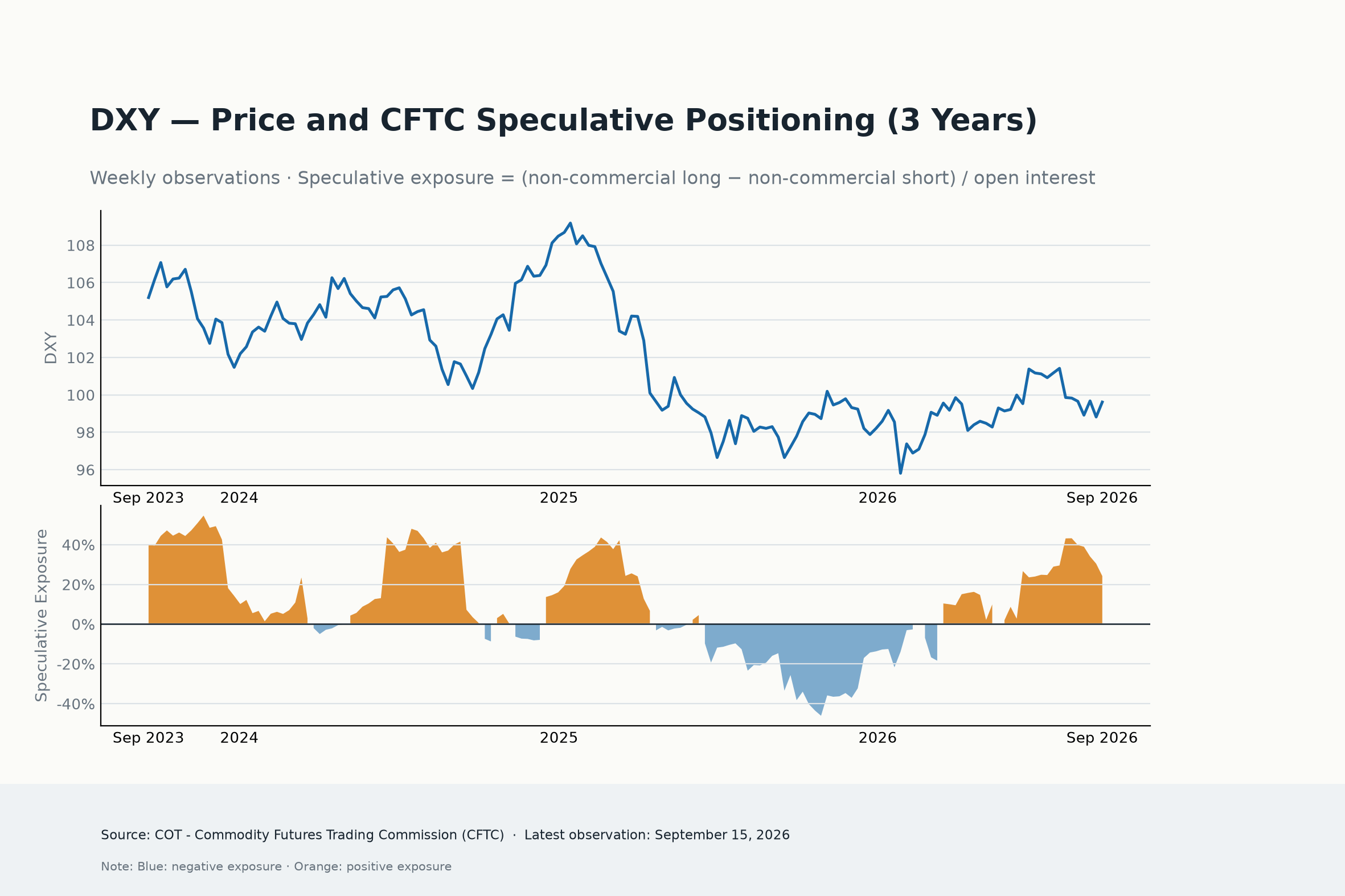
All in all, the data point to a market in transition. USD positioning is still net long, but the sharp liquidation, negative 4-week trend and neutral percentile readings suggest that bullish conviction has weakened considerably. For now, the figures indicate a loss of optimism rather than a fully fledged bearish consensus.
What’s next for the US Dollar
Next week will be particularly significant, with the US labour market in focus as we see the releases of JOLTS Job Openings, the ADP report, and finally, the Nonfarm Payrolls.
In addition, the ISM will publish its Manufacturing gauge, while a slew of Fed speakers should keep investors’ attention on the rise.
Forecast: Fundamentals remain on the Dollar's side
The US Dollar has found its mojo again in recent weeks, supported by a combination of resilient economic activity, rising Treasury yields and a Fed that still argues that the fight against inflation is not over yet. Renewed geopolitical tensions and the higher energy prices have only reinforced that narrative, helping to restore the Greenback's appeal as a yield play and as a traditional safe-haven asset.
Still, the latest CFTC numbers suggest investors are less convinced of the bullish USD story. Speculative longs have come down, which is a good sign of positioning normalising, but the macro backdrop is still very supportive. This divergence in the data does not indicate a trend change is imminent, but it does suggest further gains may need fresh confirmation from incoming data rather than just positioning.
For now, the balance of risks still favours the buck.
As long as the US economy continues to outperform its peers, inflation remains stubborn enough to keep another Fed rate hike on the table, and geopolitical uncertainty persists, the Dollar should remain well supported. The next challenge will be proving that the recent rally reflects more than a positioning adjustment and can instead evolve into a more durable trend.
Inflation FAQs
Inflation measures the rise in the price of a representative basket of goods and services. Headline inflation is usually expressed as a percentage change on a month-on-month (MoM) and year-on-year (YoY) basis. Core inflation excludes more volatile elements such as food and fuel which can fluctuate because of geopolitical and seasonal factors. Core inflation is the figure economists focus on and is the level targeted by central banks, which are mandated to keep inflation at a manageable level, usually around 2%.
The Consumer Price Index (CPI) measures the change in prices of a basket of goods and services over a period of time. It is usually expressed as a percentage change on a month-on-month (MoM) and year-on-year (YoY) basis. Core CPI is the figure targeted by central banks as it excludes volatile food and fuel inputs. When Core CPI rises above 2% it usually results in higher interest rates and vice versa when it falls below 2%. Since higher interest rates are positive for a currency, higher inflation usually results in a stronger currency. The opposite is true when inflation falls.
Although it may seem counter-intuitive, high inflation in a country pushes up the value of its currency and vice versa for lower inflation. This is because the central bank will normally raise interest rates to combat the higher inflation, which attract more global capital inflows from investors looking for a lucrative place to park their money.
Formerly, Gold was the asset investors turned to in times of high inflation because it preserved its value, and whilst investors will often still buy Gold for its safe-haven properties in times of extreme market turmoil, this is not the case most of the time. This is because when inflation is high, central banks will put up interest rates to combat it. Higher interest rates are negative for Gold because they increase the opportunity-cost of holding Gold vis-a-vis an interest-bearing asset or placing the money in a cash deposit account. On the flipside, lower inflation tends to be positive for Gold as it brings interest rates down, making the bright metal a more viable investment alternative.
Author

Pablo Piovano
FXStreet
Born and bred in Argentina, Pablo has been carrying on with his passion for FX markets and trading since his first college years.















