Gold keeps falling until the Fed stops raising rate forecasts
Gold pays no interest, so the thing it competes with is what a safe government bond pays above inflation. In 2026, that payment has gone up because investors expect the Federal Reserve (Fed) to keep raising rates, and Gold has gone down. The 10-year Treasury yield is near 5.20%, its highest since 2007, and Gold is back near 4,300, almost a quarter below its January high near 5,600.
The debasement bet behind Gold's 2025 rally assumed governments with record debts would let inflation shrink them, which means borrowing at less than the rate of inflation. The US government now pays more above inflation to borrow for 10 years than at any time since November 2008. How long that lasts depends on a gap between the Fed's own forecasts and the hikes investors are betting on.
Only one kind of rise in yields hurts Gold
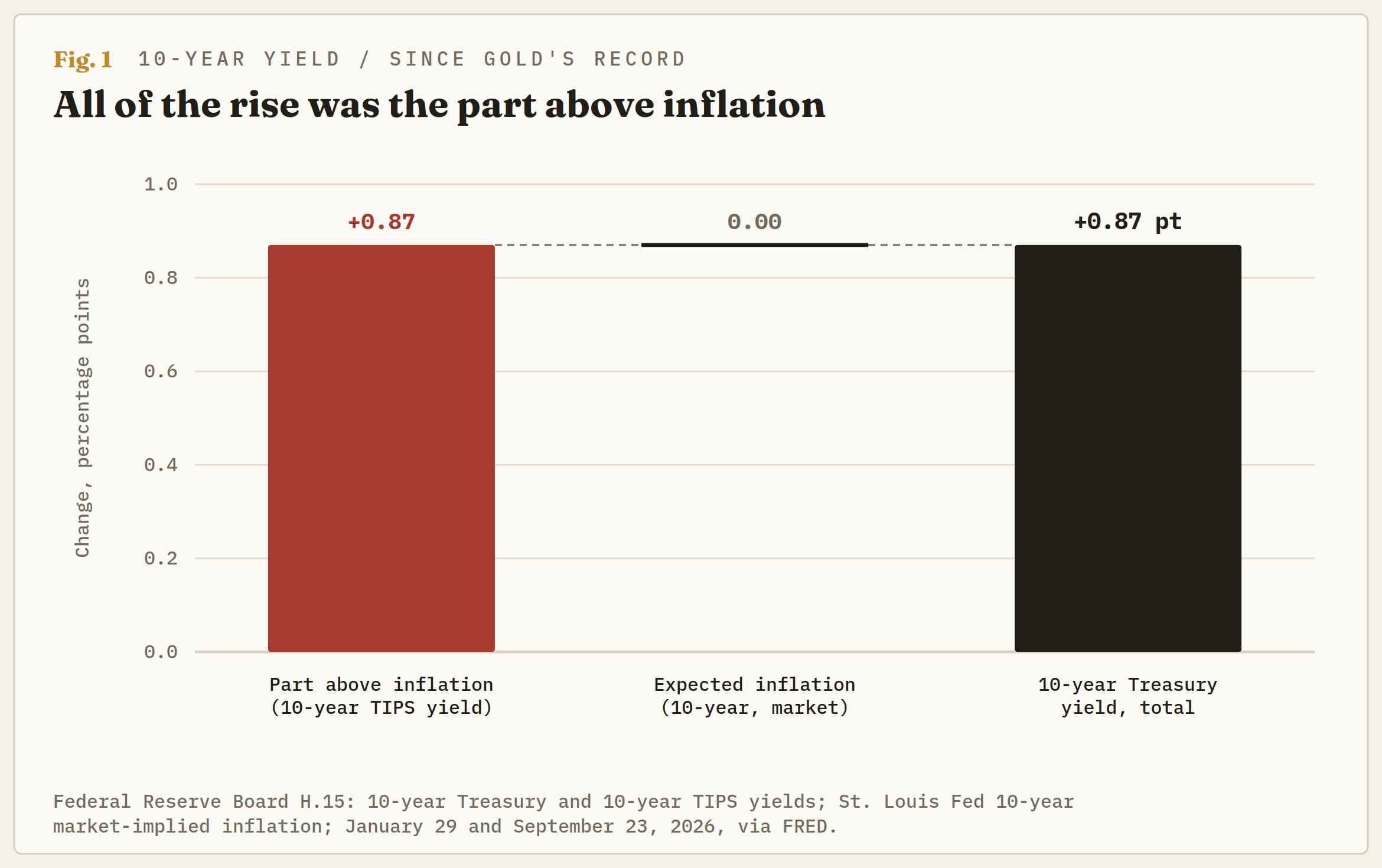
A 10-year Treasury yield has two parts. One is the inflation rate investors expect over the decade, and when that part rises, bondholders are asking to be paid for money losing its value, which is the case for owning Gold. The other is what the bond pays on top of inflation, which goes up when investors expect the Fed to keep raising rates, and that part raises the cost of holding a metal that pays nothing.
The second part is measured by Treasury Inflation-Protected Securities (TIPS), government bonds whose face value rises with consumer prices. The ordinary 10-year yield rose 0.87 percentage points between Gold's record on January 29 and September 23, and the TIPS yield rose by the same amount. The inflation rate investors expect over the next decade was 2.35% on both dates.
Inflation went up without moving the bond market's forecast
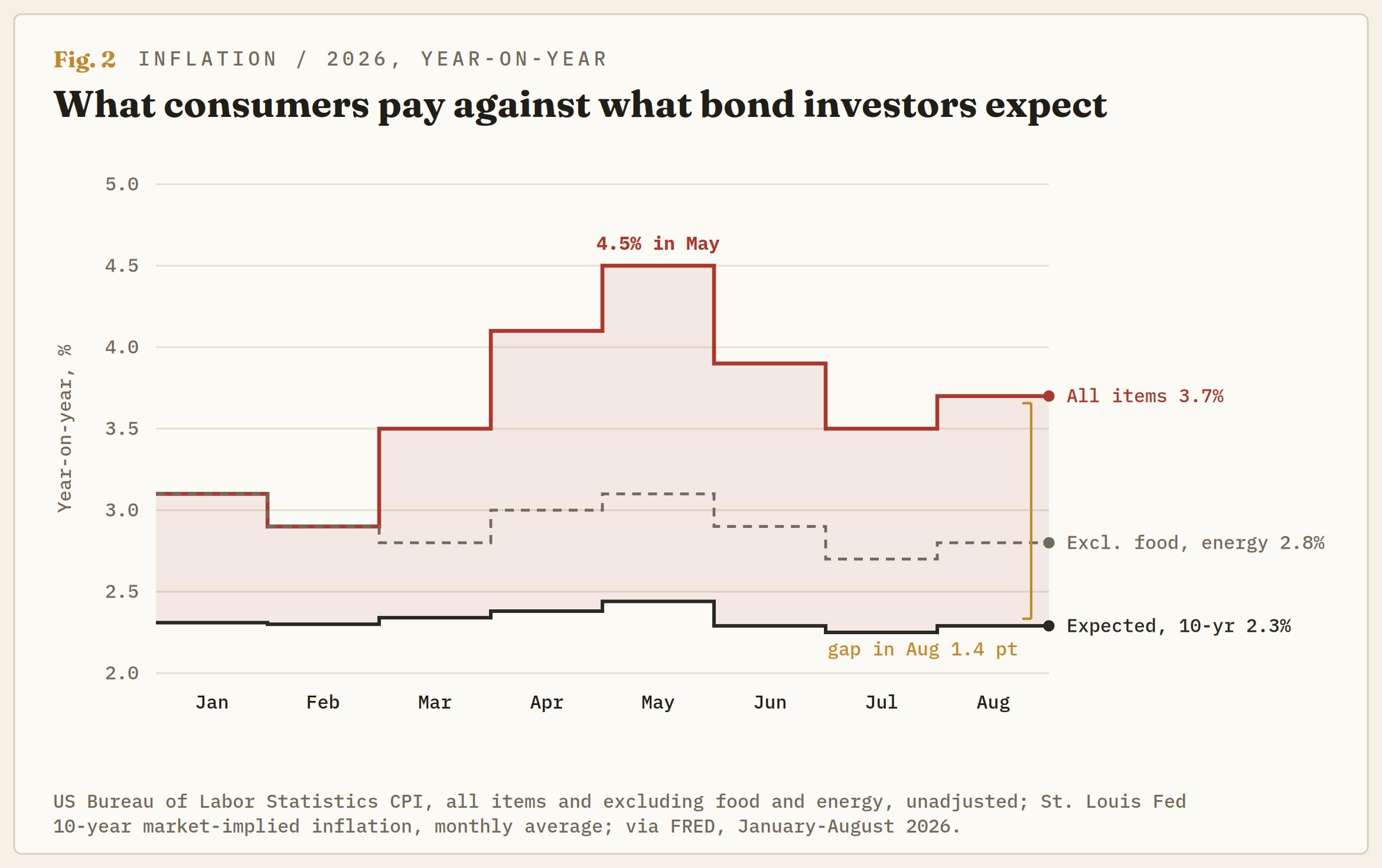
US consumer prices rose 3.7% in the year to August, up from 2.9% in February, but food and energy did almost all of that: excluding them, inflation was 2.8%, lower than in January. For Gold, that is the problem, because an Oil shock that stays in the Oil price gives investors no reason to expect lasting inflation.
The market's 10-year inflation expectation has stayed between 2.2% and 2.5% all year, so bond investors are treating the shock as something the Fed will contain. The Fed raised rates on September 16 for the first time since 2023, and Fed Chair Kevin Warsh described the job as keeping higher energy costs out of everything else. In plain terms, bond investors expect the Fed to win, and Gold only does well if it loses.
2025 broke the rule and 2026 restored it
In 2025, Gold rose by nearly two-thirds while the TIPS yield ended the year only 0.3 of a point lower, so almost none of that rally came from bond yields. Buyers were paying for a different risk, a Fed that might hold rates down under political pressure, and that premium came out on January 30, when the White House named its pick to run the Fed. Gold had its worst day since the 1980s, and the 10-year yield moved two hundredths of a point. Since then, Gold has mostly moved the opposite way to the TIPS yield, falling in the months it rose and rallying in the months it fell, with August's rally the main exception.
One more hike on the Fed's map, several in the market's
Gold keeps falling for as long as the Fed is the reason yields rise: on 2026's relationship, each tenth of a point added to the TIPS yield has taken about 1% off Gold on average, so a further quarter-point would be worth 2%-3% and take Gold from near 4,300 toward 4,200. So far it has been the Fed. Two-year yields, which follow the Fed's rate most closely, have risen faster than 30-year yields since August, and the market's inflation expectation is where it was in January. Each monthly consumer price report tests whether that holds.
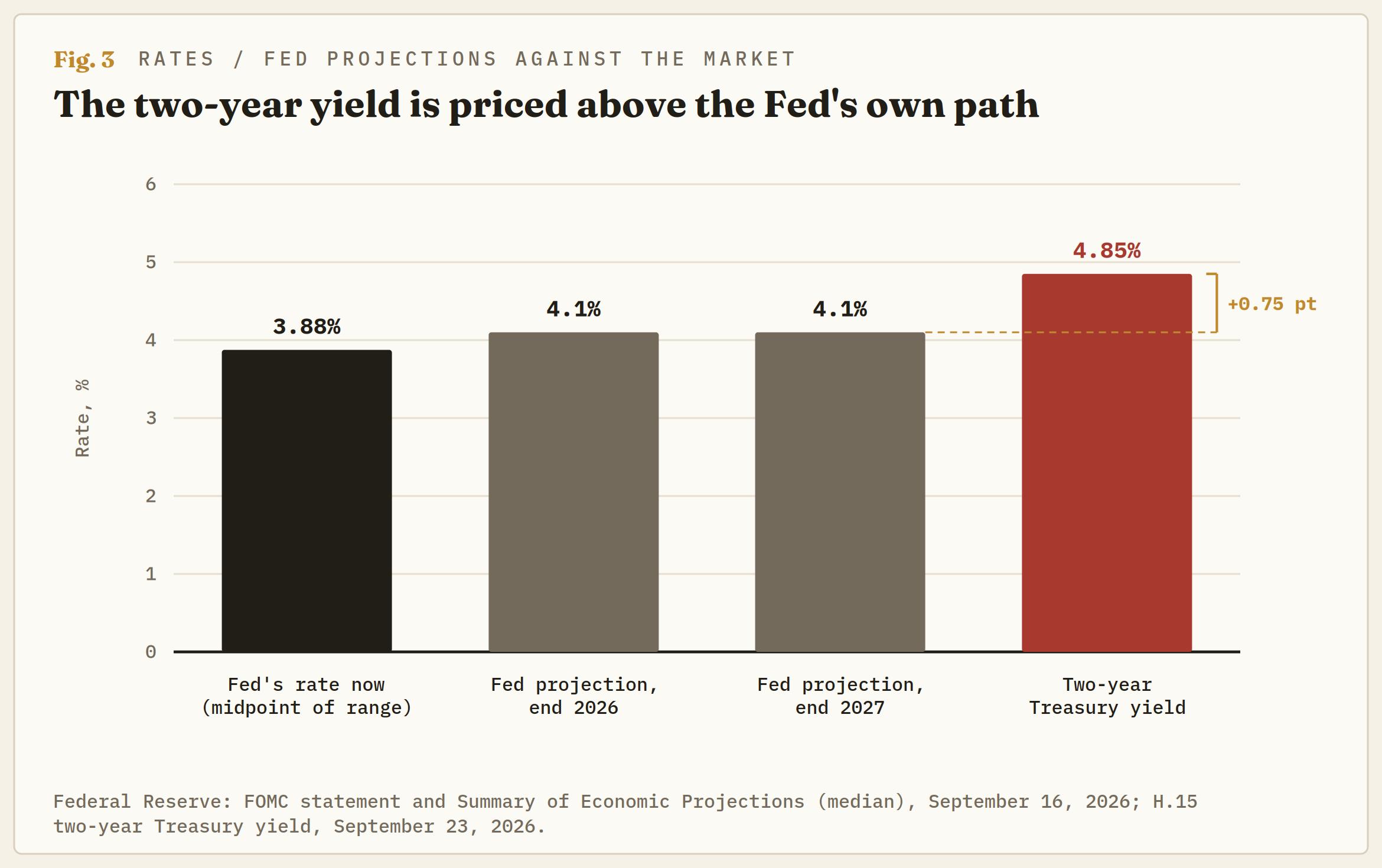
The two-year yield is about a point above the Fed's rate, a price for several more hikes, while the Fed's own projections show one more quarter-point in 2026 and no change through 2027. The pressure on Gold continues only while the Fed keeps raising its forecasts toward what investors already expect, as it did in September when the 2027 projection went from 3.6% to 4.1%. The day it stops, investors will have to bet on fewer hikes, and the part of yields that has been hurting Gold would fall. If it stops with consumer prices still rising 3.7% a year, the rise in yields would also start to come from inflation, which is the kind of rise the debasement bet needs.
The lean is lower for as long as the Fed keeps raising its forecasts and the TIPS yield rises with them. The case is wrong if Gold makes a daily close above 4,400, the top of its September range, while that yield is still climbing, because the metal would then have stopped trading off bond yields, as in 2025. Since mid-September, the TIPS yield has added another 0.14 of a point and Gold has barely moved, the first sign that this could happen. The Fed has put both tests on its calendar, a decision on October 28 and new projections on December 9, and rate futures already price a hike at the first of them.
Author

Joshua Gibson
FXStreet
Joshua joins the FXStreet team as an Economics and Finance double major from Vancouver Island University with twelve years' experience as an independent trader focusing on technical analysis.















