The AI rocket ship lifts off despite surging Oil and a fractured Fed
- AI remains the only engine driving markets, with massive capital deployment anchoring valuations and keeping the tape afloat.
- Oil has shifted from a risk narrative to a physical constraint, tightening supply and embedding delayed inflation pressure.
- The surge in yields reflects a steady repricing of energy-driven inflation rather than a disorderly bond selloff.
- Fed dissents highlight a growing policy fracture, signalling uncertainty just as inflation risks begin to build beneath the surface.
- Markets are being held together by tech earnings while macro pressures quietly accumulate, creating a fragile balance that cannot hold indefinitely.
The AI rocket ship lifts
US equity futures pushed higher, carried by a late surge in the tech complex, as the AI trade once again showed it is the only game in town, powered by earnings momentum and a scale of spending so vast it now creates its own gravitational pull. The Nasdaq found its footing after an early wobble, reversing losses not on fresh conviction but on necessity, as capital flowed back into the same narrow leadership that has been carrying the tape. It was not a broad risk bid. It was a controlled lift, the kind that comes when the market knows exactly which pillar is still standing and leans into it because there is nowhere else to go.
The bid felt almost mechanical, with megacap tech acting less like a leadership group and more like a structural support beam holding the entire equity complex in place. The AI buildout has evolved into a full capital cycle, in which enormous sums are being deployed to secure future dominance and, in doing so, are anchoring present valuations. It is no longer just a narrative. It is a necessity trade, where the market continues to allocate not because conditions are improving, but because stepping away carries greater risk than staying in.
But that lift is unfolding against a macro backdrop that is tightening rather than easing. Crude is no longer just rising; it is compressing the system. Brent pushing toward $118 and WTI extending its run for a fourth straight session reflects a market that has shifted from pricing risk to absorbing constraint. With the Strait reduced to a restricted flow and policy locking the valve, the oil market has moved into rationing mode, where supply is dictated by limitation rather than availability, and the impact spreads outward with a lag rather than a shock.
Rates are beginning to register that pressure. The 10-year pushing toward 4.43 percent is not a panic move; it is a recalibration, a steady repricing of inflation driven by energy rather than demand. Bonds are not collapsing; they are yielding ground in measured steps, and that tone has carried into Asia, where curves are tracking lower as higher oil feeds directly into inflation expectations.
Within that tightening macro frame, earnings are acting less as a catalyst and more as a stabilizer. Alphabet delivered where it needed to, reinforcing the revenue side of the AI narrative, while Meta exposed the other side of the equation, where ambition meets cost. The reaction there is telling. It is not just about one company; it is the market beginning to question how much spending it is willing to underwrite, even within its most dominant names. The AI trade is still carrying the tape, but the weight it is carrying is growing heavier with each cycle.
The broader tape reflects that tension. Equities are holding together, but not with ease. Each push higher meets resistance, each pullback finds support just quickly enough to prevent a break. It is a market adjusting in real time, maintaining balance rather than building momentum, holding at an elevated level without truly advancing.
History tells us that this widening divide between stocks, oil, and rates can only stretch so far before the physical shock bleeds into the real economy. Expensive energy is not abstract. It moves quietly through the system, from the pump to logistics to margins, eventually surfacing in the data that central banks respond to after the fact.
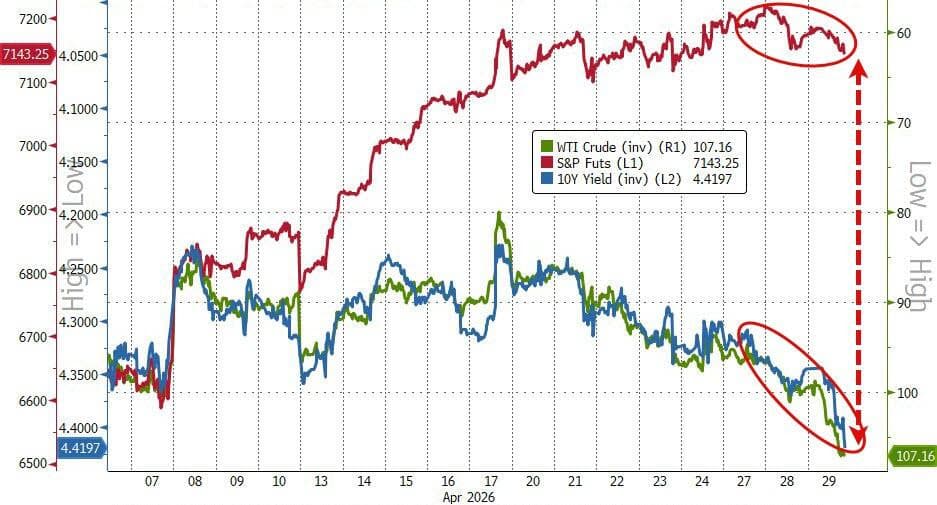
That is the backdrop in which policy is being set. Rates are on hold, but the fracture beneath the surface is unmistakable, with Fed dissents reaching levels not seen in decades and a committee no longer moving in lockstep. This is not a message of clarity; it is one of growing divergence.
Powell leaned hawkish in his press conference, mentioning that “the effects of oil-related inflation are still in front of us,” adding that:
We were just doing some work, and it does seem the effect on real economic growth does take 3 to 4 months to show up in some of the consumer spending data.
At face value, oil-driven inflation is not behind us; it is ahead, and, more importantly, it arrives with a lag that the market is choosing to discount. That lag is the real pressure point, building quietly beneath the surface, not yet visible in the data but already embedded in the path forward.
Meanwhile, the geopolitical engine driving the oil move shows no sign of easing. The US blockade remains in place, and the standoff has shifted from negotiation to endurance. Flows are being reshaped in real time. Storage is filling, exports are constrained, and the risk is no longer just supply loss but production impairment. When crude cannot move, wells shut in, and when that happens under stress, restarting is neither immediate nor guaranteed. That is how a temporary disruption begins to harden into something more structural.
‘Endgame’ For Iran’s Oil Sector? How the US Blockade May Impact Tehran’s Calculus ( Radio Free Europe, Radio Liberty)
What emerges is a market suspended between two clocks. The equity clock, driven by AI spending and tech earnings, is still ticking, providing the lift to hold the structure together. The oil clock, driven by physical constraint and delayed inflation, is already counting forward, embedding pressure that has yet to fully surface.
For now, the system holds. But it holds with tension. Tech continues to carry the tape even as oil and rates tighten the conditions beneath it, creating a controlled glide rather than a clean trend. The rally that has pushed equities back to highs is now being tested not by a single shock, but by the accumulation of forces pulling in different directions.
This is not a market that breaks suddenly. It is one that tightens gradually, where each incremental move adds another layer of strain. Oil edges higher, yields follow, spending rises, and the balance becomes harder to maintain. For now, that balance remains intact. But the longer it holds, the more meaningful the eventual release becomes.
Author

Stephen Innes
SPI Asset Management
With more than 25 years of experience, Stephen has a deep-seated knowledge of G10 and Asian currency markets as well as precious metal and oil markets.