Gold failed to rally on the weakest jobs data in months: 2 analysts disagree on what that means

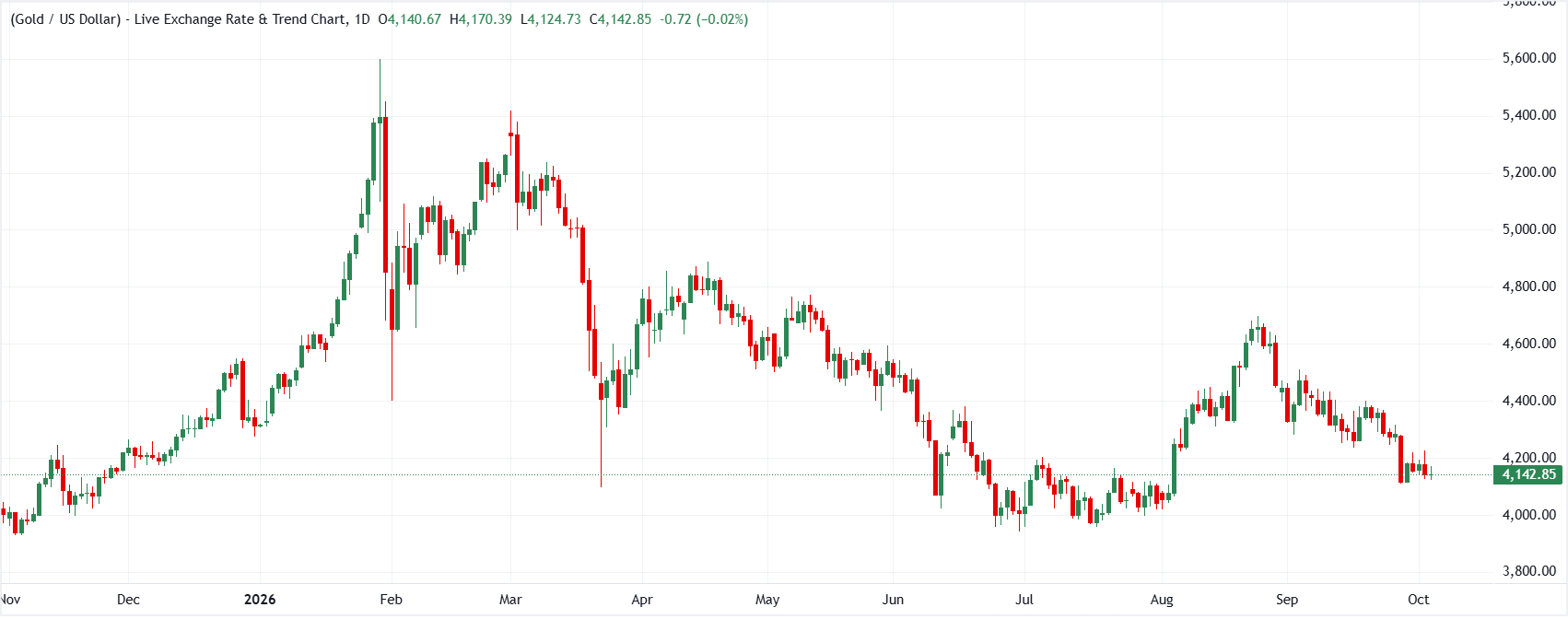
Gold (XAU/USD) just posted its second failure on bullish news in three sessions. It took a gain at the weekly open on the weakest US jobs report in months on Friday, then gave it all back by settlement. The two most recent FXStreet analyses disagree on what that failure means: one argues the yellow metal's trend is still set by rising long-term US Treasury yields – and points lower –, while the other argues Gold's resilience above $4,000 despite those same yields is the real signal, with structural drivers pointing higher.
Przemyslaw Radomski: "The signal is in Friday's reaction"
Radomski is the bearish voice, and his thesis is that Gold failed the test that should have made it rally. "Friday's jobs report was the most gold-friendly US data in months," he wrote — payrolls rose by just 29,000 against 85,000 to 90,000 expected, and October hike odds fell to "about 20 percent or less, from about 70 percent earlier in the week" — yet gold settled down 3.6 percent on the week. The explanation, he argues, is the bond market: "The front end priced a softer Fed, the long end did not, and gold followed the long end," with the 10-year yield closing at 5.276%, higher on the day. On today's oddity of Gold and the US Dollar rising together, he is dismissive: "today's move is a currency-specific dollar rally next to an oversold bounce in gold after a 3.6 percent weekly decline." His conclusion is unambiguous: "Friday's data told gold to rally, and it fell. Today's dollar told gold to fall, and it rose. The signal is in Friday's reaction." — Read the full report
Anna Sokolidou: "Gold is showing remarkable resilience"
Sokolidou takes the opposite view, framing the same setup as bullish. "Everyone is talking about a cycle of Fed interest rate hikes, higher inflation for longer, and precious metals losing appeal. But it is nowhere near true," she wrote. Her core point: Gold is holding above $4,000 an ounce even as US 10-year real yields stand at 2.24% and nominal yields sit near twenty-year highs. "Neither the strong dollar nor the high yields nor the rate hikes expected substantially decrease gold prices," she argues. She points to structural demand — central banks, led by Poland and China, buying gold for years — and to Gold's role as a hedge against geopolitical uncertainty and US Dollar-diversification by BRICS+ members. Her ultimate upside driver is the Fed itself: "eventually the Fed's tightening would cause a recession and excessive money printing thereafter," which she calls "an important growth factor for gold." She concedes one near-term downside risk — a recession-driven dollar surge — but calls that "only short-term." — Read the full report
The takeaway
Two analysts look at the same post-jobs-report Gold market and reach opposite conclusions. Radomski reads the metal's second failure on bullish news in three sessions as proof the trend is still governed by the long end of the bond market — and points lower. Sokolidou reads Gold's refusal to break below $4,000 in the face of 20-year-high yields as evidence of structural demand that will ultimately win out. Watch the long-term Treasury yield and the US Dollar's driver: if yields keep rising and the US Dollar's gains are US-driven, Radomski's bearish read holds; if central-bank and safe-haven demand keep absorbing the pressure, Sokolidou's resilience thesis wins.
(This article was created with the help of an Artificial Intelligence tool and reviewed by an editor. Know more.)
Author

FXStreet Insights Team
FXStreet
The FXStreet Insights Team is a group of journalists that handpicks selected market observations published by renowned experts. The content includes notes by commercial as well as additional insights by internal and external analysts.
















