The 2023 recession will feel much worse than the economic impact of the pandemic

Outlook: The data this week is a little on the weak side until Friday, when we get eurozone CPI–probably a welcome retreat at 9.5% y/y after 10.1% in November, or the lowest since August. Core CPI will edge up, though, to 5.1% from 5.0%. Various countries report all week leading up to the group number.
We get the German CPI numbers later today. So far we have Baden-Wuerttenberg at 8.5% for Dec from 9.6% and Bavaria at 9.2% from 10.9%. The rest of the Laender report all day. A dip in European inflation number coupled with talk of resolve at the ECB is a powerful combination favoring the euro, so it’s confusing for the euro to have fallen overnight. Reports indicate the market expects a 50 bp hike in Feb and another 50 bp in March, with two more smaller hikes in May and June or July for an “ending rate” of 3.5%. It’s 2% now, and that came very fast from zero. Assuming the eurozone plunges into recession in Q1, can these rate hike expectations survive?
Also on Friday is US nonfarm payrolls, probably slowing but still fairly high at around 200,000 vs. 263,000 in November. We get the ADP private sector version on Thursday.
Over the holiday, the IMF’s managing director said “that a third of the global economy and half of the EU would be hit by recession this year,” according to the FT. And the UK will be the worst among the many, due in part of incompetent management. “The UK will face one of the worst recessions and weakest recoveries in the G7 in the coming year, as households pay a heavy price for the government’s policy failings, economists say.
“A clear majority of the 101 respondents in the FT’s annual poll of leading UK-based economists said the inflationary shock caused by the pandemic and the Ukraine war would persist for longer in the UK than elsewhere, forcing the Bank of England to keep interest rates high and the government to run a tight fiscal policy.”
“’The 2023 recession will feel much worse than the economic impact of the pandemic,’ said John Philpott, an independent labour market economist. Others described the outlook for consumers – especially those on low incomes or mortgage deals that were set to expire –as “tough”, “bleak”, “grim”, “miserable” and “terrible”. ‘The combination of falling real wages, tight financial conditions and a housing market correction are as bad as it gets,’ said Kallum Pickering, senior economist at Berenberg bank.”
Bottom line, we have a battle between recession and inflation-fighting central banks. The betting now is that it’s the US Fed that will blink, while the BoE and ECB will remain resolute. You have to ask yourself whether this is in keeping with history, and even whether history matters in a case like the UK, where the BoE struggles to win back confidence in public institutions after the lettuce experiment and in the face of more misery.
In Asia, China has fallen down the rabbit hole but we must beware making premature judgments because China can always surprise to the upside–and maybe the bottom is in, if January has the worst of the Covid outbreak and the economy comes roaring back after the lunar holiday (Jan 22 to Feb 6). And of course everyone now expects 2023 to be the year of the yen, going to 125 or maybe 110. Where does this leave the dollar? Probably falling some more, but stay tuned.
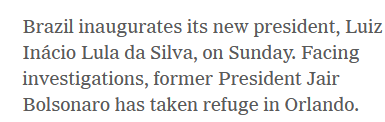
Fun Tidbit: Sub-head from the NYT on Sunday:
Forecasts for 2023: You can’t pay us enough to concoct forecasts for a whole year. But we skim through the forecasts of those poor souls at mainstream publications who drew the short straw for that assignment. And we are appalled.
Consider The Economist’s “World Ahead” list. It has Ukraine, recession, climate, China, divided America, other conflicts (Taiwan)–and Covid comes 8th. It has the “metaverse,” one of the most stupid undertakings of all time, but not Russia/oil, the Trump trial, or overindebtedness by parties large and small, including criticals like the US, Italy, China and Japan. FX doesn’t appear anywhere except in the form of digital yuan. Crypto is not mentioned at all, either (nor, for that matter, nuclear war, admittedly a small probability but not zero).
Finally, not anywhere in the year-end issue is any mention of the Hubble and Webb telescopes, and the plans to add manned space exploration in the near-term. When you have lost your sense of wonder, it’s time to hang up your hat.
We would re-order the list to put the biggest and not improbable dangers first, including events most likely to have lasting effects. That yields Covid–another global lockdown would be fiscally catastrophic. So let’s tuck overindebtedness into that category. One weird idea not yet on the radar screen: maybe China decided to reopen in order deliberately to get widespread infections, since those already infected have better immunity than those vaccinated, and the Chinese vaccine is lousy. All the new infections would include whatever variants have come along since any of the vaccines were invented and distributed, including those in the West, giving China a competitive advantage. This is actually not a stupid strategy. Inhumane, but not stupid.
Second comes Russia/oil or oil/Russia–same thing. It seems obvious Russia is going to lose the Ukraine war. This is actually a war by Russia against NATO, which is essentially the US and Europe. Weigh the military assets and capabilities on both sides, and Russia can’t win. Putin’s fate is unknown, but once Russia is unmistakably defeated, the West will rush to fix its broken economy with some of the same ardor it brought to Germany and Japan, and will bring to Ukraine. Since Russia is a giant gas station, that means subsidized investment in energy; and since commodities get priced on expectations, a large and long-lasting drop in the price of oil and gas. This would be a giant boost to output and productivity, but at the same time a drag on exploration and development, leading to higher prices farther down that road. The drop in oil and gas prices will impede the quest for green energy, too.
Third is the trial or trials of former president Trump, something all the forecasts ignore entirely. If all we get is charges on the theft of US government property (the Mar-a-Lago papers), he can run for president again. As noted before, convicted felons have run for office and been elected from their jail cells. If he is indicted and convicted on the sedition charges, he can’t run for federal office. If indicted and convicted on the other charges, such as obstruction of justice, he can run but at least some of the die-hard Trumpies and many more of the independents will hive off (many having already done so in the mid-terms). Gallup reports as many as 45% of American voters identify themselves as independent. Those living in the Fox bubble can’t avoid learning about it once indictments start raining down. And rain down they will.
The so-what? test is not about whether Trump can win the 2024 presidential election. He can’t. The charges and the trials are about the rule of law, and about whether the “exceptional country,” the first to design and implement a nation built on the rule of law over of the rule of man, a principle Trump failed to learn, can survive and thrive. This is no small matter. People all over the world are watching, including those in outright totalitarian states or notionally democratic countries that are really autocracies. The list is very long and getting longer–Turkey, China, Pakistan, Hungary, Saudi Arabia, most of Latin America, et al.
Indicting and convicting Trump has as many economic and financial market implications as political ones in such places, starting with official public corruption, free markets vs. overregulated or state-owned ones (and the entrepreneurial spirit), allocation of public money (especially for education, including education of girls), ability to raise and to repay public debt, and on and on. The meaning of the US applying the rule of law, however seemingly belatedly, is wide and deep and long-lasting.
Why not include recession, or the consequences of recession like earnings slumps? Because recessions come and recessions go. So does inflation. It comes and it goes, sometimes with very little cause-and-effect evident from policy efforts. As for digital currencies like the yuan, this is not the same thing as crypto. It’s only the application of technology to the elderly and sclerotic status quo, and the technology is not all that new, anyway. It’s about efficiency, and not even close to being on a par with the cotton gin, the railroad or the combustion engine.
Why not mention FX? Because FX is the pinnacle of high finance reflecting all these factors, and it’s also the grubbiest of profit-seeking ventures. Ethics don’t come into it, except in the control of infrastructure and conduct by regulators. FX is the grease in the wheels, not the wheels. Is it not asymmetrical to name oil and gas prices but not FX? No, because oil prices are a cause of a long chain of things, while FX is the effect.
This is an excerpt from “The Rockefeller Morning Briefing,” which is far larger (about 10 pages). The Briefing has been published every day for over 25 years and represents experienced analysis and insight. The report offers deep background and is not intended to guide FX trading. Rockefeller produces other reports (in spot and futures) for trading purposes.
To get a two-week trial of the full reports plus traders advice for only $3.95. Click here!
This is an excerpt from “The Rockefeller Morning Briefing,” which is far larger (about 10 pages). The Briefing has been published every day for over 25 years and represents experienced analysis and insight. The report offers deep background and is not intended to guide FX trading. Rockefeller produces other reports (in spot and futures) for trading purposes.
To get a two-week trial of the full reports plus traders advice for only $3.95. Click here!
Author

Barbara Rockefeller
Rockefeller Treasury Services, Inc.
Experience Before founding Rockefeller Treasury, Barbara worked at Citibank and other banks as a risk manager, new product developer (Cititrend), FX trader, advisor and loan officer. Miss Rockefeller is engaged to perform FX-relat
















