The 2020 presidential election: A summer update

Executive Summary
The 2020 U.S. Presidential election is scheduled for November 3, and there are some key dates on the horizon that signal the heart of campaign season will soon be upon us. The Democratic and Republican National Conventions are scheduled for August 17-20 and August 24-27, respectively, and Democratic candidate Joe Biden has suggested that a Vice President pick will likely take place sometime around August 1. In this report, we take stock of where the races for the White House and Congress stand. At present, Joe Biden has a sizable lead in the national polls, nearly three times bigger than the lead Hillary Clinton had in mid-July 2016. Polling at the Congressional level looks equally as robust for the Democrats. This strength in recent polling data is reflected in betting markets, which are increasingly priced for a Democratic sweep. If the election were held today, we suspect Joe Biden would rightly be considered a healthy favorite going into the vote tally.
But elections and campaigns are fluid, with twists and turns and inflection points even in normal times. In 2020, with a historic pandemic raging and significant uncertainty about what the world will look like come November, we believe it is even more important than usual to remain attentive to changes in the election landscape. As such, we will be updating this report periodically as new data/trends emerge.
State of the 2020 Race for the US Presidency
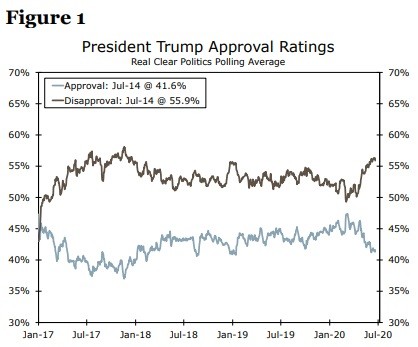
President Trump's approval ratings have deteriorated somewhat over the past couple months. The Real Clear Politics (RCP) polling average of President's Trump's approval ratings stand at 42% approve/56% disapprove, roughly a five percentage point decline from the average in February (Figure 1). Another poll aggregator produced by Five Thirty Eight, which adjusts and weights the polls based on factors such as past accuracy and partisan lean, has a similar split at 40%/55%.
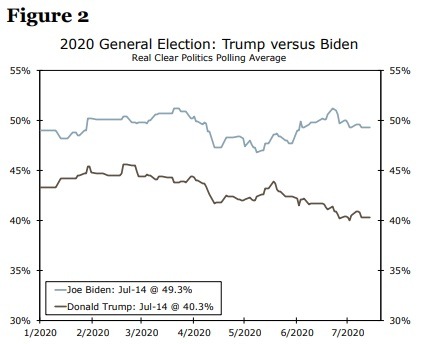
The story is similar when looking at head-to-head matchups of President Trump and Joe Biden. President Trump's position in the polls have slipped of late, and at present he trails Joe Biden on a national basis by about nine percentage points (Figure 2), roughly double what the gap was two months ago. FiveThirtyEight's poll aggregator once again yields similar results, with Biden up also nine percentage points. Betting markets have moved accordingly. On May 14, PredictIt had President Trump as a slight favorite in the race, but the odds have now swung in Joe Biden's favor such that the implied probability of him winning the race is roughly 60%.
If Joe Biden's lead at the national level really is around nine percentage points, this would be an especially big lead. The last candidate to win the popular vote by nine or more percentage points was Ronald Regan in 1984, who won the popular vote that year by roughly 18 percentage points and the Electoral College in a 525 to 13 landslide. Of course, as we have already mentioned, there is a long way to go until November 3, and while this caveat applies in every election cycle, this year it applies even more than usual given the uncertainty around COVID-19 and the economic fallout that has come with it. But even setting aside these inherent uncertainties, how much can we really trust the polls? Weren't the polls wildly off in 2016?
Author
Wells Fargo Research Team
Wells Fargo