Testing the waters after a failed break: USD/CHF, USD/SGD, USD/PLN


Weekly thoughts
When markets fail to break down at a long-term support, it often speaks louder than if they had.
That's what's happened to the US dollar vs multiple currencies - and I have three of our favourite examples (setups) this week.
I also want to renew last week’s discussion. Namely, how to pull the ‘trigger’.
We have a theory i.e. we think something is setting up in the market – in this case, a (at least temporary) bottom in the US dollar.
Theories need testing.
So, how do we test it?
We test it in the market by trading - there’s no other way.
First, let’s discuss the setup.
A failed breakdown
When a market repeatedly tests a major support level but can’t break beneath it, that failure itself becomes the signal. It suggests demand is stepping in each time price dips beneath the lows.
The general idea is that when there is a downtrend, sellers are in control.
But if the sellers aren’t selling enough to push the price through the lows, they must be losing control.
The loss of control could be temporary or more long-lasting, that depends on the specific setup and the other factors involved.
One way to think about this is - imagine you are a big institution and you are a buyer.
The market is moving lower, so it’s easy to buy because everybody else is selling. You have a level to buy at, you buy - and because your buy orders have such an outsized influence, the price moves up. What do you do? You wait for the price to return to your level- and buy again.
What I’ve described above is how a support level works.
I think of a false breakdown as a ‘sneakier’ version of a support level holding.
Let’s say the big market makers (money centre banks) know that they have this large institution’s buy orders on their books. They need to find some sellers to match this big buyer.
Well, there are sellers with sell stops underneath the support level. These could either be stop losses or new short entries but it doesn’t matter.
The market makers push the price beneath the support, triggering those stop orders. That sudden flush of selling provides the liquidity they need to fill the big buyer’s position.
But notice what happens next: once the stops are triggered and the large buy orders are filled, the selling pressure dries up. With no follow-through to the downside, the price snaps back above support.
That’s the essence of a failed breakdown — the move lower was less about genuine bearish conviction and more about clearing the deck.
For traders, this is where theory meets opportunity. The failed breakdown tells us that the market has absorbed all that selling and still can’t stay down. It’s a signal that control may be shifting from sellers to buyers.
From a charting standpoint, you’ll often see this fake lower low accompanied by momentum indicators starting to turn higher, hinting that selling pressure is waning.
Zooming into shorter timeframes, the structure often shifts into some form of consolidation — a wedge, triangle, or sideways range.
From there, price begins probing higher ground, and traders are left with the question: is this the start of a reversal, or just another pause before another leg lower?
The trigger and execution tactics
This is where the art of trading meets the signal.
What we advocate is ‘testing the market’.
- Test the waters at market
Enter a small starter position around current levels. The idea is that if the market is ready to take off, you want early exposure.
- Quick exit on failed test
If price doesn’t show that early momentum i.e. it quickly rolls over, then exit without hesitation. No harm in cutting small.
- Buy the retest
Should price pull back towards near term support or a demand zone, watch for a bullish candlestick (engulfing, pin bar) to confirm entry.
- Exit again if wrong
If the support level doesn’t hold, cut your losses and move on.
- Scale in if right
If the move higher develops, you’re already positioned. Add on strength — for instance, on a breakout of resistance or out of a chart pattern.
As usual, we could be wrong that the US dollar has bottomed. It’s famously difficult to call a bottom in any market until after the fact! That’s why we have stop losses..
And if the US dollar can’t find a bid, there are some other charts that look good - NOK/USD is one our fav’s mentioned in week 35.
Setups and signals
We look at hundreds of charts each week and present you with three of our favourite setups and signals.
USD/CHF
Setup
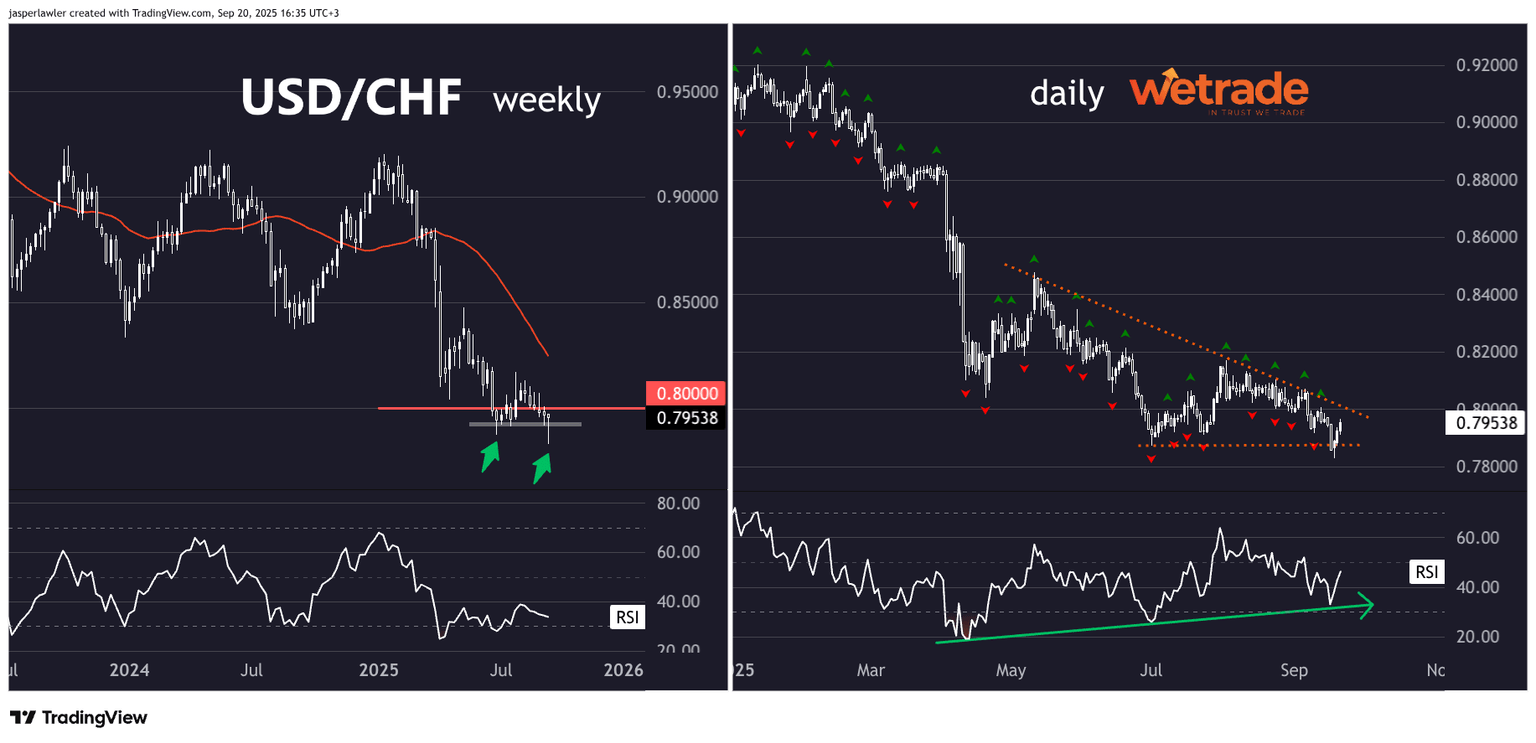
The 0.80 level is a big one for the Swiss franc. Last week’s candle was a hammer pattern and a bullish sign 0.80 could eventually hold as support.
Signal
A failed breakdown seen better on the daily chart has the price sitting inside a triangle pattern with bullish RSI divergence. A breakout above the triangle could confirm the long term level has held.
USD/SGD
Setup
Big support from last year was 1.28. This year the price got down to 1.27 twice but both times it didn’t last long.
Signal
The price is retesting a broken rising trendline and could fall back as bears sell the retest. However any drop back towards 1.28 could be an opportunity to get bullish at lower prices, while a push back above the trendline could be a bullish confirmation.

USD/PLN
Setup
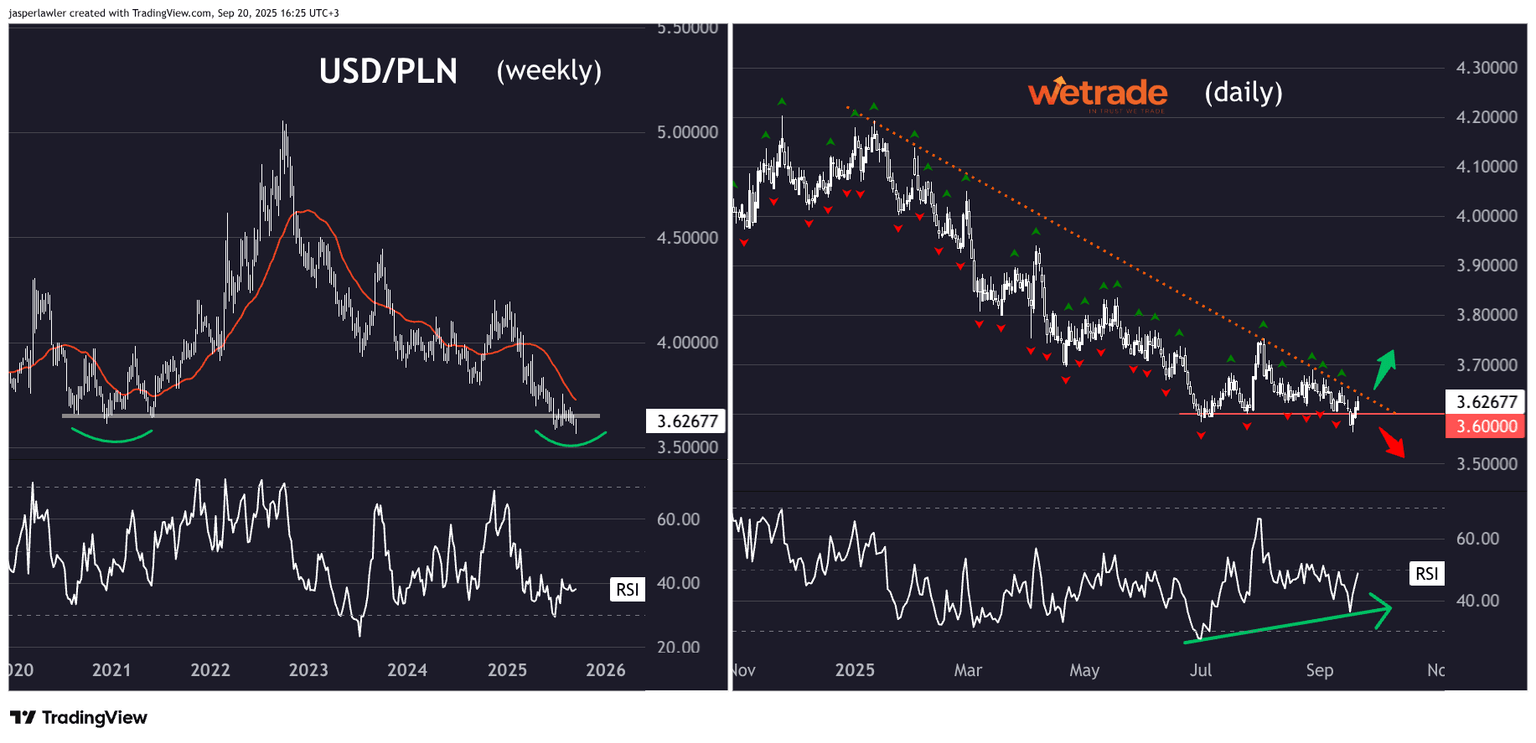
The Polish Zloty is setting up a possible double bottom with its 2021 low. 1.36 is the big round number to watch.
Signal
A false breakdown could be the first sign of a bullish recovery. A break back over the downtrend line could offer confirmation the bottom is in.
Author
Jasper Lawler
Trading Writers
With 18 years of trading experience, Jasper began his career as a stockbroker on Wall Street in New York City before sharpening his analytical skills at top trading firms in the City of London.

















