|

Technical analysis: GBP/USD holds above 1.25 but weak bullish bias

  • GBP/USD finds strong support in 1.2480 region.

  • But upside momentum struggles to take off.
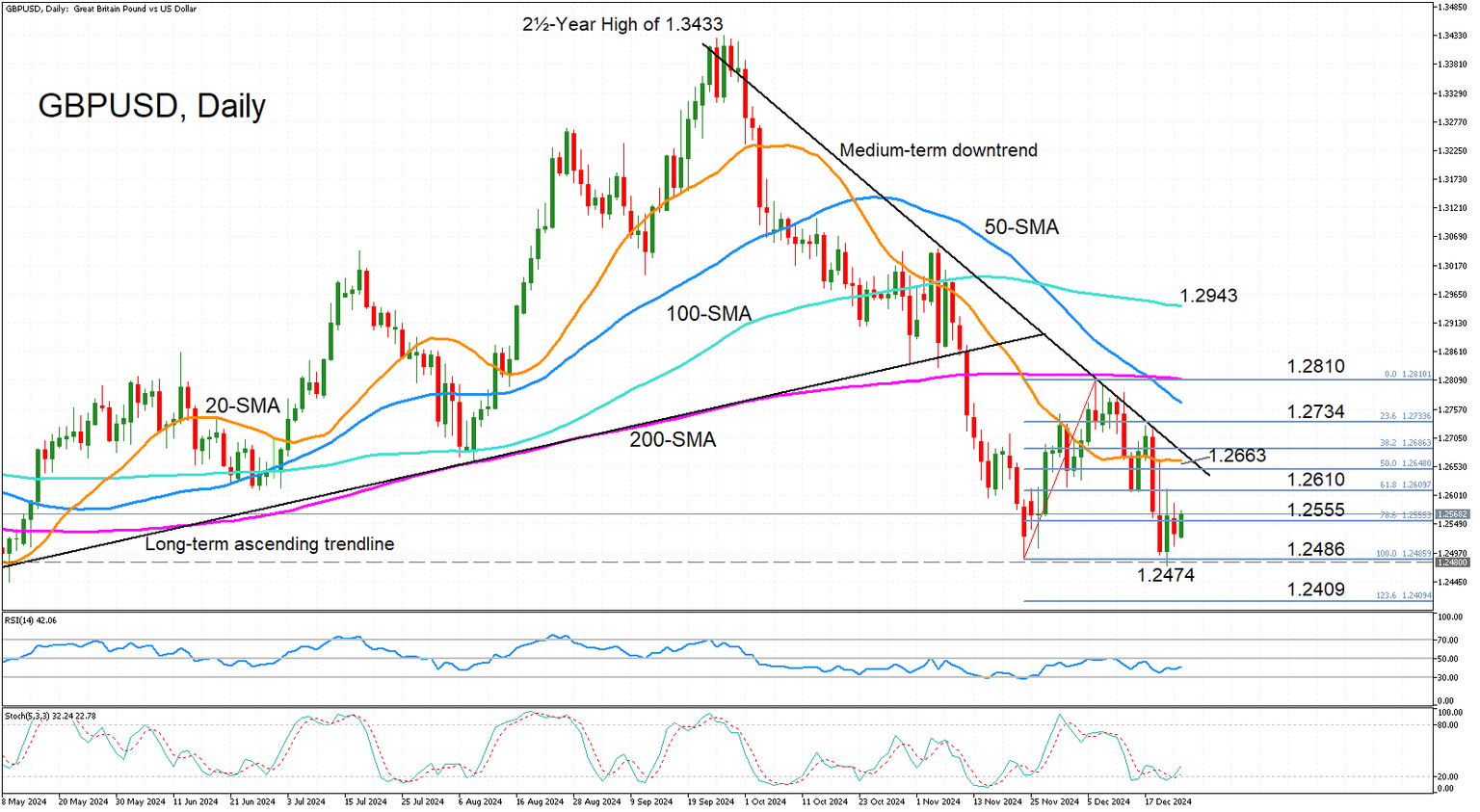
GBP/USD has managed to hold above the 1.2500 mark this week following last week’s post-Fed tumble that pulled the pair to the lowest since May, hitting 1.2474. The slide reinforced the medium-term downtrend line as a strong resistance wall, but now the bulls face additional barriers.

Any recovery attempt would first need to overcome the 61.8% Fibonacci retracement of the November-December upleg at 1.2610 and then battle the 20-day simple moving average (SMA) at 1.2663 before cracking the descending trendline.

However, a successful break above it would strengthen the short-term bullish bias, while switching the bearish outlook in the medium term to a more neutral one. It would also clear the path towards the December peak of 1.2810, which is where the 200-day SMA is currently converging.

In the bigger picture, the bulls would ideally need to aim for the 100-day SMA at 1.2943 as well for the long-term uptrend to stand any chance of being restored.

But given the weak positive momentum, further downside cannot be ruled out in the near term. The RSI is only slightly pointing upwards and remains below 50, while the stochastic oscillator has some way to go before reaching neutral levels.

Should the bears retake control, the 1.2480 support area is likely to be tested again before attention turns to the 1.2400 handle that lies slightly below the 123.6% Fibonacci extension.

To sum up, there is a greater possibility of GBPUSD resuming its medium-term downtrend than reviving its long-term uptrend over the next few sessions. 

Author

Raffi Boyadjian

Mr Boyadjian graduated from the London School of Economics in 1999 with a BSc in Business Mathematics and Statistics. Following graduation, he joined PricewaterhouseCoopers in the Business Recoveries team, where he was responsibl


More from Raffi Boyadjian
Share:

Markets move fast. We move first.

Orange Juice Newsletter brings you expert driven insights - not headlines. Every day on your inbox.

By subscribing you agree to our Terms and conditions.

Editor's Picks

EUR/USD falls toward 1.1700 on broad USD recovery

EUR/USD turns south and declines toward 1.1700 on Wednesday. The US Dollar gathers recovery momentum and forces the pair to stay on the back foor, as traders look to USD short-covering ahead of US inflation report on Thursday. However, the downside could be capped by hawkish ECB expectations. 

GBP/USD trades deep in red below 1.3350 after soft UK inflation data

GBP/USD stays under strong selling pressure midweek and trades below 1.3350. The UK annual headline and core CPI rose by 3.2% each, missing estimates of 3.5% and 3.4%, respectively, reaffirming dovish BoE expectations and smashing the Pound Sterling across the board ahead of Thurday's BoE policy announcements. 

Gold clings to moderate daily gains above $4,300

Following Tuesday's volatile action, Gold regains its traction on Wednesday and trades in positive territory above $4,300. While the buildup in the USD recovery momentum caps XAU/USD's upside, the cautious market stance helps the pair hold its ground.

Bitcoin risks deeper correction as ETF outflows mount, derivative traders stay on the sidelines

Bitcoin (BTC) remains under pressure, trading below $87,000 on Wednesday, nearing a key support level. A decisive daily close below this zone could open the door to a deeper correction.

Monetary policy: Three central banks, three decisions, the same caution

While the Fed eased its monetary policy on 10 December for the third consecutive FOMC meeting, without making any guarantees about future action, the BoE, the ECB and the BoJ are holding their respective meetings this week. 

AAVE slips below $186 as bearish signals outweigh the SEC investigation closure

Aave (AAVE) price continues its decline, trading below $186 at the time of writing on Wednesday after a rejection at the key resistance zone. Derivatives positioning and momentum indicators suggest that bearish forces still dominate in the near term.