|

Lower output expectations bullish for oats price

USDA forecasts lower US oats production. Will the oats prices continue rising?

The US Department of Agriculture National Agricultural Statistics Service ( NASS ) Small Grains Summary projected 2019/20 oat production at 54.2 million bushels, 6.2 million below last month’s for comparable States. The decline was due both lower yield and planting projections. Average yield is estimated at 64.4 bushels per acre, down 2.0 bushels from last month’s forecast. And harvested area is projected 67,000 acres lower at 842,000 acres. Lower production is bullish for oats price.
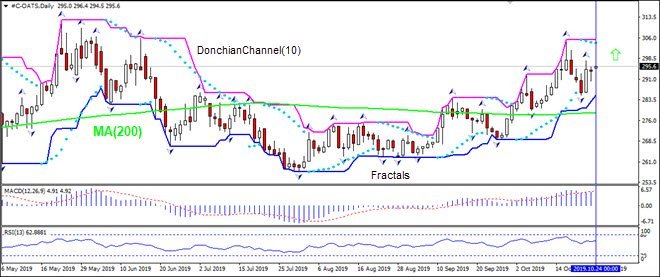
chart

On the daily timeframe the OATS: D1 is above the 200-day moving average MA(200) which is rising .

  • The Parabolic indicator gives a sell signal.

  • The Donchian channel indicates uptrend: it is narrowing up.

  • The MACD indicator gives a bullish signal: it is above the signal line and the gap is widening.

  • The RSI oscillator is rising but has not reached the overbought zone.

We believe the bullish momentum will continue. A pending order to buy can be placed above the level 296.4. The stop loss can be placed below the lower Donchian boundary at 285.1. After placing the order, the stop loss is to be moved every day to the next fractal low, following Parabolic signals. Thus, we are changing the expected profit/loss ratio to the breakeven point. If the price meets the stop loss level (285.1) without reaching the order (296.4), we recommend cancelling the order: the market has undergone internal changes which were not taken into account.

Technical Analysis Summary

OrderBuy
Buy stopAbove 296.4
Stop lossBelow 285.1

Want to get more free analytics? Open Demo Account now to get daily news and analytical materials.


Want to get more free analytics? Open Demo Account now to get daily news and analytical materials.

Author

Dmitry  Lukashov

Dmitry Lukashov

IFC Markets

Dimtry Lukashov is the senior analyst of IFC Markets. He started his professional career in the financial market as a trader interested in stocks and obligations.


More from Dmitry Lukashov
Share:

Editor's Picks

GBP/USD bulls seem hesitant as Hormuz ship attack supports safe-haven USD

The GBP/USD pair sticks to a positive bias for the second straight day, albeit it remains below the previous day's swing high and trades just below the 1.3200 mark during the Asian session on Friday. Furthermore, the fundamental backdrop warrants caution before positioning for any meaningful recovery from November 2025 lows, around the 1.3140 region, touched on Wednesday.

EUR/USD holds above mid-1.1300s amid Hormuz risks, bearish setup

The EUR/USD pair struggles to capitalize on the previous day's modest recovery gains and oscillates in a narrow band during the Asian session. Spot prices, however, hold above mid-1.1300s and the lowest level since May 2025, set on Thursday, warranting some caution for bearish traders.

Gold recovers early lost ground; bearish bias remains amid Fed hike bets

Gold builds on its modest intraday bounce from the $3,983-$3982 region, and climbs to the top end of its daily range heading into the European session. The US Dollar remains depressed below its highest level since May 2025 set on Thursday, amid receding Federal Reserve rate-hike bets. This is seen as a key factor lending some support to the commodity.

Ripple price clings to $1 as long liquidations deepen bearish trend

Ripple (XRP) trades near the key psychological support level of $1 after losing more than 8% so far this week. CoinGlass liquidation data shows that over 97% XRP long positions were wiped out over the past 24 hours. In addition, derivatives metrics continue to favor the bears.

Asian stock markets plummet as Apple price hike raises inflation concerns, KOSPI dives over 8%
Asian equity markets on Friday are significantly down as price hikes announced by Apple Inc. due to memory chip shortages have prompted fears of high inflation globally and concerns on earning projections of various companies that rely on these sophisticated chips for their final products.
Regime change: Inside Kevin Warsh's first move to make the Fed unreadable on purpose

The rate did not move. That was the least interesting thing about Kevin Warsh's first meeting in charge of the Fed. The FOMC held its benchmark at 3.50%-3.75% for the fourth straight meeting, exactly as priced, and then the new chair used his first press conference to dismantle the machinery the market has leaned on for a decade.














