|

Falling Indonesia output bullish for cocoa price

Cocoa production is falling in Indonesia and Malaysia. Will the cocoa price continue rising?

Cocoa production is decreasing in Indonesia and Malaysia. Indonesia is the third-largest cocoa exporter in the world after Ghana and Ivory Coast. Indonesia produced around 260,000 metric tons (MT) of beans in 2017, down 31 percent from the previous year according to the Indonesia Cocoa Industry Association (AIKI) estimates. Indonesia now imports cocoa with 240,000 MT imported in 2018. Cocoa beans yield low income which motivates farmers to switch to profitable crops like palm oil. Falling cocoa crop in the world’s No. 2 exporter of the commodity is bullish for cocoa price.
Cocoa

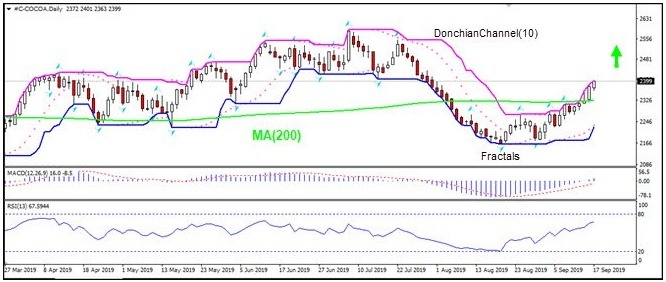
On the daily timeframe the COCOA: D1 has been rising and has breached above the 200-day moving average MA(200).

  • The Parabolic indicator has formed a buy signal.

  • The Donchian channel indicates uptrend: it is tilted up.

  • The MACD indicator gives a bullish signal: it is above the signal line and the gap is widening.

  • The RSI oscillator is above 50 level but has not reached the overbought zone.

We expect the bullish momentum will resume after the price breaches above the upper Donchian bound at 2384. A price above that level can be used as an entry point for a pending order to buy. The stop loss can be placed below the lower Donchian bound at 2184. After placing the pending order, the stop loss is to be moved to the next fractal low, following Parabolic signals. By doing so, we are changing the expected profit/loss ratio to the breakeven point. If the price meets the stop loss level (2184) without reaching the order, we recommend canceling the order: the market sustains internal changes which were not taken into account.

Technical Analysis Summary

OrderBuy
Buy stopAbove 2384
Stop lossBelow 2184

Want to get more free analytics? Open Demo Account now to get daily news and analytical materials.


Want to get more free analytics? Open Demo Account now to get daily news and analytical materials.

Author

Dmitry  Lukashov

Dmitry Lukashov

IFC Markets

Dimtry Lukashov is the senior analyst of IFC Markets. He started his professional career in the financial market as a trader interested in stocks and obligations.


More from Dmitry Lukashov
Share:

Editor's Picks

AUD/USD bulls regain control above 0.6950 amid USD retreat

AUD/USD regains traction and extends the previous day's bounce from the weekly low, aiming for 0.7000 in Asia on Friday. The overnight pullback in US bond yields keeps the US Dollar below an 18-month high, which in turn offers some support to the pair. Meanwhile, hawkish RBA expectations also keep the major underpinned.

USD/JPY holds gains near 158.00 after Japan's weak Household Spending data

USD/JPY clings to gains around 158.00 after data showed on Friday that Japan's Household Spending fell for the ninth straight month, undermining the Japanese Yen. Meanwhile, the US Dollar remains depressed as the overnight fall in US bond yields counters a hawkish Fed and geopolitical uncertainties, could cap any downside in the pair.

Gold remains range-bound below $4,200

Gold has given up some ground after an initial bullish attempt to reach weekly highs, returning to below the $4,200 mark per troy ounce on Friday. The US Dollar’s strong upside momentum, combined with rising US Treasury yields across the curve, seems to keep further gains in the yellow metal under scrutiny.

Has Bitcoin really escaped the macro forces it was built to fight?
Over 17 years ago, Satoshi Nakamoto designed Bitcoin (BTC) on the back of a global financial crisis as an alternative to the global monetary system outside the control of central banks, governments and traditional intermediaries. This raises a key question: has Bitcoin really become independent of the macroeconomic forces it was built to challenge?
The Euro is not the sick man of Europe. France's bond market is
EUR/USD remains under pressure, near the 17-month low of 1.1161 reached on Monday. The pair has lost more than 7% since its yearly peak, as concerns over France's public finances increasingly weigh on the single currency. But behind the weakness of the Euro (EUR), the problem does not necessarily lie with the European economy as a whole.
Has Bitcoin really escaped the macro forces it was built to fight?
Over 17 years ago, Satoshi Nakamoto designed Bitcoin (BTC) on the back of a global financial crisis as an alternative to the global monetary system outside the control of central banks, governments and traditional intermediaries. This raises a key question: has Bitcoin really become independent of the macroeconomic forces it was built to challenge?














