Tech sector saga unfolds: Some question the GDP impact if the sector retreats and regroups

Outlook
As the tech sector saga has developed, a few lone voices have questioned what happens to GDP/growth if the sector has to retreat and regroup. Much of the growth—some say all—is due to or associated with the sector. The sector plus Trump policies are blamed for the housing crisis—mostly mortgages over 7% but also the higher cost of materials and the shortage of construction workers lured away to data centers and the loss of immigrant labor.
Have these changes gone on long enough to be considered structural?
The relationship pf the tech sector with the bond market is murky. We know about crowding out. What about this chart from Bloomberg? It shows the inverse correlation on a 20-day basis. Why 20 days? Is this a statistical trick? Disraeli--
"Lies, damned lies, and statistics."
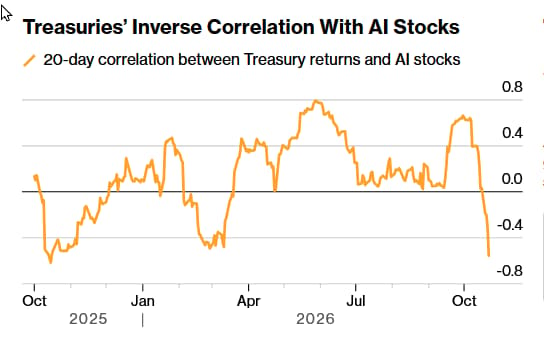
At a guess, it’s more complicated than that, because the two should be positively correlated for a number of reasons, including a potential slowdown, war nerves, etc. The one thing that is inverse if flight to safety and way off in the corner, the idea that the Fed could cut instead of hike to rescue the tech sector. Rocky’s Rule 10: Be careful what you read.
Given the French bond crisis, ING now says the ECB will not hike next week—and maybe not in Dec, either. The rise in yields is itself a tightening of roughly 25 bp (and 50 bp for France). And despite inflation on the rise, new staff forecasts might price in lower energy costs. “So far, there has hardly been any pass-through of higher energy prices in the rest of the economy. If this remains the case, the need for further rate hikes drops. If it doesn’t, the likelihood of new rate hikes goes up.”
Wait a minute—energy price not passed through? We checked the Eurostat website. It has data from 2025. Y-Charts reports the “European Union Consumer Price Index for Energy reached 116.62 in September 2026, reflecting a 17.57% increase year-over-year.“
To be fair, it’s not evenly distributed. Countries with price caps and subsides still have higher costs, but limited (Hungary, Spain). The data availability is awful. Most comparisons are for 2021, meaning the Ukraine war, not the Iran war.
This brings up the question of whether if you can’t see it, it’s not there. For governments to prevent higher prices from reaching households by using caps means the companies pay the higher price. We must assume there’s an offset somewhere, like subsidies or taxes. If subsides direct to households are used, that adds to government debt and eventually, the piper must be paid… presumably in taxes.
We have been writing for many years that the price of oil permeates everything, everywhere. Hence the cost of even oddball things like paper (fuel to run the machinery). In the Us, technically electricity is up 4.2% y/y, but in data center places, it’s more like 100%. In Virginia, my electric bill is up more than that. Gasoline and diesel are up 34%, but regional disparities have it as high as 70%.
That’s a huge difference in European vs. US government management. The Europeans, generally, protect households. The Americans embrace free market capitalism, red in tooth and claw. Remember, the US exports diesel! We see the same thing in healthcare. In Europe it’s a right and specified in the EU Charter of Fundamental Rights. In the US, the left is fighting for universal health care, and never mind it would cost more (a lot more) than the Pentagon.
The US multi-payer system makes it hard to compare, but one comparison is $14,800-15,500 per person in the US vs. “household out-of-pocket expenses in the EU average about €542 per year“ (Peterson Institute). Costs vary by nation, of course, but you get the idea. The US wouldn’t come close to that average with Medicare for all. Too many obese people, first of all. One rabbit hole we went down led to diabetes.
Finally, data. Today it’s the flash Oct PMI from S&P, which runs second in influence but never mind. The forecast is a dip to 57.1 from 58.4 in the composite, still quite good but the first dip in 4 months. This will feed the Atlanta Fed GDPNow, currently at 3.5% with a revision next Tuesday. Can data save the tech sector and the bonds and the dollar? No. It doesn’t help that AI is threatening the majority of websites and other crimes.
Forecast
It’s Friday, and anything can happen. The tech sector problem/yield retreat can worsen. Risk aversion can send the dollar up, but it didn’t do that yesterday. Some important Fed (like NY’s Williams) can say something relevant, pushing the dovish stance a little harder. That might help the tech sector but not the dollar.
Trump can bomb Iran over the weekend or talk about doing it Monday. We continue to wonder why he would wait until after the midterms when the war is one reason he’s losing. An end to the war, even if Trump lies about it, would bring energy price relief and get some votes. For all his many faults, Trump is politically astute.
Now is a good time to fold your tents and run for the hills.
This is an excerpt from “The Rockefeller Morning Briefing,” which is far larger (about 10 pages). The Briefing has been published every day for over 25 years and represents experienced analysis and insight. The report offers deep background and is not intended to guide FX trading. Rockefeller produces other reports (in spot and futures) for trading purposes.
To get a two-week trial of the full reports plus traders advice for only $3.95. Click here!
Author

Barbara Rockefeller
Rockefeller Treasury Services, Inc.
Experience Before founding Rockefeller Treasury, Barbara worked at Citibank and other banks as a risk manager, new product developer (Cititrend), FX trader, advisor and loan officer. Miss Rockefeller is engaged to perform FX-relat