Tariffs, inflation, and the Fed's balancing act


Trump’s tariffs were unlawful
Although a holiday-shortened week, it certainly did not feel like it. In fact, the year has been moving so fast.
Friday was a busy one, wrapping up with the Supreme Court's 6-3 ruling that effectively struck down US President Donald Trump’s reciprocal tariffs. The Court found that the 1977 emergency powers law (IEEPA) that Trump had used to justify the import taxes did not extend to them.
Does this mean an end to Trump’s tariff regime? No. In fact, shortly after the ruling, the President announced a 10% blanket tariff across all countries via his Truth Social platform (see below), effective almost immediately, using different legal avenues.

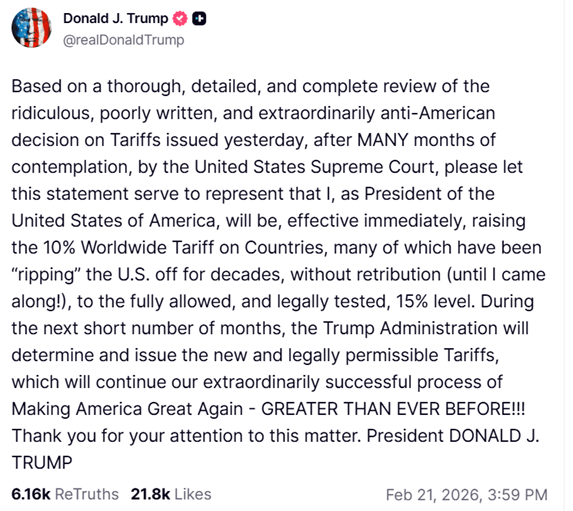
It did not end there. A day later, Trump announced that he would increase the levy from 10% to the ‘fully allowed and legally tested’ 15% (see below). The President is now enforcing Section 122 of the Trade Act of 1974, permitting him to implement a temporary 150-day tariff of up to 15%. Once this time has passed, Congress must then approve an extension.
I assume that the previously agreed levies of 10% for countries like the UK and Australia are now being shelved, and that they must adhere to the new 15% rule?
Another burning question, of course, is the refund procedure. The tariffs that companies have already paid under IEEPA are now unlawful, opening the door to substantial reimbursements, estimated at US$160 billion. As the ruling did not outline how this process would work, this will likely be messy and could remain in litigation for the foreseeable future.
The immediate market reaction saw a bid in Stocks, with yields rising moderately across the curve amid concerns over the budget. Trump's tariffs were generating substantial government revenue, used to fund spending and tax cuts. With this essentially removed from the government’s coffers, the US deficit will become larger, meaning the government will need to borrow more, which may ultimately underpin yields.
Also, on Friday in the US
US economic activity grew at a much slower pace than forecast, reporting an annualised 1.4% rate for Q4 24 according to the first estimate. Down from 4.4% in Q3, this was substantially lower than the 3.0% median estimate and below the 1.5% minimum forecast. The primary drag was the government shutdown-induced collapse in Federal spending, which led consumer spending to slow to 2.4% in Q4, down from a brisk 3.5% in Q3.
Additionally, the December PCE inflation surprised to the upside, with the headline YY number coming in at 2.9% (from 2.8% in November), whilst core YY increased by 3.0% (from 2.8%) – quite a way above the Fed’s 2.0% target. From the Personal Income and Outlays report, we also saw that the saving rate cooled to 3.6%, down from 3.7%, while consumer spending held up, suggesting households are drawing down savings to sustain spending.
Earlier in the week, the Fed minutes also took on a more hawkish tone; several participants explicitly kept rate hikes on the table, and most cautioned that the return to 2.0% inflation could be slower and more uneven than expected. As I am sure you can see, this places the Fed in a dilemma. GDP growth is softening, but price pressures remain elevated and sticky. While money markets are still pricing in around two rate cuts by year-end, the USD could remain supported by the Fed’s hawkish stance and increased geopolitical risk.
What’s ahead this week in the US?
The US-Iran situation and Trump’s tariffs will likely remain front and centre this week. However, in terms of US data – and pretty much global data – the calendar is rather thin. I will be watching the US Conference Board’s February consumer confidence data on Tuesday and the January wholesale PPI inflation data on Friday.
The US consumer confidence report may be interesting this week, particularly on the jobs front. You may recall that the previous release showed a marked deterioration in consumers’ perceptions of job availability, dropping 23.9% from 27.5%, combined with an uptick in those reporting that jobs were ‘hard to get’. If we see a marked deterioration here, this could weigh on yields and the USD.
In terms of the US PPI report, moderation from 3.0% to the expected 2.6% YY would likely be viewed as encouraging that supply-side pressures are easing. Unlike the CPI release that measures price change from a buyer’s viewpoint, the PPI report focusses on the price change from a seller’s perspective. So, with pipeline pressures expected to ease, this should give policymakers at the Fed a bit of breathing room. Nevertheless, even at 2.6%, while it may trigger a modest push lower in the USD, it is unlikely to be enough to materially shift things for the Fed.
Finally, Nvidia’s (NVDA) quarterly report (fiscal quarter ending January 2026) will land on Wednesday after the market close. I think the key point here is that, given the huge weightings this company has in the S&P 500 and the Nasdaq 100 at 7.37% and 13.68%, respectively, this could impact major US Stock benchmarks. NVDA remains the bellwether for whether the AI infrastructure build-out is a sustainable structural shift or a front-loaded bubble. If the results disappoint, this could weigh on Stocks; conversely, if they surprise to the upside, this may underpin the market.
Author
Aaron Hill
FP Markets
After completing his Bachelor’s degree in English and Creative Writing in the UK, and subsequently spending a handful of years teaching English as a foreign language teacher around Asia, Aaron was introduced to financial trading,