|

Still a soft landing?

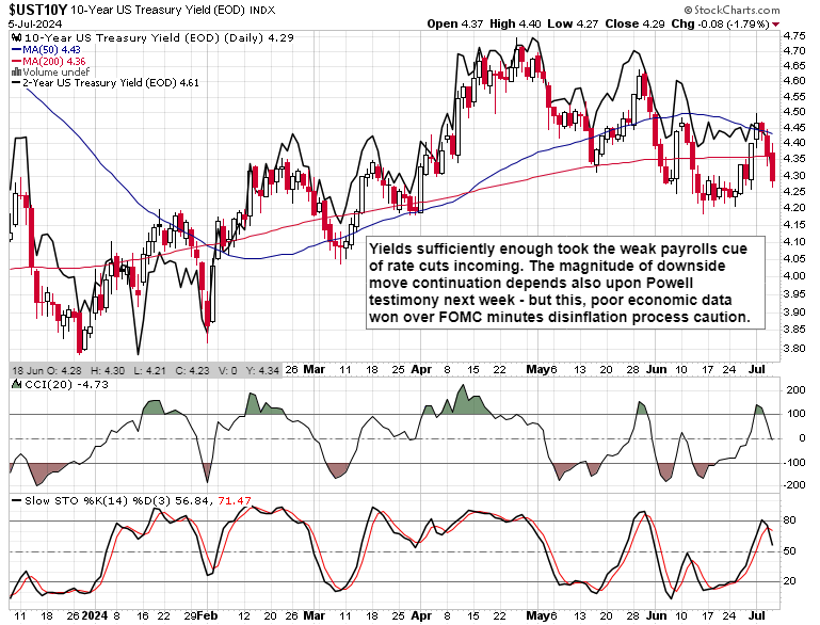
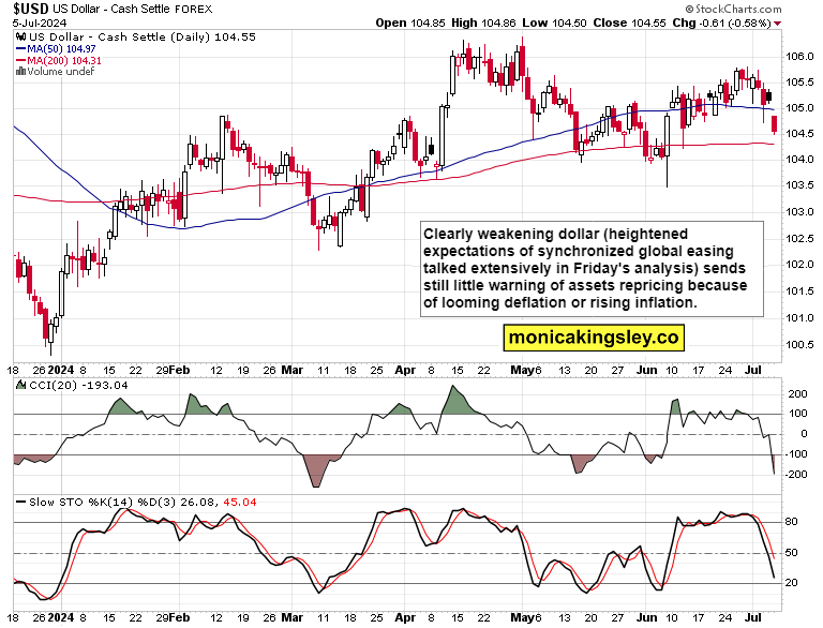
S&P 500 wasn‘t fooled by sizable government hiring skewing NFPs, and neither was Nasdaq. Its performance showed what matters – it‘s rate cut odds, and two 2024 cuts being priced in with the two-day heavy selling in Treasuries reversed while the dollar is being dumped.

You knew it all from my live NFPs commentary and also about the importance of synchronized global easing – see the very extensive Friday‘s analysis. With the wealth of underwhelming data this week, culminating in the (private, look at private) non-farm payrolls after manufacturing and services PMI – resulting in the odds of the Fed not cutting in Sep dipping to 27% only.

Remember also that my worry had been what kind of (equals how temporary or shallow) the deflationary whiff is going to be. Yes, next week we‘re getting (bank earnings and) both CPI and PPI, and they‘re still to underscore the disinflationary trend. But what is weakening economic growth together with falling inflation? Deflationary whiff is what‘s hanging in the air. Forget for a moment that if we get more of the downward revisions of Friday‘s kind, recession could get retroactively declared to have started before spring 2025.

Is it an issue for the stock market? To drop a couple of clues that I would go on to develop in the premium sections for individual markets, think about where bonds are headed, whether commodities are coming back, and the same applies to Bitcoin following its Friday‘s flush. What did I say about international stocks? Does China look to you as a buy or are you selling here? Look at Nasdaq market breadth, short vs. long end of the curve, and USD as well.
Author

Monica Kingsley

Monica Kingsley

Monicakingsley

Monica Kingsley is a trader and financial analyst serving countless investors and traders since Feb 2020.


More from Monica Kingsley
Share:

Editor's Picks

AUD/USD hangs close to monthly lows, still defends 0.7100 ahead of Fed decision

AUD/USD retains its negative bias for the third straight day, defending 0.7100 while trading close to a monthly low in Wednesday's Asian session on Wednesday. The US Dollar stands firm near a two-week high as the anticipated Fed rate hike and oil-driven inflation fears continue to push US bond yields to a multi-year high. Furthermore, escalating Middle East tensions benefit the safe-haven buck and weigh on the risk-sensitive Aussie.

USD/JPY holds firm above 155.00, awaits Fed policy announcements

USD/JPY climbs to a fresh one-week high above 155.00 in the Asian session on Wednesday amid a bullish US Dollar. Oil-driven inflation fears, along with the anticipated Fed rate hike, continue to support surging US bond yields. Moreover, rising US-Iran tensions underpin the USD's reserve currency status. The pair, however, remains below the mid-155.00s as bulls seem hesitant ahead of the Fed decision later today and the BoJ meeting, starting on Thursday.

Gold clings to recovery gains above $4,300, awaits Fed

Gold struggles to capitalize on its modest intraday move higher and remains below the $4,350 level in European trading on Wednesday. The US Dollar pauses for a breather after touching a two-week high and offers some support to the commodity. Traders, however, seem hesitant to place aggressive directional bets and opt to wait on the sidelines heading into the key Fed event risk.

Bitcoin, Ethereum, and Ripple retreat as Fed rate decision looms
Bitcoin (BTC), Ethereum (ETH) and Ripple (XRP) remain under pressure and consolidate at the time of writing on Wednesday after falling more than 3%, 4% and 9%, respectively, as the Clarity Act failed to advance in the Senate on Tuesday.
Asian stocks trade with modest gains as investors remain cautious ahead of Fed decision

Asian equity markets trade with modest gains on Wednesday, tracking stability in US stock index futures, though sentiment remains cautious ahead of the highly anticipated US Federal Reserve policy decision. High oil prices, escalating Middle East tensions and surging bond yields also kept markets on edge.

How Japan became the World's Banker and why that era may be ending

Japan's ultra-low interest rates helped finance trillions of dollars in global investments for more than a decade, making the Japanese Yen one of the world’s cheapest sources of funding. With the Bank of Japan expected to tighten policy again this week, that advantage may be entering a new phase. While most major economies raised interest rates, Japan remained the world's outlier.