S&P 500 earnings just hit a record. The AI data centre bill hasn't landed yet

S&P 500 companies are on track for a third straight quarter of earnings growth above 25%, according to FactSet. Their profit margin hit 17% in the April-June quarter, the highest in FactSet data going back to 2009. The cash behind those earnings has been shrinking for two years, and almost all of the shrinkage is in the handful of companies building data centres for artificial intelligence (AI). That gap is mostly an accounting delay, because companies have spent the money, and most of the cost has yet to hit the income statement. When the gap closes, it closes through earnings.
Bank of America's US equity strategists track free cash flow, the cash a company has left after paying for its buildings and equipment, as a share of its reported profit. Across most of the S&P 500, that figure is about 85% for the next 12 months. It ran at roughly 90%-95% between 2016 and 2023. The hyperscalers, the companies that build cloud and AI computing capacity at the largest scale, are at roughly -15%. For every $100 of profit they are expected to make over the next year, they are on course to spend $15 more than their businesses bring in.
Nvidia records the profit now and Alphabet spreads the cost over six years
Microsoft (MSFT), Alphabet (GOOG, GOOGL), Amazon (AMZN) and the Mark Zuckerberg-founded Meta (META) are the four biggest spenders in that group. When one of them buys a rack of AI chips from the Jensen Huang-founded Nvidia (NVDA), Nvidia records the sale and the profit in the quarter the chips ship. The buyer pays for the rack, but it doesn't count the purchase as a cost that quarter. It adds the rack to its assets and charges a slice of the price against profit each year. That charge is depreciation, spread over the years the buyer expects the equipment to last.
The companies set those lives themselves, generally five to six years for servers. On that schedule, a server bought in 2026 has a fifth or less of its cost charged against 2026 profit, and the rest lands from 2027 on. In 2025, Amazon cut some server lives to five years because AI technology is moving faster, and Meta lengthened most of its own to five and a half.
All five companies are in the S&P 500, so the index's earnings include the seller's profit straight away and the buyer's cost in installments. FactSet expects third-quarter earnings in the technology sector to grow 65.1%, with chip makers contributing the most. Much of chip makers' revenue comes from cloud companies' spending.
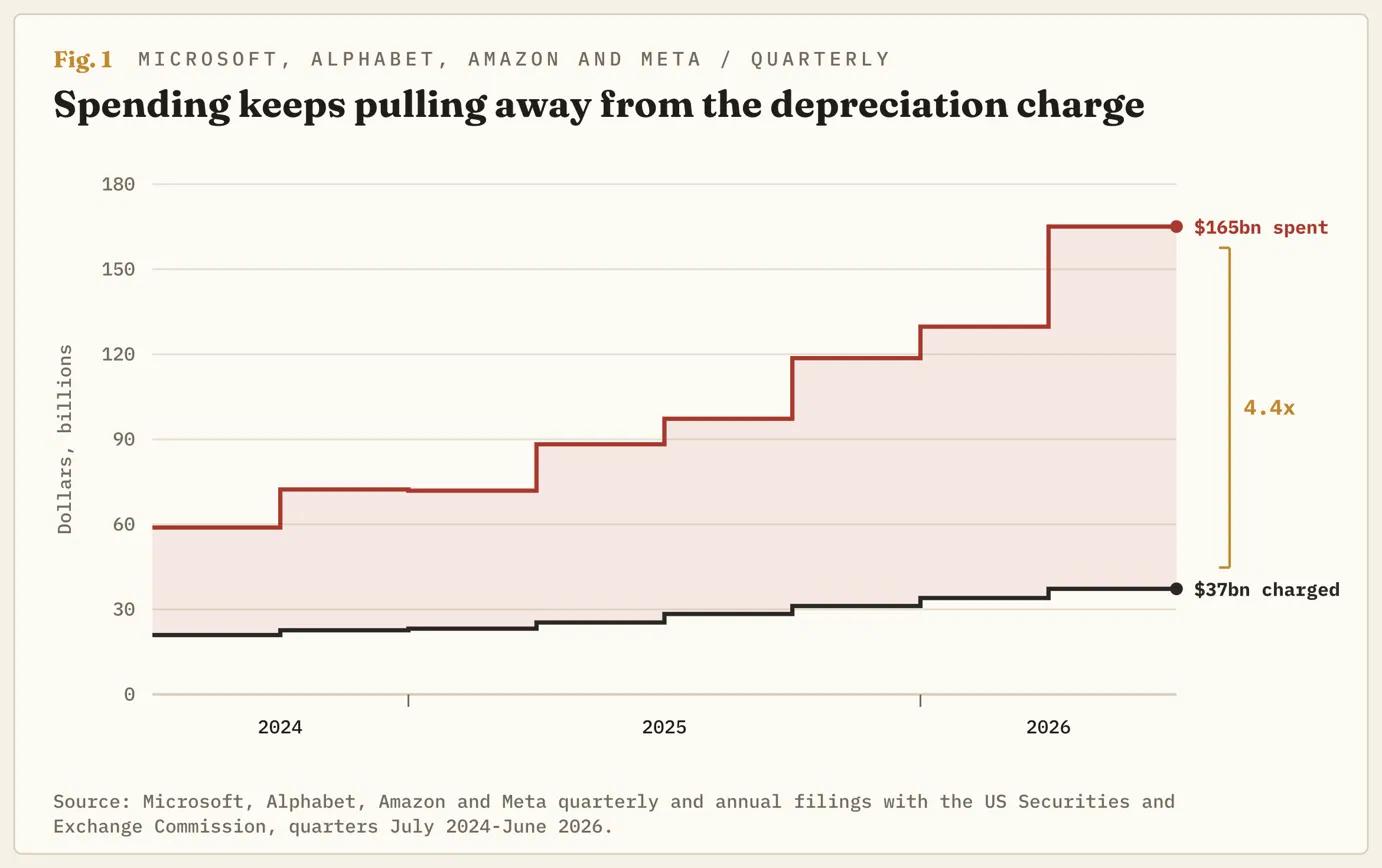
For every dollar counted as a cost, four are spent
In the April-June quarter, the four spent $165 billion on buildings and equipment and charged $37 billion of depreciation against profit, according to their filings. A year earlier, the split was $88 billion and $25 billion. Spending rose 87% and the depreciation charge rose 47%, so the amount already paid out and still waiting to reach profit got bigger again.
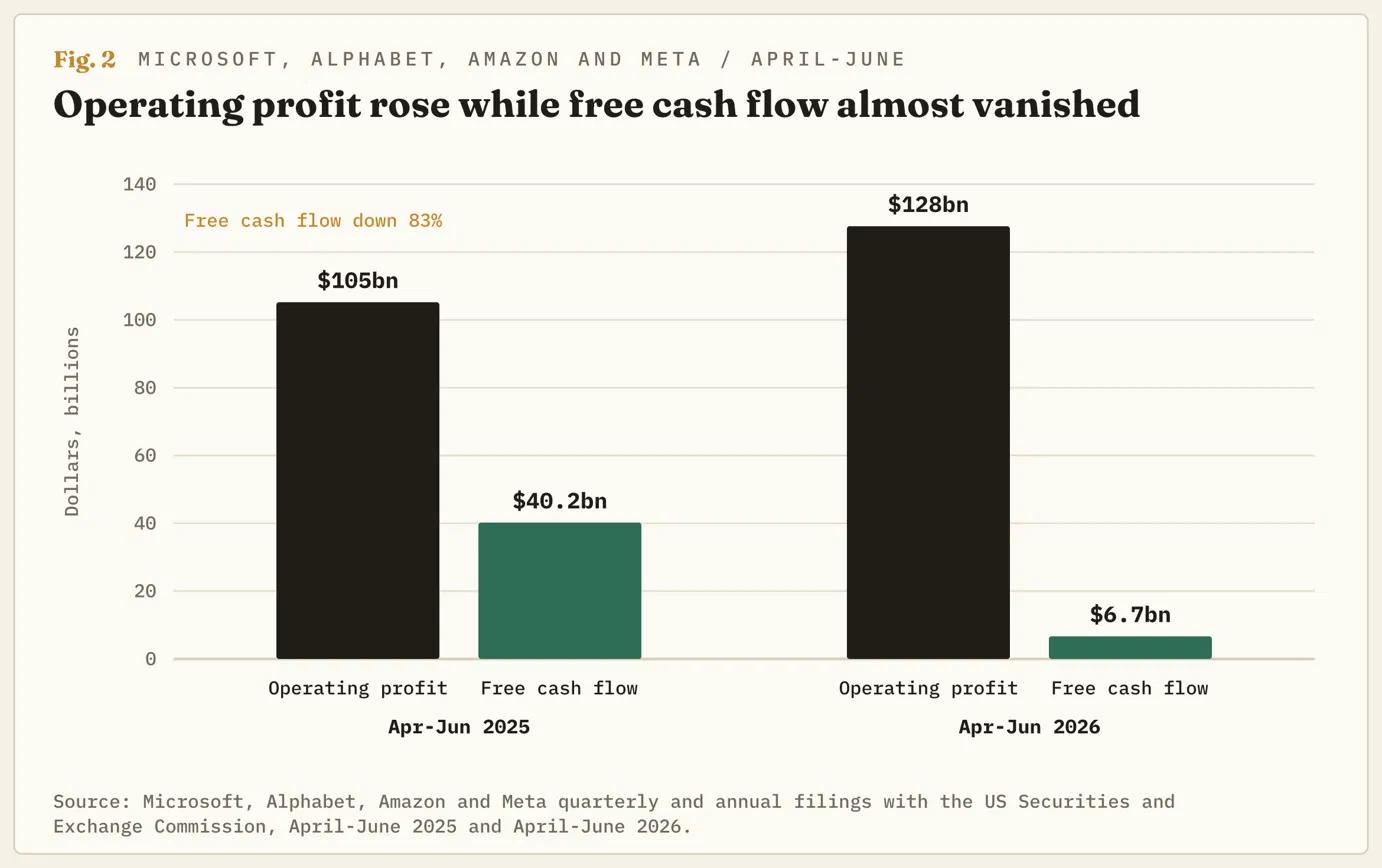
Operating profit at the four, the profit from the business itself, was $128 billion in the quarter, up from $105 billion a year earlier. They had about $7 billion of cash left after paying for equipment.
Together, the four expect to spend roughly $730 billion in 2026, while depreciation runs at about $150 billion a year. Moody's expects spending by the largest cloud companies to approach $1 trillion in 2027.
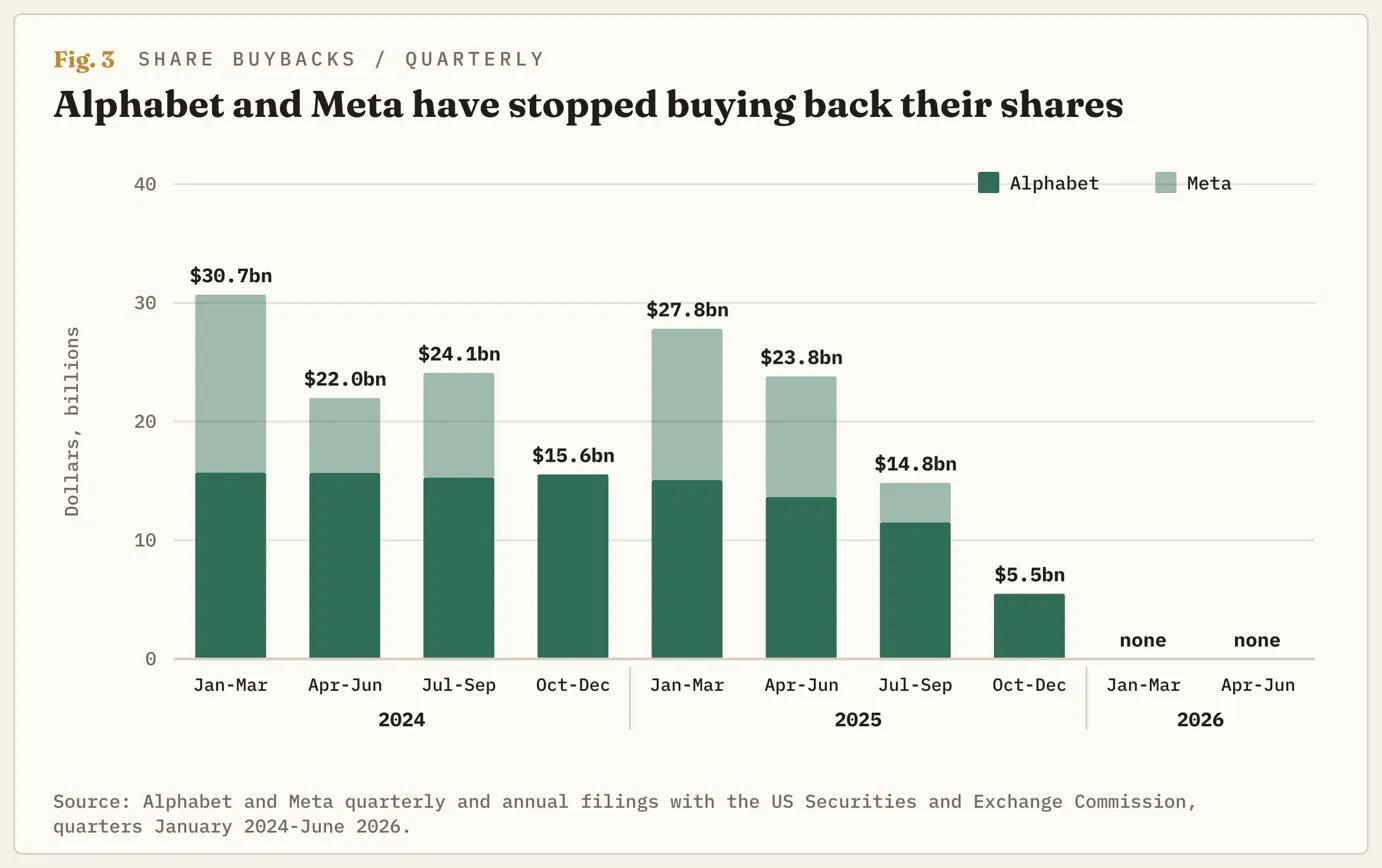
The biggest buyers of their own shares have stopped buying
Free cash flow funds buybacks, which add about $1 trillion a year in demand for S&P 500 shares, according to S&P Dow Jones Indices. Alphabet and Meta bought back $72 billion of their own stock between them in 2025 and none in the first half of 2026. Over those six months, Meta borrowed $24.9 billion, and Alphabet raised $49.6 billion selling new shares and preferred stock that turns into shares. Alphabet has gone from one of the biggest buyers of its own stock in the index to a seller of it inside a year.
Either the spending slows or the depreciation catches up
The gap between profit and cash closes one of two ways, and either way the cost lands in S&P 500 earnings. If the four keep raising spending, depreciation keeps climbing into profits for years after the cash is gone, and buybacks stay off. If they slow down, free cash flow returns quickly, but the chip makers lose the revenue that drove much of the index's growth. It's possible spending slows in 2027, though Alphabet has already said its own will rise again.
The lean is that 2026 earnings for the four are partly borrowed from 2027 and 2028. Their operating profit grew 21% in the April-June quarter and their depreciation 47%, so the charge is rising more than twice as fast as the profit it comes out of.
This is wrong if the four's operating profit outgrows their depreciation in the July-September reports, because then the new capacity is paying for itself. Microsoft reports on October 28, with Alphabet, Amazon and Meta expected the same week.
Author

Joshua Gibson
FXStreet
Joshua joins the FXStreet team as an Economics and Finance double major from Vancouver Island University with twelve years' experience as an independent trader focusing on technical analysis.

















