What happens after a US Treasury market crash

The global bond market is under severe pressure as US Treasury yields reach multi-decade highs, driven by persistent inflation risk, heavy government and corporate debt issuance, and expanding term premiums. Higher yields raise borrowing costs and tighten financial conditions, but a severe bond selloff can ultimately shift investor focus from inflation to growth and financial stability. This mechanism can paradoxically spark a rally in US Treasuries while altering the trajectory for Gold, depending on whether real yields remain elevated or a risk-off event unfolds.

The drivers behind rising global yields
This isn't simply a story about the Federal Reserve (Fed) keeping interest rates higher for longer. The current bond-market selloff is much bigger. Reuters recently reported that government borrowing costs across the US, Europe, and Japan had reached multi-decade highs. The pressure isn’t limited to the US. Bond markets in Europe and Japan are also under pressure, showing that this is becoming a broader global bond-market story.
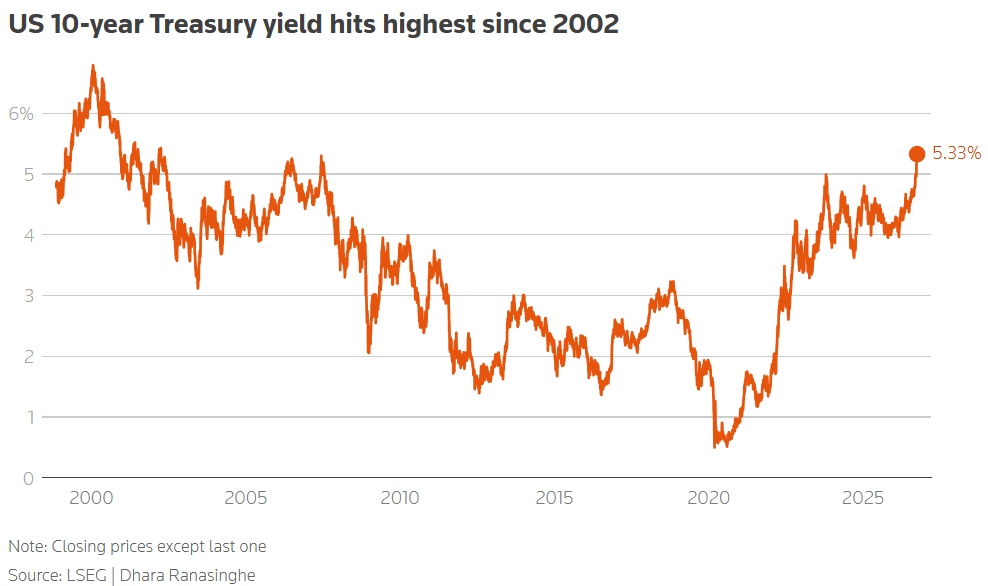
The US 10-year Treasury yield reached around 5.34% in October, its highest level since 2002. The benchmark yield also rose sharply in the third quarter.
There are several forces hitting the bond market at the same time:
- Inflation risk: Energy prices and geopolitical uncertainty are keeping inflation concerns alive.
- Government borrowing: Governments are running large deficits and issuing enormous amounts of debt.
- Corporate borrowing: The Artificial Intelligence (AI) investment boom is creating another huge source of demand for capital. Reuters reported that five major AI companies, including Alphabet, Amazon, Meta, Microsoft, and Oracle, had already issued around $220 billion of debt in 2026, more than twice the previous year's amount.
- The term premium: Investors are demanding more compensation to lock their money into long-term bonds because uncertainty around inflation, fiscal policy, issuance, and future interest rates has increased.
Fidelity describes this as part of a broader shift away from the era of easy money toward a new regime where the cost of capital and rate volatility may remain structurally higher. And that's the real story.
Repricing the interest-rate regime
The market isn't simply repricing the next Fed meeting; it's repricing the entire interest-rate regime. For roughly a decade after the financial crisis, the dominant assumption was relatively simple: low inflation, weak growth, quantitative easing, abundant global savings, and low interest rates. That environment rewarded investors who owned long-duration bonds.
But the assumptions are changing. The market is increasingly dealing with persistent inflation risk, huge fiscal deficits, massive AI and infrastructure investment, large government debt issuance, less monetary accommodation, and geopolitical uncertainty. That creates a completely different environment.
So, rising yields don't automatically signal a crisis. Higher yields can reflect stronger economic growth, inflation uncertainty, government borrowing, and AI-related capital spending. Every bond selloff cannot be called a financial crisis.
How higher yields feed back into the economy
Rising yields are not necessarily the crisis. The real danger is what those yields start doing to the financial system. The higher yields go, the more expensive the entire financial system becomes. Mortgage rates rise. Corporate borrowing costs rise. Government interest expenses rise. Refinancing becomes more expensive. And investors start demanding higher returns from almost every asset.
That's where the bond selloff can begin feeding back into the economy. A government issuing debt has to pay more to finance that debt. A company refinancing old debt has to pay more. Stocks can also come under pressure as higher yields increase the discount rate applied to future earnings, particularly when valuations are already elevated.
The bond market doesn’t exist in isolation. The yield on government bonds becomes part of the cost of capital for the rest of the financial system.
What happens after a bond-market crash
No single outcome happens every time. But in a severe enough bond-market shock, there is a recurring mechanism worth watching.
At first, yields rise because investors demand more compensation. Financial conditions tighten. Riskier borrowers begin feeling the pressure. Highly leveraged positions become more difficult to maintain.
Eventually, if the stress spreads far enough, investors can move from worrying about inflation to worrying about growth and financial stability. And that's the potential turning point. Suddenly, the question changes from: "How high can yields go?" to "How much economic damage are these yields causing?"
That's when the traditional safe-haven mechanism can come back into play. The same force pushing yields higher can eventually push them back down. If investors aggressively reduce risk, they may seek the deepest, most liquid government bond markets. That can push US Treasury prices higher. And because bond prices and yields move inversely, yields can suddenly fall.
This is the paradox: the bond selloff itself can eventually create the conditions for the bond rally that ends it. GoldBroker argues that a genuine risk-off event, deleveraging, or a credit shock could eventually bring renewed demand for Treasuries and push long-term yields sharply lower.
The impact on Gold
If yields eventually reverse, the next question becomes: what happens to Gold?
Under normal circumstances, rising bond yields are bad news for Gold because if US Treasury yields rise significantly, the opportunity cost of holding Gold increases. That's the traditional relationship. But Gold hasn't fallen hard even as long-term US yields have moved dramatically higher. This could reflect investors looking beyond absolute interest-rate levels and focusing instead on what higher rates tell us about sovereign debt, fiscal pressures, and the term premium.
This creates two very different Gold scenarios:
- Yields keep rising without a financial break: That's potentially bearish for Gold. Higher real yields and a stronger US Dollar (USD) can keep pressuring the metal. In this scenario, the traditional relationship between Gold and real yields is still dominating. The bond market is under pressure, but the financial system is absorbing that pressure.
- Yields rise so aggressively that they trigger a risk-off event: That's a completely different environment. If growth deteriorates, credit spreads widen, leverage unwinds, and long-term yields eventually collapse, Gold could benefit from both falling real yields and expectations of renewed monetary support.
And there's another factor: fiscal credibility. If investors become increasingly concerned about government debt and deficits, Gold can become attractive not simply as an inflation hedge, but as an alternative asset outside the government-debt system. In a genuine liquidity crisis, Gold can also experience forced selling, but the medium-term aftermath can be very different.
Five key signals to watch
No one knows exactly when repricing turns into a crisis. So instead of trying to predict the top in yields, watch for the signals that indicate the market is changing regime:
- Treasury yields: If long-term yields continue making new highs, financial conditions are tightening. But don't simply assume that another new high means a crisis is imminent. What matters is how the economy and financial markets react to those higher yields.
- Bond volatility: The Merrill Lynch Option Volatility Estimate, or MOVE Index, is particularly important. This index reflects the implied volatility of the US Treasury options market. A sustained surge in MOVE tells you the problem isn't simply valuation; it's becoming a volatility problem.
- Treasury auction demand: Reuters recently reported unusually weak demand at a September five-year Treasury auction, including a large "tail" and the weakest bid-to-cover ratio in nine years. That doesn't mean the US Treasury will fail to sell its debt; the issue is the price it needs to attract buyers.
- Credit spreads: If corporate and lower-quality credit spreads begin widening sharply, that's a warning that rising government yields are spreading into the private credit system. This may be one of the most important confirmations that the problem is becoming systemic.
- Gold versus real yields: If real yields keep rising and Gold collapses, the traditional relationship still dominates. But if real yields rise while Gold refuses to fall, or Gold begins rising despite higher real rates, that could signal that investors are becoming more concerned about the underlying reason yields are rising.
The biggest mistake right now is assuming that the highest bond yields are automatically the highest point of the cycle. Structurally higher inflation, fiscal deficits, AI investment, and heavy issuance can keep yields elevated for an extended period. Fidelity specifically warns that elevated rates and rate volatility could remain a feature of the investment landscape rather than being a temporary phenomenon.
Don't try to predict the exact top in yields — watch the reaction to higher yields. If yields rise and the economy absorbs it, the bond selloff can continue. If yields rise and financial stress starts spreading, the story changes. A severe bond selloff can tighten financial conditions so aggressively that it eventually creates the conditions for yields to fall again and potentially changes the outlook for Gold. Keep watching Treasury yields, bond volatility, auction demand, credit spreads, and Gold's reaction to real rates.
(This article was created with the help of an Artificial Intelligence tool and reviewed by an editor. Know more.)
Author

Dhwani Mehta
FXStreet
Residing in Mumbai (India), Dhwani is a Senior Analyst and Manager of the Asian session at FXStreet. She has over 10 years of experience in analyzing and covering the global financial markets, with specialization in Forex and commodities markets.

















