|

EUR/GBP outlook: Bears take a breather after two-week descend, overall picture remains negative

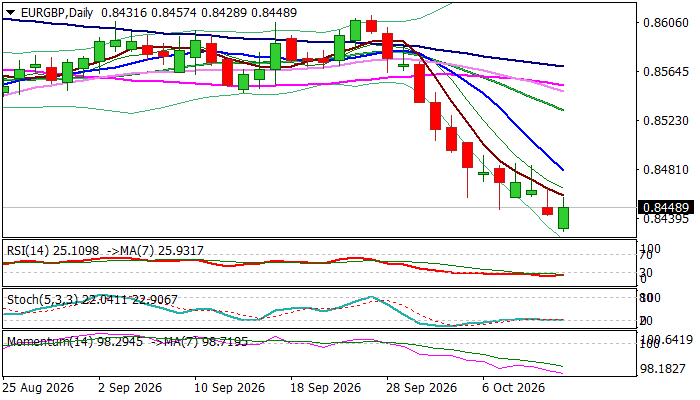
EURGBP bounced from new multi-month low (the lowest since 5 June 2025) on Tuesday, as US dollar and crude oil eased, while German inflation rose further in September, contributing to supportive factors.

Profit taking after steep and uninterrupted fall in past two weeks, was also behind today’s move, as well as oversold daily RSI and stretched 14-d momentum (at the lowest since early May 2025).

Oversold conditions should provide significant support to recovery, but firmly bearish daily studies warn that correction is likely to be limited.

The notion is supported by the latest fiscal turbulence in France which seems to be just a top of the iceberg, as many other bloc members face similar problems and very painful measures required to ease pressure.

This contributes to fragile economic conditions, crisis with energy and wars in Ukraine and the Middle East, with all negative consequences to the EU that is expected to keep the Euro under pressure.

Recent break of Fibo support at 0.8467 (61.8% retracement of 0.8222/0.8865 advance opens way towards targets at 0.8373 (Fibo 76.4%) and 0.8355 (29 May 2025 low).

Falling 10DMA (0.8480) offers solid resistance, ahead of 0.8530 (20DMA / Aug 17 low).
                                                                                                                                                                    

Res: 0.8467; 0.8480; 0.8530; 0.8543

Sup: 0.8428; 0.8373; 0.8355; 0.8300
Author

Slobodan Drvenica

Slobodan Drvenica

Windsor Brokers

Industry veteran with over 22 years’ experience, Slobodan Drvenica joined Windsor Brokers in 1995 when he was an active trader for more than 10 years, managing the trading desk and own account departments.


More from Slobodan Drvenica
Share:

Editor's Picks

AUD/USD remains depressed near 0.6950 after RBA minutes

AUD/USD attracts follow-through selling during Tuesday’s Asian session, looking to extend the overnight rejection slide from 0.7000, or a two-week top, following the release of RBA meeting Minutes. The US Dollar retains a bullish undertone near its highest level since April 2025 as energy-driven inflation risks keep December Fed rate hike bets firmly on the table. Adding to this, geopolitical risks further underpin the safe-haven USD.

USD/JPY extends retreat below 158.50 as intervention risks loom

USD/JPY is dropping below 158.50 in the Asian session on Tuesday, snapping a two-day winning streak and pulling back from an over two-week top touched the previous day, despite Japan's soft PPI inflation print. Bulls turn cautious amid speculation that authorities will step in to prop up the Japanese Yen, which, in turn, weighs on the pair.

Gold: Bears struggle to breach below $4,150

Gold now gives away its initial gains and resumes its decline, revisiting the $4,160 region per troy ounce on Tuesday. The precious metal’s pullback comes despite the fresh downward trend in the Greenback in combination with a mixed performance of US Treasury yields across the board and easing tensions on the geopolitical front.

Bitcoin rebounds despite cautious sentiment

Bitcoin rebounds over 2%, trading above $83,500 on Tuesday, recovering the previous day’s losses. Persistent geopolitical tensions and mixed signals continue to weigh on risk appetite, keeping investors cautious despite BTC’s recovery.

US – Midterm update: Democratic lead holds three weeks before election

With three weeks until the US midterm election on 3 November, prediction markets are more or less unchanged. Polymarket continues to put the probability of a Democratic sweep at 60-65%. The House is seen as a fairly safe Democratic win, with a probability of around 90%.

Has Bitcoin really escaped the macro forces it was built to fight?
Over 17 years ago, Satoshi Nakamoto designed Bitcoin (BTC) on the back of a global financial crisis as an alternative to the global monetary system outside the control of central banks, governments and traditional intermediaries. This raises a key question: has Bitcoin really become independent of the macroeconomic forces it was built to challenge?















