Singapore GDP Accelerates in Q3

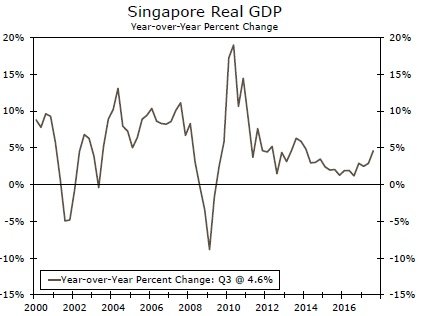
Real GDP growth in Singapore was 4.6 percent year-over-year in Q3, the fastest pace of economic growth since Q1-2014. Strengthening global growth has continued to benefit Singapore's open economy.
Singapore Kicks Off Q3 Growth Readings with a Bang
Data released this morning showed Singapore's economy grew at a 6.3 percent annualized rate on a sequential basis in Q3, well above the consensus expectation. Real GDP growth in the Lion City is inherently volatile on a sequential basis, so we tend to focus on the year-over-year rate. Over the past 12-months, economic growth in Singapore was 4.6 percent, a marked pick-up in growth relative to the pace that has prevailed over the past few years (top chart).
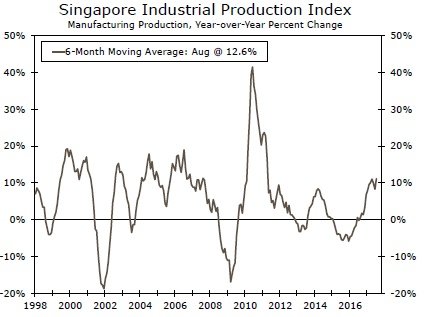
Singapore's relatively small open economy and early GDP release can lead to volatile quarterly prints for economic growth. In Q3, a 23.1 percent quarterly surge in manufacturing output drove the bulk of the gain in economic growth. Conversely, output in the construction sector remained depressed, declining at a 9.2 percent annualized rate over the quarter and 6.3 percent over the year. Output in the service sector saw a more tame 1.5 percent gain in the quarter, but production growth in this sector has steadily been gaining ground. After reaching an expansion low of 0.4 percent year-over-year growth in Q3-2016, services output has accelerated each quarter since, touching 2.6 percent in this morning's print. Although there may simply be some noise in the data on the manufacturing front, industrial production has clearly accelerated in Singapore (middle chart). The strength in the manufacturing sector is consistent with monthly data indicating that export growth was solid in the third quarter. Given Singapore's heavy reliance on trade, accelerating output is an encouraging sign from one of the global economy's bellwethers and corresponds with strengthening industrial production growth in both advanced and developing economies. Our forecast for real global GDP growth in 2017 is about half a percentage point higher than the rate achieved last year.
MAS Leaves Current Policy Unchanged but Shifts Policy Outlook
Because of the open nature of Singapore's economy, along with the importance of trade, the Monetary Authority of Singapore (MAS) is primarily concerned with the nation's exchange rate. In a policy statement released this morning, the MAS signaled that the bands around the Singapore dollar's effective exchange rate would remain flat, although the central bank dropped language saying that this neutral stance would be appropriate "for an extended period of time." With economic growth and trade strengthening both at home and abroad, the MAS appears open to allowing the currency to appreciate at some point in the near future. Against the U.S. dollar, the Sing dollar has appreciated modestly in 2017 (bottom chart). Our currency strategy team looks for the U.S. dollar to continue to depreciate gradually versus the Sing dollar over the mediumterm amid broad-based weakness in the greenback.

Author
Wells Fargo Research Team
Wells Fargo

















