Silver rose 11% as inflation cooled
The number that has weighed most on silver this year was set at a US government bond auction in late July, the first since 2008 to pay this much above inflation.
Silver pays you nothing to hold it. So, the question sitting underneath its price is always what you give up by owning it instead of something safe, and in July that alternative got about as attractive as it has been in eighteen years. Then it started reversing. In the ten days since, a weak jobs report and a second consecutive month of cooling inflation have cut the odds of a rate rise sharply, and silver has gained 11%. The metal did not rally because inflation frightened anyone. It rallied because inflation stopped frightening the Federal Reserve.
Silver trades near $65.32 an ounce as I write, with gold around $4,379 and the gold-silver ratio at 67.0, down from 69.1 when this issue went out on August 5. Silver is up more than 70% year over year, still about 8% lower on the year and roughly 46% below the January high. The ratio matters as much as the price here: it means silver has outpaced gold through the move, which is the pattern you would expect if falling rate expectations are doing the work. Tracing that chain from a bond auction to a silver price is the sort of work I do at Golden Meadow®.
The most hawkish meeting of the cycle
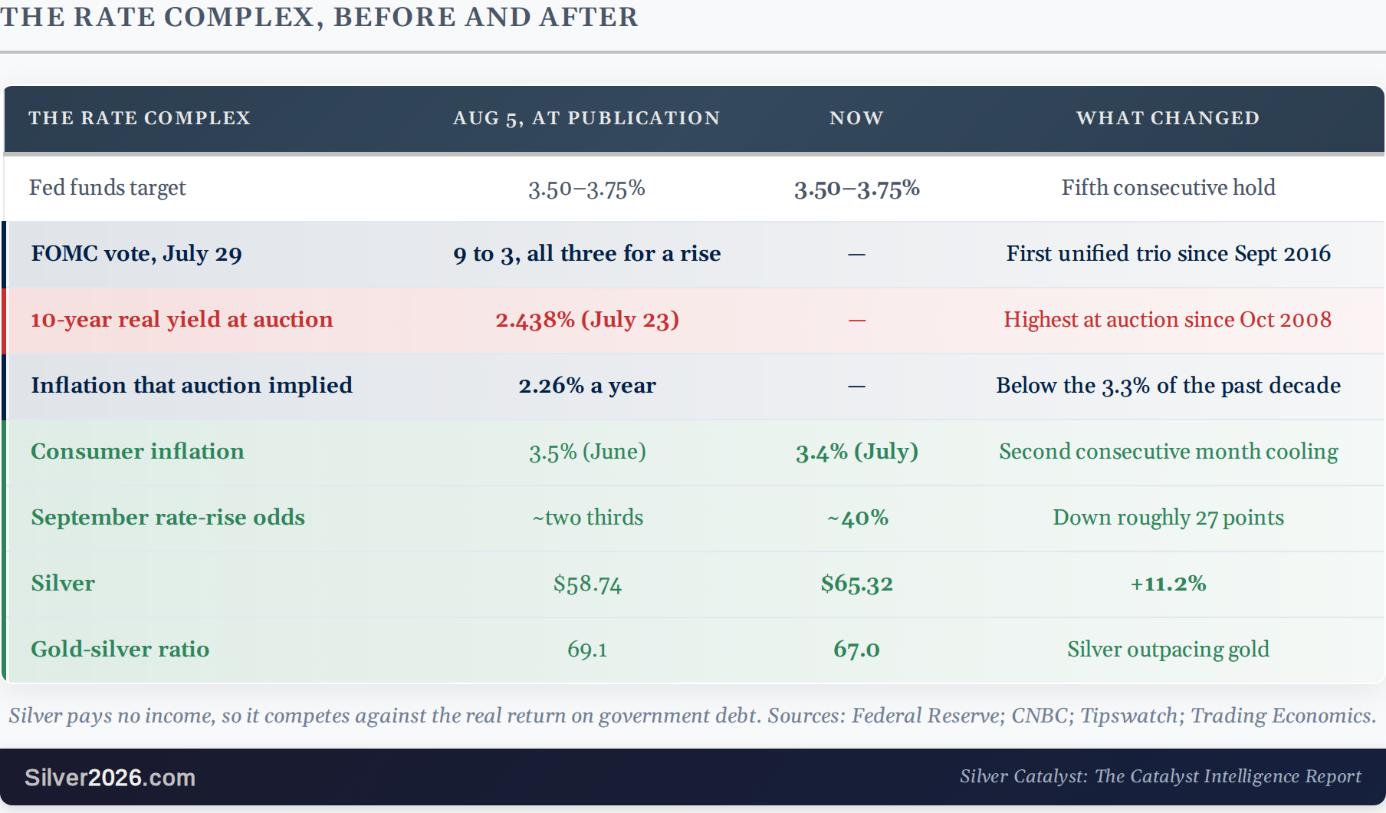
On July 29 the Federal Reserve held its target range at 3.50% to 3.75% for a fifth consecutive meeting, and the vote was the story. Beth Hammack of Cleveland, Neel Kashkari of Minneapolis and Lorie Logan of Dallas each dissented in favour of raising rates. Three policymakers had not pushed the same direction together since September 2016.
Chair Kevin Warsh has removed forward guidance from the Fed's communication entirely. Asked whether five years of inflation above target had created a softer unofficial goal, he told reporters there is only a target, and it is 2 percent.
Six days earlier, the bond market had already delivered the number that mattered more.
The auction
On July 23 the Treasury sold ten-year inflation-protected bonds at a real yield of 2.438%, the highest for that maturity at auction since October 2008. Demand was weak even at that level.
A real yield is what a bond pays you after inflation. These particular bonds adjust their payments to whatever inflation turns out to be, then add a fixed amount on top. So a buyer at that auction locked in inflation plus 2.44% a year, for ten years, with no storage cost and no price risk if the bond is held to maturity.
That is the bar silver has to clear to be worth owning, and it had not been that high since the financial crisis.
Here is the part most commentary got backwards. The same auction showed investors expecting inflation of only 2.26% a year over the coming decade, below what the last ten years actually delivered. So this was never a market bracing for runaway prices. It was a market demanding a much better real return simply to lend to the government at all, driven by war risk and by the sheer volume of borrowing coming from Washington and from the companies building artificial intelligence capacity. Long-dated yields reached a nineteen-year high in the days after the meeting.
The distinction is not academic. If the problem had been inflation expectations, then hotter inflation would have helped silver. Because the problem was real yields, hotter inflation would have made things worse by putting the Fed back in play.
What happened next
Cooler inflation is what actually arrived. The August 7 employment report came in weak. Then July consumer prices eased for a second consecutive month to 3.4%, rising just 0.1% from June. Markets now put the odds of a September rate rise at roughly 40%, down from about 50% the day before the inflation print and from around two thirds in early August.
Lower rate expectations, lower yields, a softer dollar. Silver went from $58.74 to $65.32 and reached its highest level since June.
Sources: Federal Reserve: FOMC Statement, July 29, 2026 | CNBC: Divided Fed Holds Rates Steady | Tipswatch: 10-Year TIPS Auction Gets Real Yield of 2.438% | Trading Economics: Silver | CNBC: Where Gold Is Headed as Rate Hike Odds Change Direction
What this Means to Silver investors
Is this good for silver? In the near term, yes, and for a reason worth understanding rather than celebrating.
Nothing about silver's supply or demand improved over these two weeks. Metals Focus and the Silver Institute still forecast a market shortfall of 46.3 million ounces for 2026, running into the sixth consecutive year of deficit. Mine supply is still expected to come in essentially flat. What changed is the alternative. When the safe return on offer falls, the cost of holding an asset that pays no income falls with it, and silver becomes easier to own. That is the whole mechanism, and it works in reverse just as reliably.
Which leads to the second point, and it is a caution. This rally rests on rate expectations, not on the metal. Two data releases moved it, and two more could move it back. Producer price data lands today, September remains genuinely live at 40%, and three voting members of the committee were arguing for higher rates a fortnight ago. A hot inflation print would put the hurdle straight back where it was.
The third point is the one to carry longest. If you own silver partly as protection against inflation, this fortnight is a useful correction to that instinct. Silver did not rise when inflation was the fear. It rose when the fear receded. The number to watch is the real yield rather than the inflation headline, because inflation only reaches the silver price through what the Federal Reserve does about it. I track that channel issue by issue in the Silver Catalyst. In 2026 that transmission has run against silver more often than for it, and the longer-term case rests on the supply and demand arithmetic underneath rather than on any single month of rate pricing.
One honest complication. The Strait of Hormuz negotiations that helped pull oil down in early August have stalled, with both sides hardening their positions. Elevated energy prices feed back into inflation, which feeds back into the Fed. The chain that has just worked in silver's favour is the same chain that can turn around, and it runs through a shipping lane rather than through a mine.
Want free follow-ups to the above article and details not available to 99%+ investors? Sign up to our free newsletter today!
Author

Przemyslaw Radomski, CFA
Gold Price Forecast
Przemyslaw Radomski, CFA (PR) is a precious metals investor and analyst who takes advantage of the emotionality on the markets, and invites you to do the same. His company, Sunshine Profits, publishes analytical software that any