Short vs long positions: What should traders do about the JPY?


Yesterday, the Japanese Yen (JPY) saw a substantial drop, hitting its lowest level against the US Dollar (USD) in almost four decades, surpassing the 160.85 mark. This recent decline brings back memories of October 2022, when the JPY also sharply declined, reaching a 34-year low of approximately 152 per USD.
As a result of that depreciation, Japan's Ministry of Finance took immediate action – marking the country's first currency intervention in more than a year. Throughout 2022, the Ministry stepped in on three occasions to stabilise the JPY, spending a significant combined total of 9.2 trillion yen in the process.
According to a recent statement from the Ministry of Finance, Japan once again intervened in the currency market between April 26th and May 29th of this year. During this period, a significant amount of 9.7885 trillion yen (approximately $62.25 billion) was spent to support the JPY.
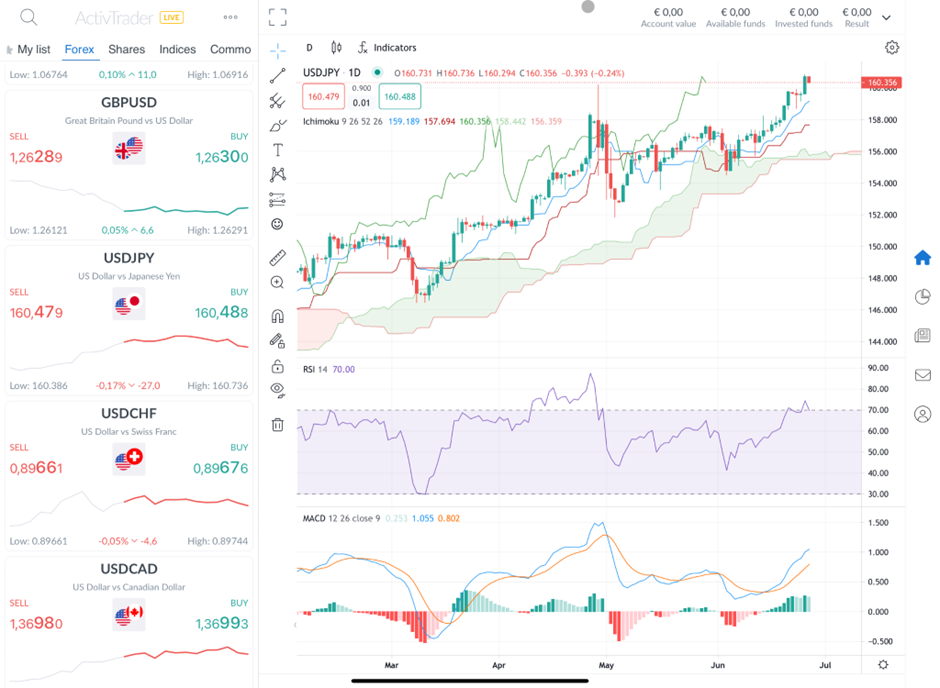
Daily USD/JPY Chart - Source: ActivTrades
What are the potential reasons behind the USD/JPY rise?
The recent decline of the Japanese Yen (JPY) could be a surprise when compared to how the Yen should have reacted to recent changes in Japan’s monetary policy. In March 2024, the Bank of Japan (BOJ) ended its long-standing policy of negative interest rates, a strategy implemented in 2016. Theoretically, this shift should have strengthened the Yen. However, the opposite has occurred, with the Yen reaching multi-year lows against major currencies like the US Dollar.
One of the main reasons is the diverging monetary policies across the globe. While Japan grapples with deflation and sluggish growth, other major economies such as the US have to deal with the challenge of rising inflation. This has led central banks, such as the US Federal Reserve, to adopt a more cautious approach by increasing interest rates in order to address inflation. Given the divergent monetary policies, the US Dollar becomes a more appealing investment option in comparison to the Yen, as investors pursue greater returns.
In addition, traders are taking into account the Federal Reserve's more cautious approach, indicating a reduced likelihood of interest rate cuts in 2024 compared to their previous forecast in December (1 vs 3). This has resulted in a stronger US Dollar, which has diminished the appeal of the Yen in comparison. Recent statements from Federal Reserve officials, such as Michelle Bowman earlier this week, who advocates for maintaining interest rates to combat inflation, have bolstered the Dollar's standing in the last few days.
However, the depreciation of the JPY poses a significant challenge for Japanese households and businesses. Imported goods may experience price increases, potentially leading to inflation and a rise in the overall cost of living. These factors may potentially impact the government's decision to intervene and stabilise the currency.
Volatile Yen: Japan's intervention on the horizon?
Despite the JPY's continuous decline, worries about possible currency intervention by Japanese authorities have not deterred traders from betting against the currency. This comes despite recent warnings from officials that they would take action in response to significant fluctuations in the currency market.
Vice Finance Minister Masato Kanda expressed his deep concern regarding the recent significant depreciation of the yen. He emphasised the government's vigilant observation of market trends and the urgency to address the situation. In addition, he mentioned that they will respond accordingly to any excessive movements. However, no progress has been made thus far.
As mentioned earlier, Japan took decisive action a few months ago to protect the Yen when the USD/JPY exchange rate surpassed the significant level of 160, aiming to stabilise the currency. This action demonstrated Japan's readiness to take decisive measures in order to avoid a sudden devaluation of the Yen.
Nevertheless, as the USD/JPY pair exceeds the 160 mark once more, concerns arise regarding the possibility of intervention occurring again. Market participants are closely monitoring any further announcements from Japanese officials and the Minister of Finance's actions with great attention. The lack of response from the government regarding their stance on current market movements only adds to the speculation.
The Japanese government must carefully navigate a complex situation. On one hand, they aim to uphold a stable and competitive Yen to support their export-driven economy. However, it is important to avoid excessive depreciation that could worsen inflation and negatively impact domestic consumers.
Although the JPY's decline may appear enticing for short sellers, it is important to take into account the significant risks at play. Japan's past actions in defending the Yen indicate a willingness to take decisive measures if necessary. If there were to be a government intervention, it could lead to a sudden change in the value of the Yen, which could result in substantial losses for short sellers who are unprepared.
It is unclear whether Japan will intervene in the currency market this time, but it is highly probable if the Yen continues to weaken and be volatile. The recent statements from officials and their previous actions suggest a firm commitment to protect the Yen.
Stay up to date with what's moving and shaking on the world's markets and never miss another important headline again! Check ActivTrades daily news and analyses here.
Author
Carolane de Palmas
ActivTrades
Carolane graduated with a Masters in Corporate Finance & Financial Markets and got the AMF Certification (Financial Markets Regulator in France). Afterward, she became an independent trader, investing mostly in European and American stocks/indices.