Risk aversion takes hold as China tensions weigh on sentiment
-
Growth fears resurface.
-
China and US both up their rhetoric.
-
Where does the trade war go next?
-
Commodities take a hit.
-
Bond yields rise as risk aversion takes hold, and Gilts lead the way.
-
UK rate cut hopes for 2026 grow after data.
-
Can US bank earnings boost sentiment?
-
Key level to watch for in the S&P 500.


There is a whiff of risk aversion about financial markets today, and as we progress through October it is as if the global stock market uptrend is facing a little more resistance on the upside.
Growth fears resurface
After bouncing back on Monday, European stocks are sharply lower this morning. The Eurostoxx 50 index is down nearly 1%, led lower by industrials, financials and tech. The FTSE 100 is getting hit with a sell off in the material sector, financials and the energy sector are also lower. This suggests that investors in European stocks are concerned about economic growth, and that is hindering a resumption in the stock market uptrend.
China and US both up their rhetoric
The fears about growth stem from comments from the US Treasury Secretary, Scott Bessant, who accused China of trying to hurt the world’s economy by imposing export restrictions on rare earth minerals. He said this was a sign of Chinese economic weakness, and that their actions will slow down the world’s economy. China has also hit back at the US and threatened further retaliatory measures against the world’s largest economy.
Where does the trade war go next?
President Trump is expected to meet President Xi in two weeks’ time in South Korea, and we expect the rhetoric could be ramped up ahead of this meeting, with both sides trying to gain leverage. This could trigger some volatility in risky assets in the coming days. However, investors may still hold out hope for a trade deal between China and the US, as it would ultimately be mutually beneficial for both sides, it could also unleash a mega Santa rally before the end of Q4.
Commodities take a hit
This has caused a broad sell off in energy prices. Brent crude is lower by more than 1.6%, this slide has caused it to drop below $63.00 per barrel. Heating oil and natural gas have also slumped this morning, and iron ore is down 1.3% as global growth concerns mix with concerns about a Chinese supply glut of the core ingredient for steel.
Bond yields rise as risk aversion takes hold, and Gilts lead the way
The drop in equities and commodities this morning is a clear sign of risk aversion, money is instead moving into sovereign bonds, and global government bond yields are lower across the board. The UK’s Gilt yields are falling at the fastest rate, and the 10-year yield is lower by 5bps, after the latest UK jobs data painted a mixed picture of the UK’s labour market. Job vacancies were lower, the unemployment rate edged higher to 4.8%, 10,000 jobs were lost in September, but this was balanced out by an upwardly revised 10,000 job increases in August. The ONS said that there were signs of stabilization in the labour market data with the number of job losses now levelling off. Wage growth moderated slightly excluding bonuses, and the BRC’s like-for-like retail sales was 2%, below expectations for a reading of 2.5%.
UK rate cut hopes for 2026 grow after data
The economic data suggests two things: 1, that the UK’s labour market continues to soften, and the unemployment rate is creeping up, and 2, that retail sales could also come under pressure down the line. This has led to a small recalibration of UK interest rate cuts, the market now expects more than one cut by March 2026, and there has been a 3bp drop in where the market expects 2025 UK interest rates to end the year at 3.86%.
Overall, we expect the Bank of England to remain concerned about rate cuts when wage growth remains well above 4%, which could limit the downside for UK Gilt yields.
Can US bank earnings boost sentiment?
Ahead today, the focus will be on earnings data and US stocks. US banks will report earnings later today. As we have mentioned, in the absence of economic data from the US, this will be a good read on the health of the US economy. Due to this, a strong set of bank earnings have the potential to turn around market sentiment later today.
Key level to watch for in the S&P 500
However, if US stocks do sell off later today, the focus could be on the S&P 500’s 50-day moving average at 6,538. This level led as strong support after Friday’s sell off, and the US index has not been below the 50-day moving average since April. Thus, if any sell off pushed the US index below this level, it would be a bearish development that could signal the end of short term upward momentum.
S&P 500, with simple moving averages
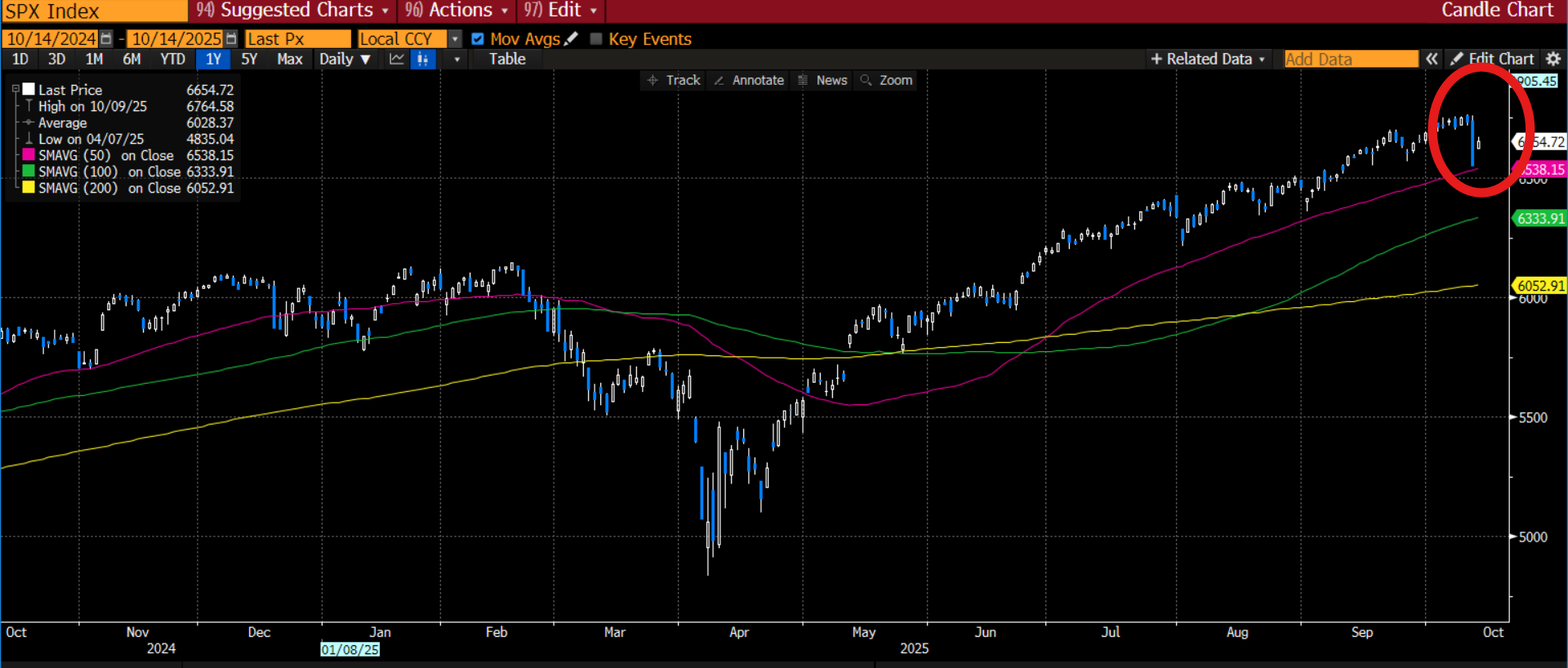
Source: XTB and Bloomberg
Author
Kathleen Brooks
XTB UK
Kathleen has nearly 15 years’ experience working with some of the leading retail trading and investment companies in the City of London.