RBA surprises with a 25 bp hike

Overview: The large bourses in Asia Pacific except Hong Kong eased. Japan and China's mainland markets are closed for the holiday. Europe's Stoxx 600 is up about 0.6%. It gapped lower yesterday and has not entered the gap today. US futures are a little softer. The 10-year Treasury nicked the 3%-mark yesterday and is just below there now. European benchmark yields are mostly 1-3 bp higher, but the UK Gilt yield has jumped eight basis points, and Australia’s surged 13 bp after the RBA delivered a larger than expected hike. The Australian dollar is the strongest of the majors, it is up about 0.70% near midday in Europe. The Norwegian krone and New Zealand dollar are slightly heavier. The other major currencies are a little firmer. Outside of the South African rand and Mexican peso on the upside, the Thai baht and South Korean won on the downside, most emerging market currencies are little changed. Gold, which two and a half weeks ago was testing $2000, found support near $1850 today. June WTI is quiet in a roughly $103.50-$106 range. US natgas is higher for a third session. It is up about 4.3% after rising 3.2% yesterday. Europe's natgas benchmark is steady after gaining 3.1% last week. Iron ore is off 1.5% while copper is about 1.3% higher after falling 3.2% yesterday. July wheat is edging higher after falling for the past four sessions.
Asia Pacific
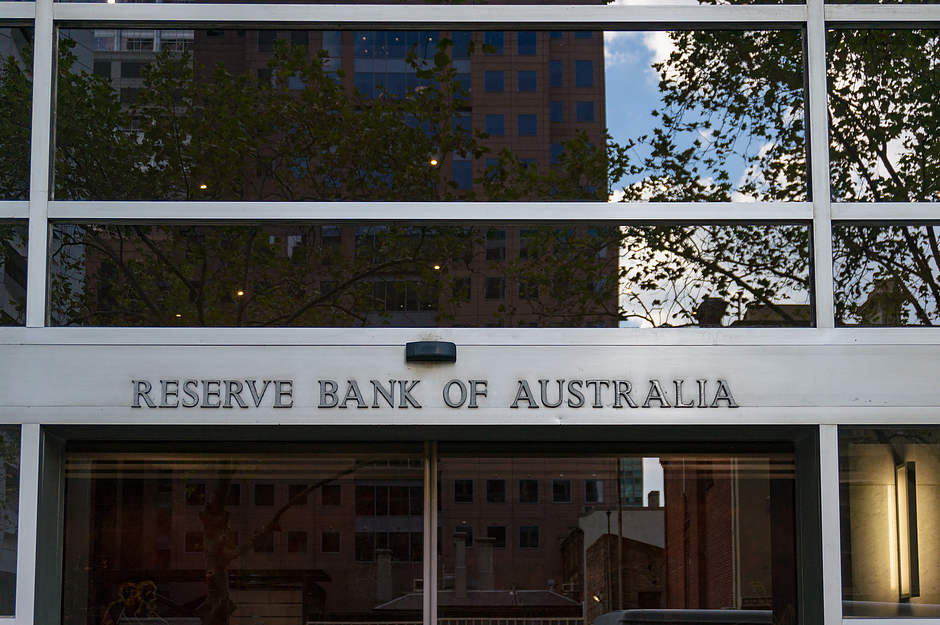
The Reserve Bank of Australia surprised the market by delivering a larger than expected 25 bp rate hike to kick-off the tightening cycle to 0.35%. The market had been leaning toward a 15 bp hike. The central bank clearly signaled more rate hikes will be forthcoming and updated its forecasts to show inflation hitting 6% this year from 5.1% in Q1. It projects inflation falling back to 3% by mid-2024. This year's growth is put at 4.25% and 2% next year. A recent Bloomberg survey found the median forecast for this year's GDP was 4.4% and 2.8% for 2023. The RBA also announced it would stop reinvesting maturing proceeds of its roughly A$650 bln balance sheet. It reportedly has few bonds maturing next year. Still, the market is pricing in an aggressive tightening cycle and sees the year-end cash rate at 2.80%, rather than 2.60% discounted yesterday.
With Japanese markets closed for holiday, the dollar has traded quietly against the yen. It has been confined to a JPY129.85-JPY130.30 range. It is inside yesterday's range, which was inside the pre-weekend range and remains within last Thursday's range: ~JPY128.35-JPY131.25. The consolidative phase may help ease Japanese angst about the pace of the move. Still, the price action is often associated with a continuation pattern, like a spring coiling. Australian interest rates jumped on the surprise RBA move and the Australian dollar jumped to almost $0.7150. It set a low yesterday near $0.7030. The Aussie stalled and a break of $0.7080 now could spur a return to the $0.7030-$0.7050 area. A move above $0.7200 is needed to improve the technical tone. The US dollar edged higher against the offshore yuan, reaching a new high near CNH6.6980. Recall it settled near CNY6.4040 at the end of last week.
Europe
The UK's April manufacturing PMI was revised to 55.8 from a preliminary reading of 55.3. It stood at 55.2 in March. However, it was at 57.9 at the end of last year. The Bank of England meets Thursday and the odds of a 50 bp move instead of 25 bp stands are less than 1-in-5, according to the swaps market. That said, over the next four meetings through mid-September, the market has 125 bp of tightening discounted. This implies that the market is pricing in a 50 bp.
Italy's Draghi has endorsed a new spending package of 16 bln euros to help families and businesses cope with rising food and energy prices. It will include a cash payment, energy subsidies, tax credits, and more funds for local governments. If it sounds familiar, it is because a similar plan was unveiled in February (~6 bln euros). The earlier plan was going to be funded by a 10% windfall tax on energy companies’ profits. It was expected to raise 4.4 bln euros. The new plan is funded by hikes that raise the tax rate to 25% and is projected to raise closer to 10 bln euros. Recall that GDP contracted by 0.2% in Q1.
The eurozone reported a larger than expected jump in March producer prices. The 5.3% month-over-month surge lifts the year-over-year rate to 36.8% from 31.5%. Separately, the March unemployment rate stood at 6.8% after the February series was revised to 6.9% (from 6.8%). In March 2021, the eurozone unemployment rate was an 8.2% and before the pandemic struck, it was at 7.5%.
The euro is pinned near its recent lows. For the fourth consecutive session, it is straddling the $1.05 level. For the third day, it has found some support near $1.0490. Last week's low was near $1.0470. There is little enthusiasm for the euro ahead of the outcome of the FOMC meeting tomorrow. Note too that the upside looks blocked by chunky options struck at $1.06 that expire over tomorrow and Thursday (1.9 bln euros and 1.5 bln euros, respectively). The next area of potential chart support is the low from last 2016 near $1.0340. Sterling also remains in its recent trough. It is trading inside yesterday’s range, which was inside the range set at the of last week, approximately, $1.2450-$1.2615. Initial support now is seen near $1.25.
America
The US reports March factory orders and the final durable goods report and the JOLTS report. Given that Q1 GDP was reported last week, and these data points will not impact expectations for revisions or tomorrow's Fed announcement, no important market reaction is likely. Arguably, the most important data today will be the April auto sales figures. Although they trickle in and the market typically does not react to them, auto sales feed into consumption and retail sales. They will likely be apart of the US economic resilience this year. The median forecast (Bloomberg survey) projects auto sales to increase to a 14.1 mln seasonally-adjust annual pace from 13.3 mln in March. It would be the first increase since January. Auto sales averaged 14.15 mln in Q1 and 12.76 mln in Q4 21. In Q1 21, they averaged nearly 16.7 mln.
Canada's April manufacturing PMI disappointed yesterday, slipping from 58.9 to a still robust 56.2. Still, it was really the March reading that stands out. Canada's manufacturing PMI has been with a 56-handle for four of the past five months back to last December. Today, the March trade figures are due. Canada is benefitting from a positive terms-of-trade shock. The 3-month average trade surplus has risen to C$1.43 bln. A year ago, it was practically zero. It is the highest three-month since 2014. A C$3.75 bln surplus is expected today, which would be the largest since 2008.
Mexico has a quiet economic calendar after yesterday's flurry. The manufacturing PMI held below the 50 boom/bust level at 49.3 (from 49.2 in March). However, the IMEF surveys have held in better. Separately, worker remittances into Mexico reached $4.68 bln, just shy of last October's record $4.82 bln. In March 2020, the stood at $4.16 bln.
The US dollar briefly traded above CAD1.29 yesterday and set a new high for the year near CAD1.2915. It pulled back initially but found support earlier today around CAD1.2835. The market looks like it wants to test the CAD1.29 area again. Today, there is a $585 mln option there that expires. The high from last December was closer to CAD1.2965 and that is the next key chart area. Last Thursday, the greenback surged to MXN20.6380 but has since largely held below MXN20.50. In fact, it has not closed above MXN20.50 since March 17. It seems to be in a consolidative phase with support near MXN20.35.
Author
Marc Chandler
Marc to Market
Experience Marc Chandler's first job out of school was with a newswire and he covered currency futures and Eurodollar and Tbill futures.