Gold ETF momentum continues with record-setting January


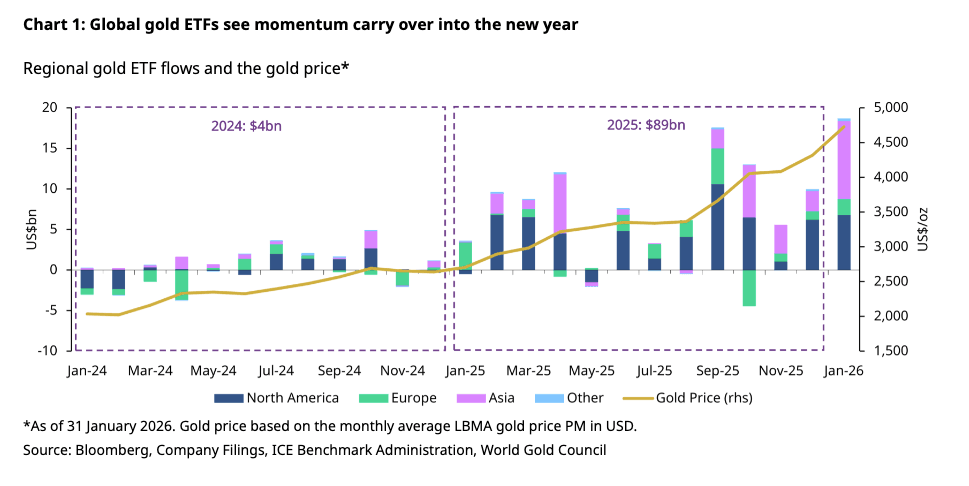
After rising to an all-time high of 4,025 tonnes in 2025, ETF gold holdings continued to climb in January, growing by another 120.1 tonnes.
In dollar terms, ETFs globally added $19 billion to their gold holdings. It was the strongest monthly gain on record.
The flow of new metal, coupled with a 14 percent price increase, pushed assets under management (AUM) by gold funds up 20 percent month-on-month to a record $669 billion.
It appears the recent sell-off failed to dampen investor interest in gold. According to the World Gold Council, “Even with the recent price decline, all regions except Europe saw net inflows on both 30 January and 2 February, as investors appeared to take advantage of the dip to add exposure to gold.”
Asian funds led the way, reporting their largest increase in gold holdings on record, adding 62 tonnes of metal valued at $10 billion.
Asia accounted for 51 percent of total global ETF inflows. This is especially notable given that Asian holdings are only about one-fifth the size of North America’s.
Chinese funds led Asian inflows, totaling around $6 billion. According to the World Gold Council, “Robust gold prices, lingering geopolitical uncertainty, and strong institutional demand all underpinned the country’s continued appetite for gold ETFs."
Indian funds also reported strong gold inflows totaling $2.5 billion.
North American funds charted their second-largest monthly gold inflow on record. ETFs based in North America expanded their gold holdings by 43.4 tonnes, valued at around $7 billion.
It was the eighth straight month of gold inflows into North American funds.
Despite the big price drop at the end of the month, coupled with heightened volatility, the region still reported net positive flows on the final trading day of January.
According to the World Gold Council, “Inflows benefited from both the price rally and rising geopolitical tensions involving the U.S. and regions such as Iran, Greenland, and parts of Europe, which helped sustain investor interest in gold.”
European ETFs added gold for the third straight month, boosting regional holdings by 12.9 tonnes, valued at $2 billion.
Geopolitical turmoil surrounding President Trump’s bid to acquire Greenland boosted safe haven demand in the region.
The UK led regional inflows as the country grapples with persistent price inflation.
Funds in other regions, including Australia and Africa, reported a 1.8-tonne increase in gold holdings.
ETFs are a convenient way for investors to play the gold market, but owning ETF shares is not the same as holding physical gold.
ETFs are relatively liquid. You can buy or sell an ETF with a couple of mouse clicks. You don’t have to worry about transporting or storing metal. In a nutshell, it allows investors to play the gold market without buying full ounces of metal at the spot price.
Since you are just buying a number in a computer, you can easily trade your ETF shares for another stock or cash whenever you want, even multiple times on the same day. Many speculative investors take advantage of this liquidity.
But while a gold ETF is a convenient way to play the price of gold on the market, you don’t actually possess any gold. You have paper. And you don’t know for sure that the fund has all the gold either, especially when the fund sees inflows. In such a scenario, there have been difficulties or delays in obtaining physical metal.
Gold trading volumes
Global market trading volumes surged to $623 billion per day in January, a 52 percent month-on-month increase. The rise in trading volume was primarily during the last week of the month.
Over-the-counter (OTC) activity also strengthened last month, with volumes rising to $280 billion per day, a 29 percent month-on-month increase. Increased LBMA trading boosted overall OTC activity.
Meanwhile, rising price volatility supported a sharp pick-up in derivatives trading across major exchanges, with volumes climbing to $320 billion per day, a 73 percent m/m rise.
COMEX net longs fell 6 percent during the month to 642 tonnes. According to the World Gold Council, the decline does not capture the final days of elevated volatility. Money manager net longs slipped 4 percent to 378 tonnes, while Other net longs declined 8 percent to 264 tonnes. According to the WGC, “This likely reflects profit‑taking after steady net‑long buildup earlier this month."
To receive free commentary and analysis on the gold and silver markets, click here to be added to the Money Metals news service.
Author
Mike Maharrey
Money Metals Exchange
Mike Maharrey is a journalist and market analyst for MoneyMetals.com with over a decade of experience in precious metals. He holds a BS in accounting from the University of Kentucky and a BA in journalism from the University of South Florida.