Rate differential powers the AUD towards three-year high against the USD

The Australian Dollar (AUD) has started 2026 on a strong footing, pushing the AUD/USD pair toward levels not seen since January 2023. The move accelerated after the Reserve Bank of Australia (RBA) raised its key interest rate on January 3, its first hike since 2023. In the two days following the decision, the AUD/USD Forex pair gained more than 1.20%, reflecting a rapid repricing of interest rate expectations. At the heart of this rally: a widening divergence between the monetary policy paths of the RBA and the US Federal Reserve (Fed), a dynamic that is likely to keep shaping the currency pair trajectory in 2026.
The RBA’s hawkish turn: Why Australia is raising rates again
The RBA’s decision to lift its cash rate by 25 basis points to 3.85% in February 2026 marked a clear shift in tone.
Australian policymakers acknowledged that inflation pressures remain stronger and more persistent than previously anticipated. Underlying inflation, the RBA’s preferred measure, rose by 0.9% in the fourth quarter of 2025, pushing the annual rate to 3.4%, its highest level in more than a year, according to the Australian Bureau of Statistics. Inflation has now surprised to the upside for two consecutive quarters and remains well above the central bank’s 2% to 3% target range.
At the same time, the Australian economy is showing signs of capacity strain rather than cooling. The unemployment rate unexpectedly fell to 4.1% in December, a seven-month low, suggesting the labour market may be tightening again. Household spending, private investment and housing prices have all remained robust, while credit conditions appear looser than the RBA previously assumed.
In its post-meeting statement, the central bank openly questioned whether financial conditions are restrictive at all, an unusually candid admission that reinforced expectations of further tightening.
Markets have responded quickly.
Interest rate futures now imply around a 75% probability of another 25-basis-point hike as early as May 2026, with some economists arguing that the total adjustment this year could reach 50 basis points. The RBA now stands alongside the Bank of Japan as one of the only major developed-market central banks actively tightening policy, while most others are either on hold or leaning toward easing. This relative stance has become a key pillar supporting the Australian Dollar.
The Fed’s dilemma: Pauses, cuts, and data disruptions
The picture in the United States looks very different.
The Federal Reserve held its policy rate steady in a range between 3.50% and 3.75% at its January 2026 meeting, following a series of rate cuts delivered through 2025. While the Fed acknowledged that economic activity remains solid and inflation “somewhat elevated,” it also removed language suggesting that labour market risks outweigh inflation risks. This change signaled a more balanced assessment of its dual mandate and pointed to a pause rather than an imminent shift in policy.
Despite the pause, markets continue to expect one or two US rate cuts later in 2026, according to pricing tracked by major data providers such as CME FedWatch. The timing is uncertain, but the bias contrasts sharply with expectations for higher rates in Australia. This divergence has widened the expected interest rate differential in favour of the Australian dollar, making AUD-denominated assets more attractive to global investors seeking yield.
Uncertainty around US economic data has added another layer of pressure on the U.S. Dollar (USD). For the second time in five months, operations at the Bureau of Labor Statistics have been disrupted by a partial government shutdown, delaying the release of the January non-farm payrolls report that were supposed to be published this Firday 6th. While data collection has been completed, the agency has been unable to process and publish the figures.
Previous shutdowns in 2025 already caused lasting gaps in inflation and employment data. For the Federal Reserve and analysts, these data gaps removed the "navigation lights" required for precision adjustments to interest rates. Consequently, policy decisions have become more reactive and reliant on private-sector estimates. According to UBS, such data can help fill the gap temporarily but cannot fully replace comprehensive government statistics. This lack of visibility complicates the Fed’s outlook and tends to weigh on the USD by increasing uncertainty around future policy decisions.
Political developments at the Fed are also being closely watched.
President Donald Trump has announced his intention to nominate former Fed governor Kevin Warsh to succeed Jerome Powell when his term ends on May 15, 2026. Trump has repeatedly voiced his preference for lower interest rates, and the transition period could prove volatile if markets perceive growing political pressure on the central bank.
Trading the widening rate gap: Where is the AUD/USD heading?
For the AUD/USD, these forces combine into a classic rate-differential trade.
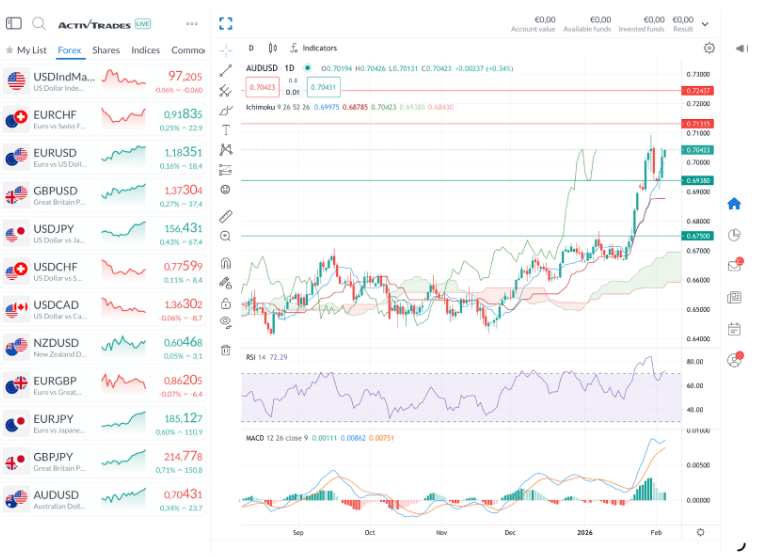
If the RBA delivers one or two additional hikes in 2026 while the Fed eventually cuts, the policy gap could widen by up to one percentage point in Australia’s favour. That scenario would likely continue to attract capital flows into the Australian Dollar. Technically, the pair is now approaching resistance levels last seen three years ago, and a sustained break above its January 2023 highs (above 0.71) would reinforce the bullish narrative.
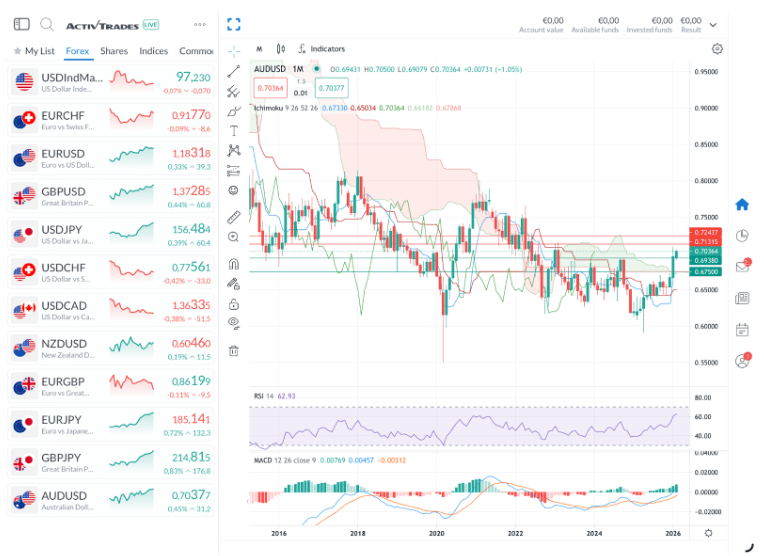
On the monthly chart, the AUD/USD has now advanced for three consecutive months, with last month's price action pushing the pair decisively above the Ichimoku cloud. The breakout was accompanied by strong bullish momentum and represents a key technical milestone that traders typically interpret as confirmation of an emerging uptrend: a significant shift toward sustained upside potential here.
The next phase for the AUD/USD will depend on a handful of key catalysts. Australian inflation data will be critical in determining whether the RBA follows through with further
tightening. In the US, the eventual release of delayed labour market and inflation figures could trigger sharp volatility, particularly if they alter expectations for Fed rate cuts. Until then, the balance of risks appears tilted toward continued Australian dollar strength.
Stay up to date with what's moving and shaking on the world's markets and never miss another important headline again! Check ActivTrades daily news and analyses here.
Author
Carolane de Palmas
ActivTrades
Carolane graduated with a Masters in Corporate Finance & Financial Markets and got the AMF Certification (Financial Markets Regulator in France). Afterward, she became an independent trader, investing mostly in European and American stocks/indices.