|

Productivity: Through the ups and downs, firm trend
Summary

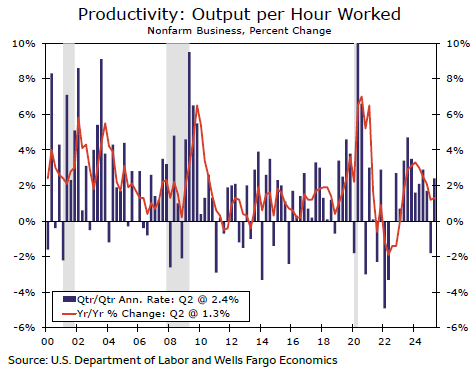
Output per hour worked increased at a 2.4% annualized rate in Q2, bouncing back from the prior quarter's decline and helping to keep the underlying trend in nonfarm labor productivity growth solid. Unit labor costs rose at a 1.6% annualized rate and the four-quarter moving average is up 2.2% over the past year. As such, the still solid pace of nominal compensation growth remains unlikely to be the force that keeps inflation meaningfully above the Fed's 2% inflation target.
Chart

Q2 productivity rebound keeps unit labor costs friendly for inflation

Amid lingering concerns about inflation and more recent worries of economic activity wobbling, the firm trend in labor productivity is a welcome bright spot. Output per hour worked increased at a 2.4% annualized rate in the second quarter, bouncing back from the prior quarter's decline (chart). The rebound was underpinned by a sharp recovery in output growth (+3.7% annualized) that outpaced a 1.3% annualized gain in hours worked. While a solid outturn, output has been more volatile than usual due to massive swings in trade flows, which has distorted readings of productivity recently.

Smoothing with a four-quarter moving average, nonfarm labor productivity is up 1.8% year-over-year (chart). This pace matches its average annualized increase since the end of 2019 and is notably stronger than the past cycle's average of 1.5%. With workers more productive, firms have generally enjoyed increased profitability and employees have seen real earnings growth. Solid productivity growth also provides firms the flexibility to absorb higher costs of production without needing to mark up their selling prices to the same degree, which could help to counterbalance the inflationary impulse from tariff-related price pressures today.

Download The Full Economic Indicator

Author

More from Wells Fargo Research Team
Share:

Markets move fast. We move first.

Orange Juice Newsletter brings you expert driven insights - not headlines. Every day on your inbox.

By subscribing you agree to our Terms and conditions.

Editor's Picks

EUR/USD moves sideways below 1.1800 on Christmas Eve

EUR/USD struggles to find direction and trades in a narrow channel below 1.1800 after posting gains for two consecutive days. Bond and stock markets in the US will open at the usual time and close early on Christmas Eve, allowing the trading action to remain subdued. 

GBP/USD keeps range around 1.3500 amid quiet markets

GBP/USD keeps its range trade intact at around 1.3500 on Wednesday. The Pound Sterling holds the upper hand over the US Dollar amid pre-Christmas light trading as traders move to the sidelines heading into the holiday season. 

Gold retreats from record highs, trades below $4,500

Gold retreats after setting a new record-high above $4,520 earlier in the day and trades in a tight range below $4,500 as trading volumes thin out ahead of the Christmas break. The US Dollar selling bias remains unabated on the back of dovish Fed expectations, which continues to act as a tailwind for the bullion amid persistent geopolitical risks.

Bitcoin slips below $87,000 as ETF outflows intensify, whale participation declines

Bitcoin price continues to trade around $86,770 on Wednesday, after failing to break above the $90,000 resistance. US-listed spot ETFs record an outflow of $188.64 million on Tuesday, marking the fourth consecutive day of withdrawals.

Economic outlook 2026-2027 in advanced countries: Solidity test

After a year marked by global economic resilience and ending on a note of optimism, 2026 looks promising and could be a year of solid economic performance. In our baseline scenario, we expect most of the supportive factors at work in 2025 to continue to play a role in 2026.

Avalanche struggles near $12 as Grayscale files updated form for ETF

Avalanche trades close to $12 by press time on Wednesday, extending the nearly 2% drop from the previous day. Grayscale filed an updated form to convert its Avalanche-focused Trust into an ETF with the US Securities and Exchange Commission.