Precious metals outlook: How will 2025’s second half compare to the first?
Gold and silver prices outperformed nearly every asset class in the first half of the year. Geopolitical uncertainty, a weaker U.S. dollar, the threat of tariffs, central bank gold buying, and silver inventory scarcity all contributed to stellar performance.
Since mid-April, however, prices have been range-bound. The question is whether there is still some fuel in the tank to power a strong second half of the year.
Let’s take a look at some of the bullish factors as well as some of the risks, starting with gold.
Bullish Gold Factors:
- Ongoing geopolitical risks and potential trade disruptions from U.S. tariffs could sustain safe-haven demand. For example, the war in Ukraine is ongoing, with the potential to escalate. Likewise, plenty of uncertainty remains around tariffs. Last week, the markets were roiled by the announcement of a 50% tariff on imported copper, commencing in August.
- Central banks are expected to continue to stockpile gold. This, along with investment demand from institutional buyers around the world, suggests global demand will remain strong.
- Inflation remains persistent. The political pressure on Federal Reserve Chair Jerome Powell is mounting. Some speculate that Powell may not survive til the end of his term next year and will be replaced by someone ready to meet the president’s demand for lower interest rates.
- Gold is getting some buzz on Wall Street with major banks forecasting higher gold. Bank of America is anticipating $4,000 gold by early next year, while JPMorgan Chase has told clients to expect $3,675/oz by the 4th Quarter.
Bearish Gold Risks:
- A stronger U.S. dollar could pressure gold prices. So far this year, the U.S. dollar has had its worst performance in 52 years relative to other major currencies. Some say the sell-off in the dollar may be overdone.
- Bitcoin and U.S. stocks are also performing well, though gains in the S&P 500 are lagging those of gold. If the buzz currently surrounding gold shifts to other assets and institutional money decides to go fully risk-on, the gold market could encounter headwinds.
- Geopolitical uncertainty is always a big driver in gold markets. Developments such as a peace deal in Ukraine or trade deals which put an end to questions over tariff policy could put a damper on safe-haven buying.
Now let's take a look at silver...
Bullish Silver Factors:
- Silver buying, including demand from industrial users, is projected to remain strong.
- Supply is going to fall short of demand, once again in 2025. Exchange of Futures for Physical (EFP) premiums for deliverable bars in the COMEX began surging again last week. People are paying well above the published price to get immediate delivery of 1000-ounce bars.
- A 50% tariff on copper imported to the U.S. could hurt copper production in places like Mexico, Canada, and South America. That would mean less supply of silver, which is produced in large quantities as a byproduct of copper mining.
- Relative to gold, silver still has plenty of catching up to do. The gold/silver ratio ended last week at 87. This is way above the long-term average, which is closer to 50.
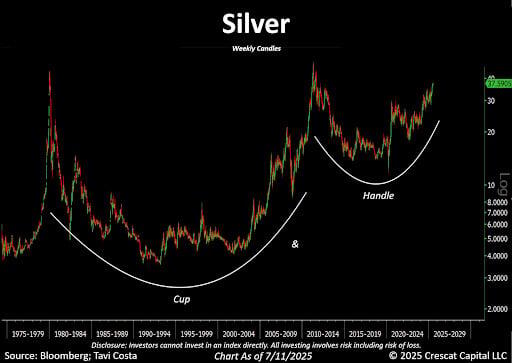
- The set-up for silver based on technical analysis is epic. Traders are looking at a cup and handle formation 45 years in the making;
- The potential for a short-squeeze is significant. As an example, it appears some traders sold hundreds of millions of ounces of paper COMEX silver on Thursday and Friday before a big rally higher. To the extent those trades are unhedged, they have a problem.
Bearish Silver Risks:
- A resolution on trade tariffs for copper could cap gains.
- A global economic downturn which hits manufacturing hard could reduce industrial demand for silver as well as catch silver in an initial wave of selling.
A Key Consideration for Both Metals:
Confidence in U.S. institutions remains on thin ice. The election of Trump last fall was a comfort to many. Conservatives, at least, felt Trump and DOGE would be able to control spending and clean up corruption.
That rise in confidence is now being tested. The Big Beautiful Bill included a $5 trillion raise in the debt ceiling. And the Trump Department of Justice just walked back a promise to release documents related to Jeffrey Epstein. Some Trump supporters aren’t happy with recent developments.
Much of the retail buying in gold and silver seems to come from people who skew a bit conservative, so their overall confidence level impacts U.S. retail bullion demand.
Gold and silver prices have risen thus far in 2025 without bullion investors doing any real heavy lifting. If this crowd loses confidence and jumps back into the markets, it will bolster demand from other sources.
To receive free commentary and analysis on the gold and silver markets, click here to be added to the Money Metals news service.
To receive free commentary and analysis on the gold and silver markets, click here to be added to the Money Metals news service.
Author

Clint Siegner
Money Metals Exchange
Clint Siegner is a Director at Money Metals Exchange, the national precious metals company named 2015 "Dealer of the Year" in the United States by an independent global ratings group.