Pound strengthens: Trade tariffs and economic data boost GBP/USD

The GBP/USD pair climbed to a two-week high on Thursday, holding near 1.3578, bolstered by improved global risk sentiment following the US-Japan trade agreement.
The deal, which replaces previously proposed 25% tariffs with a 15% levy, also includes the creation of a $550 billion investment fund to support the US economy. President Donald Trump hailed the agreement as mutually beneficial, further lifting market confidence.
Investors are now turning their attention to key UK economic indicators. PMI forecasts suggest the smallest contraction in manufacturing activity in six months, accompanied by the sharpest rise in services sector growth in nearly a year. Retail sales are also expected to rebound, aided by recent warm weather.
However, concerns linger after the UK reported a June budget deficit of £20.7 billion – the second-highest June figure since 1993. Rising inflation-linked bond repayments pushed debt servicing costs to £16.4 billion, adding pressure on public finances.
Amid these developments, speculation is mounting that Chancellor Rachel Reeves could announce tax increases as early as the autumn to address fiscal challenges.
Technical analysis: GBP/USD
H4 Chart:
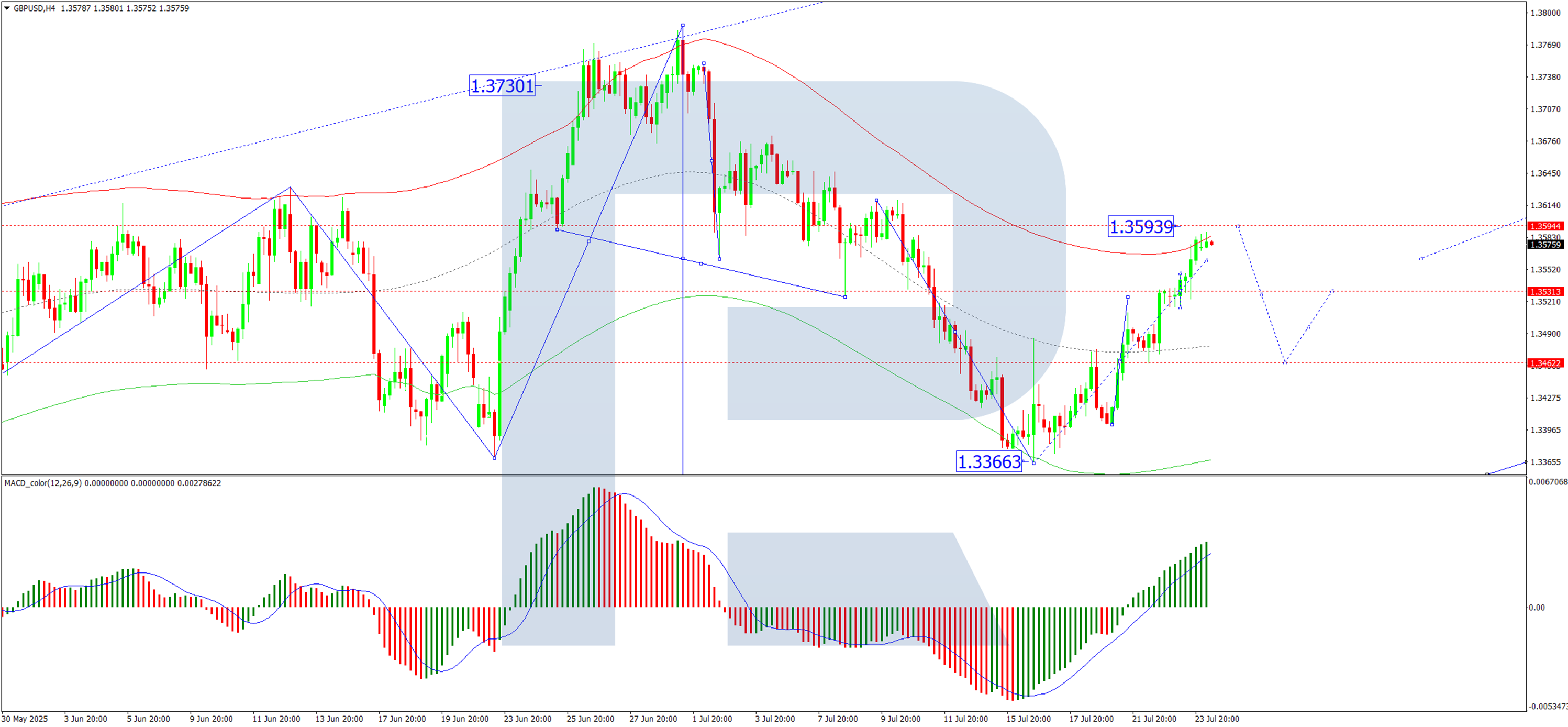
On the H4 chart, GBP/USD completed an upward wave to 1.3535, forming a consolidation range around this level. A breakout above this range could extend gains towards 1.3593. However, a subsequent correction downwards to 1.3530 remains possible. This scenario is supported by the MACD indicator, where the signal line sits above zero and is pointing firmly upward.
H1 Chart:

The H1 chart shows the pair finding support at 1.3462, with the current growth wave reaching its initial target of 1.3585. A short-term pullback to 1.3530 may occur before another upward move towards 1.3593. The Stochastic oscillator aligns with this outlook, as its signal line hovers below 5 and is trending downward towards 20.
Conclusion
The GBP/USD rally reflects an improvement in risk sentiment and anticipation of stronger UK economic data. However, fiscal concerns and technical indicators suggest potential volatility ahead. Traders should monitor PMI releases and fiscal policy announcements for further direction.
Author

RoboForex Analysis Department
RoboForex
RoboForex Analysis Department provides timely market insights, expert technical analysis, and actionable forecasts across forex, commodities, indices, and equities.