Philly Fed Prices Paid Index Jumps to 59, Up From 44


The Philly Fed prices paid index jumped in April. 59% of firms reported paying more for inputs, up from 44% in March.
The April 2018 Philadelphia Fed Manufacturing Business Outlook Survey shows continued expansion but input prices are rising far faster than prices received for manufactured goods.

I have not paid much attention to the regional Fed reports because they have tracked actual manufacturing output poorly for quite some time.
However, the prices paid and prices received indexes make perfect sense in light of Trump's foolish tariffs.
Price increases for purchased inputs were reported by 59 percent of the manufacturers this month, up notably from 44 percent in March. The prices paid diffusion index increased 14 points to its highest reading since March 2011. The current prices received index, reflecting the manufacturers’ own prices, increased 9 points to a reading of 29.8, its highest reading since May 2008.
Diffusion Index Comments
Once again diffusion indexes have serious problems. They measure direction, not amplitude.
For example, if one firm reports prices paid rises 25% and another reports prices paid drops 1%, there is no net change in the index for those two firms.
We have an idea that prices are rising, but there is no indication by how much.
Beige Book
There is nothing remotely startling by this report in light of the Beige Book report yesterday.
The Beige Book is a compilation of all the Fed regional reports, including the Philly Fed.
Yesterday, I commented Fed's Beige Book Notes "Dramatic" Increases in Prices Due to Tariffs.
Bond Market Reaction
Even though the Philly Fed report should have been completely expected, bond yields jumped as if the report provided new, significant news.
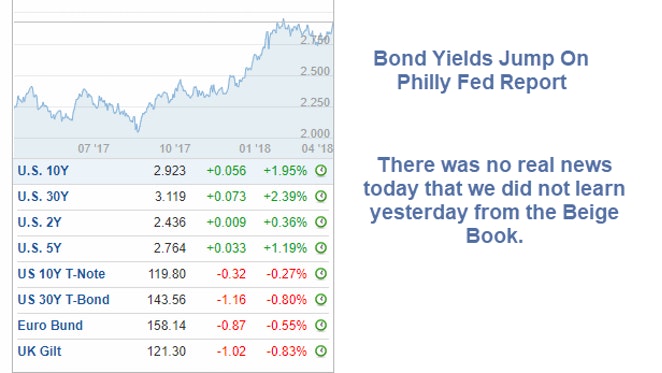
The inflation scare is in full swing, but the long end of the curve is still quite contained.
I side with Lacy Hunt at Hoisington Management regarding the attractiveness of the long end of the curve.
Author

Mike “Mish” Shedlock's
Sitka Pacific Capital Management,Llc
Mike “Mish” Shedlock is a registered investment advisor for SitkaPacific Capital Management.

















