On the tariff front, China is demanding the US start treating it respectfully


Outlook
A potential development is the PoWell speech at the Chicago Economics Club, but with low expectations of anything dramatic or different from his “not yet” stance—the Fed can be “patient.” Then there is the Bank of Canada rate decision. If not this time, then in May for sure.
On the tariff front, China is demanding the US start treating it respectfully. It also wants a deal and not shilly-shallying. It has taken a targeted approach—no Boeing, no Nvidia chips—instead of the chaotic, on-a-whim everything-all-at-once US approach. In a word, China is smarter.
Here’s the problem: China comes across as smarter. Trump looks unprofessional and unmoored to standards of presidential behavior, let alone the norms of civilization. Two outcomes are possible: he behaves properly, as he did when smooching Bill Maher, who said the crazy man in the White House is just putting on a show. Alternatively, he delivers the petulant 4-year old. We shall see.
In the big picture, the important BoA/ML survey of investment managers shows they think the US stock market comes well after some other assets for return in the coming year—gold, cash, and bonds. In other words, they are scared. And a hefty 61% expect the dollar to continue to devalue. See the chart.
We sometimes make fun of investment managers for being cookie-cutter conventional, aka sheep, but they do manage vast amounts of money. To the extent the confirmation bias kicks in, they will get what they expect to get and to some degree, make it happen. This is not unfair, since they are reflecting what every single sane economist has been saying for months—we are in for a hard landing. They vote on that, too. Their estimate of the probability of a hard landing jumped to 49% from 5% at the Jan 20 inauguration and having never been over 30 before.
That’s if we do not get a financial crisis (from some overleveraged dingbat with a wide spread) and if China doesn’t deliver a Shock by taking back all its reserve Treasuries. These are low probability events, but not impossible. China will use the Treasury holdings in negotiations. It would lose face by just taking their ball and going home, giving insult ammunition to the rude guy in Washington. They would rather Trump be the one to lose face. Having said that, the bond market is the biggest markets in the world, bigger than Trump appreciates, and even a whiff of Chinese capital flight would set off a panic the likes of which we have literally never seen in the US.
Who has seen it is the UK. Consider that the US tends to track the UK in many things. The pound was devalued in 1949, 1967, 1992 and 2016. And this was after Bretton Woods when the dollar took over the reserve currency spot.
Forecast
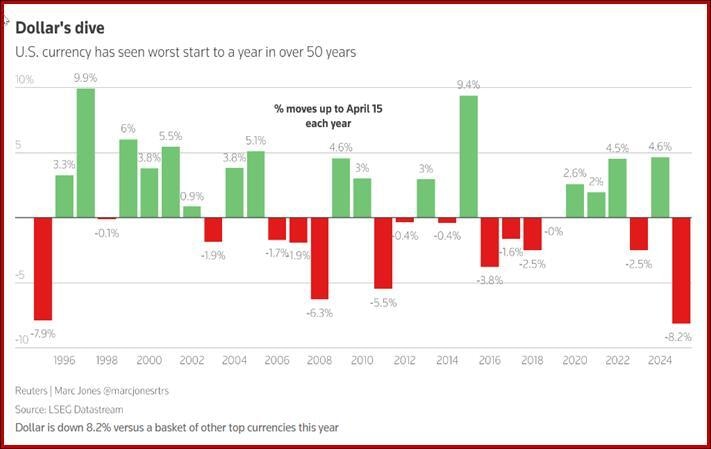
We got snookered again by the charts, which clearly showed a significant pullback that on past experience “should” have persisted for another day or two while the big traders adjusted positions. But no, the one-day pullback only goes to show that the negative sentiment toward the dollar is stronger than the usual market behavior. There is nothing usual about what is happening now. See the Reuters chart at the end—this is the worst start of a year in 50 years.
Remember that Good Friday on April 18 will close most European and the US stock and bond markets. FX trading desks will be thinly manned. The implication is that traders will square up ahead of the 3-day holiday, meaning they will get less long the currencies and less short the dollar. This is a standard move and barely nudged by whatever small moves in sentiment come along. Don’t be fooled.
Tidbit: Skeptics and conspiracy theorists keep talking about the US losing reserve currency status. We keep saying okay, maybe, but it will take a long time for two simple reasons—first, the US has the biggest and most varied markets, and the US has a Constitution protecting private property from the government except with a due process court-fight.
But bond guru Romanchuk makes a few critical points on the subject of the dollar as reserve currency that adds to the discussion.
First, consider that most of the big holders of reserve dollars “… are mainly Asian export-led growth powerhouses, energy exporters, along with India with precautionary reserves, Switzerland due to its massive intervention to keep the franc stable versus the euro (not the dollar), and the U.S.’ legacy gold reserve position.”
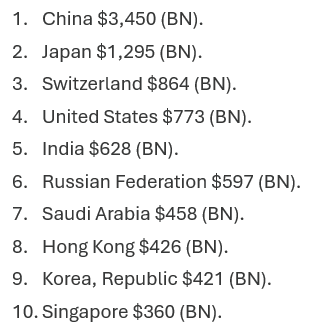
We are a little surprised not to see the UK and tax havens like Lichtenstein on the top 10 list. A lot of that is really oil exporters and Russian mobsters.
Next is the possibility of private outfits taking over from governments as stockpilers of dollars, to be used for buying US goods, to peg their currencies to the dollar, or just to get the yield. This is a big maybe. “The United States was the only country that stomached having distant foreign countries peg their currencies to the local currency as a means of pursuing export-led growth. (There are a variety of pegs to the euro, but those are on the European periphery.)
“The instability of the American regime means that such strategies are now a thing of the past. Instead, we are in a world of managed trade agreements, and trade imbalances are unlikely to get as extreme.”
The phrase “the instability of the American regime” should make your blood run cold.
This is an excerpt from “The Rockefeller Morning Briefing,” which is far larger (about 10 pages). The Briefing has been published every day for over 25 years and represents experienced analysis and insight. The report offers deep background and is not intended to guide FX trading. Rockefeller produces other reports (in spot and futures) for trading purposes.
To get a two-week trial of the full reports plus traders advice for only $3.95. Click here!
This is an excerpt from “The Rockefeller Morning Briefing,” which is far larger (about 10 pages). The Briefing has been published every day for over 25 years and represents experienced analysis and insight. The report offers deep background and is not intended to guide FX trading. Rockefeller produces other reports (in spot and futures) for trading purposes.
To get a two-week trial of the full reports plus traders advice for only $3.95. Click here!
Author
Barbara Rockefeller
Rockefeller Treasury Services, Inc.
Experience Before founding Rockefeller Treasury, Barbara worked at Citibank and other banks as a risk manager, new product developer (Cititrend), FX trader, advisor and loan officer. Miss Rockefeller is engaged to perform FX-relat

















