Oil outlook: US Government shutdown as OPEC+ meeting looms


WTI’s price over the past week and since our last report, has moved lower. On a fundamental level we are to have a look at the state of the US oil market, the US Government shutdown, OPEC+’s upcoming meeting and the possible tightening of oil sanctions on Russia’s partners. The report is to be concluded with a technical analysis of WTI’s daily chart for a rounder view.
US government shutdown enters day two
The US Government has entered its second shutdown day and does not appear to have an end in sight at the time of this report. As a reminder, the US Government “shut down” following a failure between Republican and Democratic Senators to reach a deal to continue funding the Government. The shutdown marks the 15th time such an event has occurred and may spark concerns over the state of the US economy. Specifically, the longer the Government remains in limbo the greater the negative impact on the economy, although should a speedy resolution occur its impact may be immaterial. However, in our view, with both Republicans and Democrats essentially playing a game of “chicken” and waiting to see who will provide concessions first, the shutdown could continue into the coming week. In turn, the implications of a negative impact on the US economy could spark worries about reduced economic activity in the US and may, in turn weigh on oil prices. In conclusion, a temporary Government shutdown may be immaterial in the long run, yet the longer this shutdown drags on, the greater the risks to the US economy, which could be reflected in the markets.
OPEC+ to increase Oil production?
According to a report by Reuters, OPEC+ may approve another oil production increase of at least 137,000 barrels per day in their meeting this Sunday. Specifically, eight OPEC+ countries will be meeting virtually in order to decide on their November output and thus an increase of oil supply into the market could possibly weigh on oil prices. However, there have been some reports that OPEC+ has refuted these allegations and that no oil output increase may occur in their next meeting. Nonetheless, in our view the relative stabilisation of oil prices may provide OPEC+ with some leeway to increase their oil production and thus we would not be surprised to see an announcement emerging over the weekend. Furthermore, with OPEC+ seeking to regain its oil market share, an increase of 137k bpd could further aid the group with its goal. In conclusion, should OPEC+ announce an oil production increase following their meeting on Sunday, it may weigh on oil prices and vice versa.
The race to tighten Oil sanctions on Russia
On Wednesday, the G7’s finance ministers stated in a joint statement that they would be taking steps in order to increase pressure on Russia by targeting those who are continuing to increase their purchases of Russian oil and those who are facilitating circumvention according to a report by Reuters. It appears that the G7 is continuing on its attempts to curb the flow of Russian oil into the markets and a possibly method to achieve their aims could be to impose pressure on the buyers of Russian oil who are notably India and China. However, that being said we are sceptical as to how pragmatic pressures on China may be, considering their status as an economic heavyweight and their close relationship to Russia. Hence in our view, we find it more plausible that India may be more willing to cooperate with their Western allies whereas China may not. Overall, even if the G7 attempts to curb Russian oil exports, unless a significant shift occurs from China, its impact on the oil markets may be of a secondary nature.
US Oil market tightens slightly
We make a start by examining the data on the US oil market. Last Friday, Baker Hughes reported once again an increase of active oil rigs in the US from 418 to 424, in a signal of potentially increased oil demand pressuring oil producers to activate more oil rigs thus, the rise of the number in the US is interpreted as a bullish signal for oil prices. The bullish signals once again intensified as API reported on Tuesday a drawdown in US crude oil inventories of -3.674 million barrels implying that oil production levels surpassed aggregated oil demand in the US once more. Although it should be said that the drawdown was lower than the prior week’s API figure. Moreover, the EIA reported an increase in US crude oil inventories of 1.792 million barrels thus casting doubt on the narrative of a tightening US oil market. In conclusion, should we see the US oil market loosening in the coming week it may weigh on oil prices and vice versa.
Technical analysis
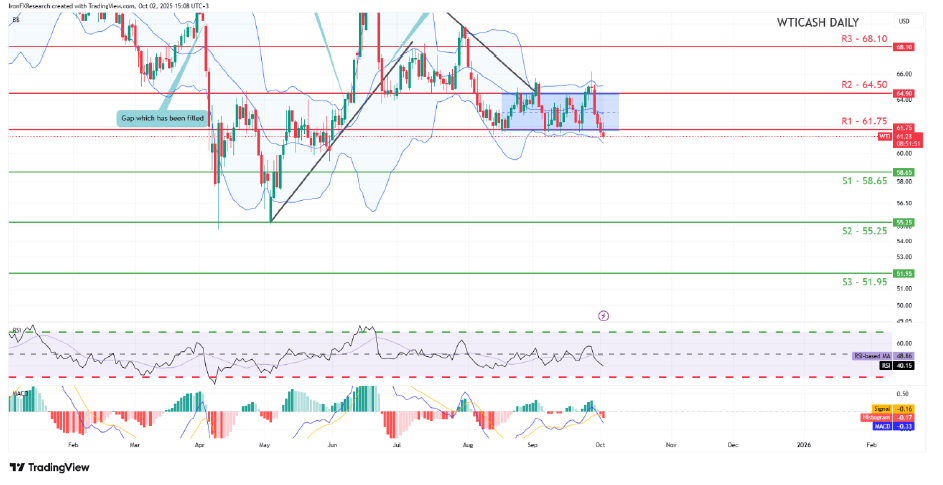
WTI Cash Daily Chart
- Support: 58.65 (S1), 55.25 (S2), 51.95 (S3).
- Resistance: 61.75 (R1), 64.50 (R2), 68.10 (R3).
WTI’s price action over the past week has been a bit of a roller coaster ride and has now emerged below our support now turned to resistance at the 61.75 (R1) level. Considering the break below our support now turned to a resistance level, we opt for a bearish outlook for the commodity’s price and supporting our case is the MACD indicator below our chart in addition to the RSI indicator which currently registers a figure near 40, implying a bearish market sentiment. For our bearish outlook to continue we would require a break below our 58.65 (S1) support level with the next possible target for the bears being our 55.25 (S2) support line. On the other hand for a bullish outlook, we would require a clear break above our 61.75 (R1) resistance line with the next possible target for the bulls being the 64.50 (R2) resistance level. Lastly, for a sideways bias we would require the commodity’s price to remain confined between our 58.65 (S1) support level and our 61.75 (R1) resistance line.
Author
Phaedros Pantelides
Independent Analyst
Mr Pantelides has graduated from the University of Reading with a degree in BSc Business Economics, where he discovered his passion for trading and analyzing global geopolitics.