Oil and Gold: Price review for the week ahead

This preview of weekly data examines USOIL and XAUUSD, with economic data expected later this week as the primary market drivers of the near-term outlook.
Highlights of the week: Major central banks' interest rate decisions, US manufacturing PMI
Tuesday
- Bank of Japan Interest rate decision at 03:00 AM GMT. The market consensus is that the rates will remain static at 0.75% while in the unlikely scenario of any shift away from this figure will most certainly create volatility on the yen pairs.
Wednesday
- Bank of Canada Interest rate decision at 13:45 GMT is expected to remain stable at 2.25%. In case of a surprise hike in the interest rates would support the loonie in the short term, while in the unlikely event of a rate cut, then it might create some turmoil for the currency.
- The Fed interest rate decision at 18:00 GMT is broadly expected to remain steady at 3.75%, with the probability of a cut at 0%. Participants are closely focusing on what the central bankers will say in the subsequent press conference to get hints about the future direction of monetary policy.
Thursday
- Flash European inflation rate at 09:00 AM GMT. The rate for April is expected to increase to 2.9%, up from the previous reading of 2.6%. This could have a short term postove affect on the Euro against its pairs because it could influence a more hawkish stance by the ECB on their press conference later in the day.
- The Bank of England decides on its interest rate at 11:00 AM GMT. The general expectation is that the central bank will hold its rate stable at 3.75%, but if we witness a hike in the rate, it could give some support to the quid in many of its pairs, especially against the US dollar, whereas in the unlikely event of a cut, it might hurt the British pound in the aftermath of the release.
- European Central Bank Interest rate decision at 12:15 GMT. The market consensus is that the European Central Bank will maintain interest rates at 2.15%. If there is a surprise rate hike, the Euro might find support against other major currencies, while a cut might result in some losses in the short term. Investors and traders are more focused on the subsequent press conference following the release, which will provide hints about the monetary policy steps ahead.
Friday
- US manufacturing PMI at 14:00 GMT. The consensus for April is for an increase from 52.7 to 53.2 points. The manufacturing sector in the States seems to be holding above the 50-basis points, meaning that the sector is still expanding and holding strong, supporting the dollar.
USOil, daily
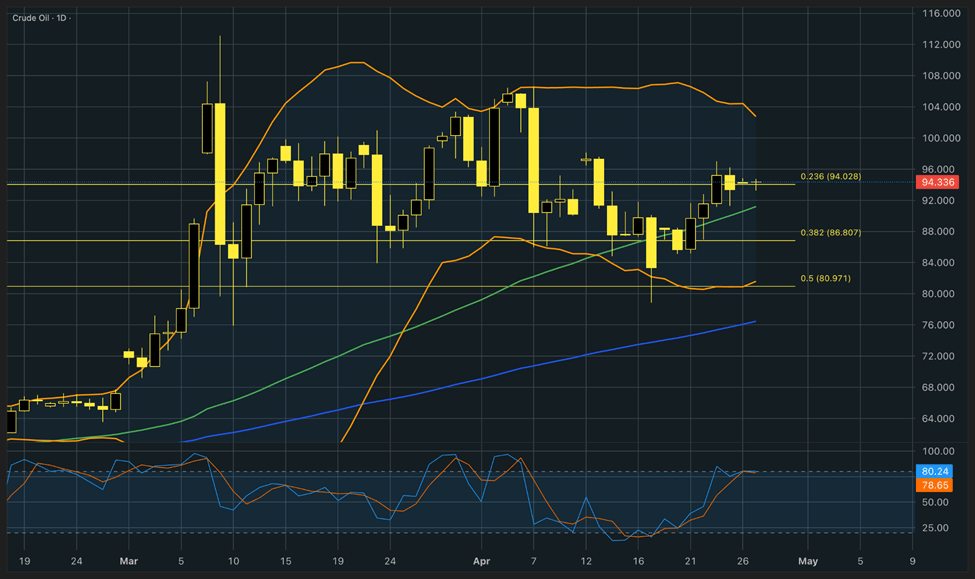
Oil prices pushed higher as attempts to restart peace talks around the Iran war stalled, while the Strait of Hormuz remains effectively shut, keeping global supply under heavy pressure. Prices initially spiked on the disruption, then eased slightly after reports that Iran floated a new proposal to the US to reopen the strait. Diplomatic progress is still stuck with Trump cancelling a planned envoy trip, saying Iran’s offer fell short, while Tehran insists it won’t negotiate under threats or blockades. Despite a ceasefire that has held since early April, both sides continue to enforce a blockade that has nearly halted traffic through the strait. The result is a major supply shock affecting crude, fuel, gas, and even fertilizers, with growing fears of a broader inflation wave. The conflict is now in its ninth week, already causing real-world disruptions like fuel shortages in parts of Asia, reduced airline activity, and tightening global supply chains. The International Energy Agency is calling it the largest supply shock on record. Markets are starting to accept that this isn’t going to be resolved quickly. Expectations are shifting toward sustained elevated prices, with traders warning that the longer the strait stays closed, the more demand will have to adjust downward to match reduced supply.
On the technical side, the price found sufficient support on the 38.2% Fibonacci retracement level early last week and has since corrected to the upside. This bullish correction has pushed the Stochastic oscillator into extreme overbought levels, hinting at a potential bearish action in the upcoming sessions. On the other hand, the moving averages are still validating the overall bullish trend while the Bollinger Bands are still quite expanded, showing that there is volatility to support any sharp moves in the short term. Currently, the price is testing a support area consisting of the 23.6% Fibonacci retracement as well as the inside support area of the 1st of April, where the price failed to break below, making it a strong support level.
Gold-Dollar, daily
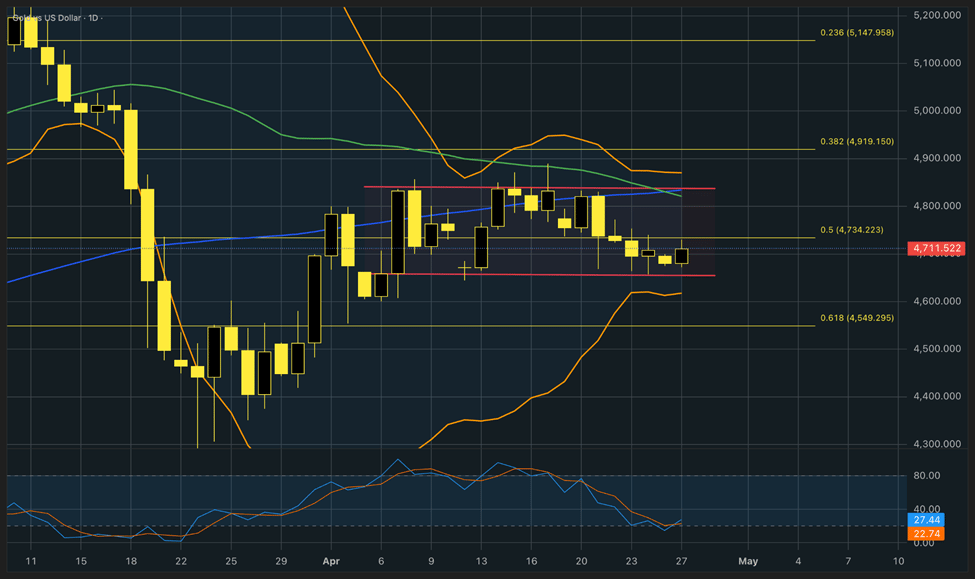
Gold held steady as US–Iran peace efforts do not seem to be proceeding, and the Strait of Hormuz remained blocked, keeping geopolitical risk and inflation concerns elevated. The metal has dropped about 11% since the conflict began, with higher interest rate expectations weighing on demand. Gold lacks clear direction, with weak conviction and investors largely staying on the sidelines. Markets are also watching US monetary policy shifts, as expectations point to a more gradual approach to rate cuts. Overall, gold is stuck in a range, with any upside likely temporary unless there’s a credible breakthrough in diplomacy.
From a technical point of view, gold is trading in a sideways channel formation for the majority of the month between the levels of $4,840 and $4,660. The Stochastic oscillator has been pushed into extreme oversold levels, hinting that there might be a bullish correction phase in the next sessions, while the moving averages have recently crossed and are now validating the overall bearish trend in the market. The Bollinger Bands have somewhat contracted, showing that volatility might be losing some steam, therefore hinting that the sideways trend could persist in the short-term outlook for gold. If this scenario plays out then the boundaries of the channel might be the strong support and resistance areas on the chart and therefore potential targets.
Author

Antreas Themistokleous
Exness
Antreas has been trading CFDs since 2018 using a combination of fundamental and technical analysis.