|

Gold at crossroads: Breakout above $4,235 or drop below $4,180?

  • Gold consolidates above $4180
  • Resistance $4235 likely to cap gains.
  • Strong Dollar Index keeps Gold under pressure.
  • Rising 10 year bond yields challenge Gold.

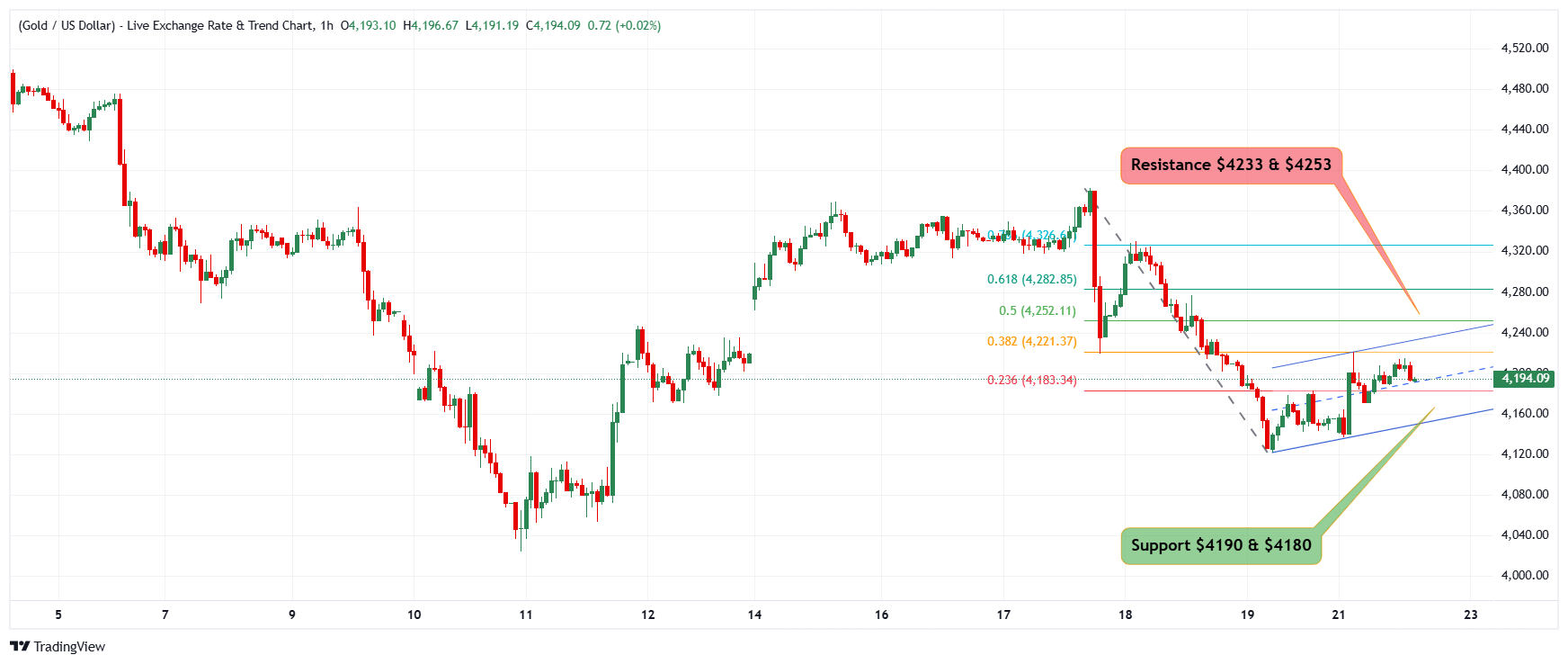
4 Hour Chart by www.skcharting.com

Current market structure

Gold remains relatively bearish on higher time frames as broad structure witnesses lower high and lower low.

Small time frames show consolidation above recent lows after broader sell off.

Buyers have been defending $4180 local demand zone while some accumulation is attempting to break immediate resistance $4220 above which next challenge sits at $4233 followed by major overhead supply zone $4253
If bulls succeed reclaiming $4253 with a decisive close, a further extension can take recovery a tad higher to $4285

Fundamental drivers

Strong Dollar Index, stability above 100.80 keeps Gold under pressure.

US-Iran peace agreement reduces risk sentiments and eases global tensions.

Federal Reserve hawkish stance reduces odds of rate cut.

Opening of Hormuz Strait eases Crude Oil prices.

Institutional ETF demand has weakened recently as also central bank Gold purchases decline recently.

Technical drivers

Small time frames show oversold conditions and some rebound attempts are on cards.

Sellers need additional liquidity on buy side to reposition their selling bets on higher side.

Bullish trend confirmation on strong breakout above $4255
Bearish trend continuation on strong breakdown below $4180-$4140

Author

Sunil Kumar Dixit

Sunil Kumar Dixit is Chief Technical Strategist and founder of SK Charting, a research firm based in India. He tracks Precious Metals, Energy, Indices and Currency Pairs. He also participates as an expert panellist on Channel Television, Nigeria.


More from Sunil Kumar Dixit
Share:

Editor's Picks

AUD/USD keeps range near 0.6950 after Australian trade data

AUD/USD consolidates near a two-month low, trading around mid-0.6900s in the Asian session on Thursday amid a bullish US Dollar. The US PCE data tempered October Fed hike bets, though oil-driven inflation fears remain supportive of elevated US bond yields. Meanwhile, Australia's trade surplus shrank sharply in August to AUD495M, having limited impact on the Aussie Dollar and the pair.


USD/JPY sits at weekly top above 158.00 as bullish USD counters intervention risks

USD/JPY is sitting at the top end of its weekly range above 158.00 in the Asian session on Thursday. Despite the softer US PCE data, oil-driven inflation risks keep US bond yields elevated near multi-year highs. Moreover, the US-Iran standoff benefits the safe-haven US Dollar and supports the pair. Broad US Dollar strength counters hawkish BoJ expectations and Japanese intervention risks.

Gold struggles as rising US Treasury yields outweigh dovish Fed repricing

Gold treads water on Thursday as a stronger US Dollar and soaring US Treasury yields limit the upside. At the time of writing, XAU/USD trades around $4,167, up 0.26% on the day, as the precious metal struggles to build on its early recovery.

Crypto Today: Bitcoin, Ethereum, XRP struggle to regain momentum amid returning ETF outflows

Bitcoin trades broadly between support at $82,500 and resistance at $85,000. Ethereum similarly remains under pressure, trading below $2,700 while the $2,600 level provides immediate support. At the same time, Ripple has slipped below the pivotal $1.50 level.

Markets are pricing a Fed pause. The jobs data says the hike is still coming

The market has rapidly changed its mind about the Fed. Only a week ago, investors saw an October interest-rate hike as the most likely outcome. However, softer inflation and cautious comments from policymakers have since turned a pause into the dominant scenario.

Markets are pricing a Fed pause. The jobs data says the hike is still coming
The market has rapidly changed its mind about the Federal Reserve (Fed). Only a week ago, investors saw an October interest-rate hike as the most likely outcome. However, softer inflation and cautious comments from policymakers have since turned a pause into the dominant scenario. Yet beneath that dramatic repricing, the US economy is sending a considerably less dovish message.