|

NZD/USD Keeps Sailing South

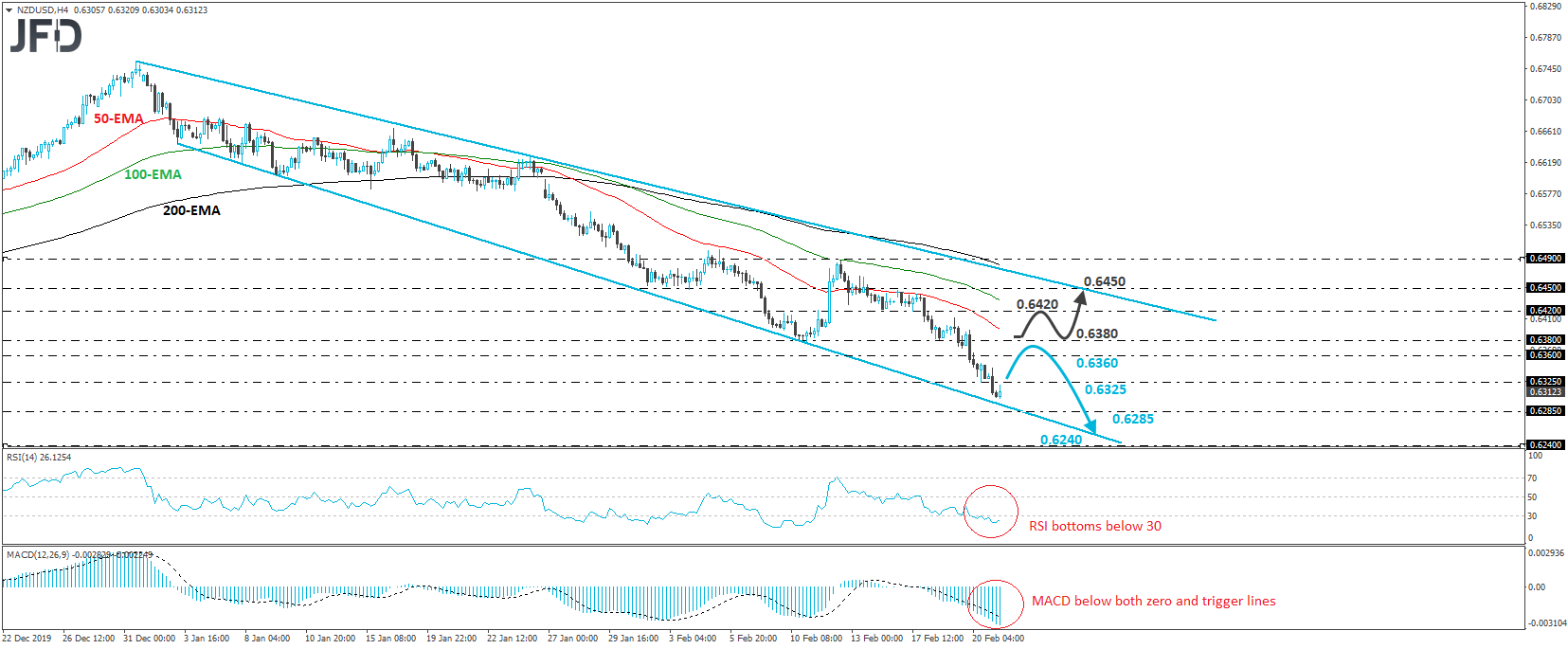
NZD/USD continued tumbling on Friday, breaking below the 0.6325 support (now turned into resistance) barrier, marked by the low of November 12th. Overall, the pair has been printing lower highs and lower lows below a tentative downtrend line drawn from the high of December 31st, which keeps the near-term picture negative. However, bearing in mind that the rate found some support near the return line taken from the low of January 3rd, we would stay careful of a possible corrective bounce before the bears decide to shoot again.

A clear break back above 0.6325 may confirm the case for a small bounce and may allow the recovery to continue towards the 0.6360 or 0.6380 levels, defined as resistance by the inside swing lows of November 14th and February 11th respectively. The bears may regain control from near those levels and may pull the trigger targeting the low of October 17th, at around 0.6285. If they are not willing to hit the brakes near that barrier either, we could see them aiming for the return line again, or the low of October 16th, at around 0.6240.

Taking a look at our short-term oscillators, we see that the RSI lies below 30, but turned up today, while the MACD, although below both its zero and trigger lines, shows signs of slowing down. It could also bottom soon. Both indicators suggest that the strong downside speed may start decelerating and support our view for a small bounce before the next negative leg.

In order to start examining the case for a somewhat larger correction, we would like to see a strong move above 0.6380. Such a move may pave the way towards the 0.6420 zone, the break of which may target the downtrend line taken from the high of December 31st. That said, we would still see decent chances from the bears to jump back in from near that line. In order to totally abandon the bearish case, we would like to see a clear close above 0.6450.
NZDUSD

JFDBANK.com - One-stop Multi-asset Experience for Trading and Investment Services


Author

More from JFD Team
Share:

Markets move fast. We move first.

Orange Juice Newsletter brings you expert driven insights - not headlines. Every day on your inbox.

By subscribing you agree to our Terms and conditions.

Editor's Picks

EUR/USD bounces toward 1.1750 as US Dollar loses strength

EUR/USD returned to the 1.1750 price zone in the American session on Friday, despite falling Wall Street, which indicates risk aversion. Trading conditions remain thin following the New Year holiday and ahead of the weekend, with the focus shifting to US employment and European data scheduled for next week.

GBP/USD nears 1.3500, holds within familiar levels

After testing 1.3400 on the last day of 2025, GBP/USD managed to stage a rebound. Nevertheless, the pair finds it difficult to gather momentum and trades with modest intraday gains at around 1.3490 as market participants remain in holiday mood.

Gold trims intraday gains, approaches $4,300

Gold retreated sharply from the $4,400  area and trades flat for the day in the $4,320 price zone. Choppy trading conditions exacerbated the intraday decline, although XAU/USD bearish case is out of the picture, considering growing expectations for a dovish Fed and persistent geopolitical tensions.

Cardano gains early New Year momentum, bulls target falling wedge breakout

Cardano kicks off the New Year on a positive note and is extending gains, trading above $0.36 at the time of writing on Friday. Improving on-chain and derivatives data point to growing bullish interest, while the technical outlook keeps an upside breakout in focus.

Economic outlook 2026-2027 in advanced countries: Solidity test

After a year marked by global economic resilience and ending on a note of optimism, 2026 looks promising and could be a year of solid economic performance. In our baseline scenario, we expect most of the supportive factors at work in 2025 to continue to play a role in 2026.

Crypto market outlook for 2026

Year 2025 was volatile, as crypto often is.  Among positive catalysts were favourable regulatory changes in the U.S., rise of Digital Asset Treasuries (DAT), adoption of AI and tokenization of Real-World-Assets (RWA).















