|

NZ Earthquake & NZ Action
Monday's NZ earthquake has proven devastating in terms of magnitude at 6.6, near the previously hit area of Christchurch. The quake was initially reported as magnitude 7.6 with aftershocks heard in the capital city of Wellington. NZD has already gapped down sharply across the board in early Monday Pacific trade with AUDNZD printing as high as 1.0760. The total cost of damage from the 2010-2011 earthquakes was estimated at NZ$15 billion – about 8% of NZ's GDP, considered twice as large in proportion in relative terms to Japan's 2011 earthquake. The bulk of damage to residential and commercial property was covered by the nation's Earthquake Commission.
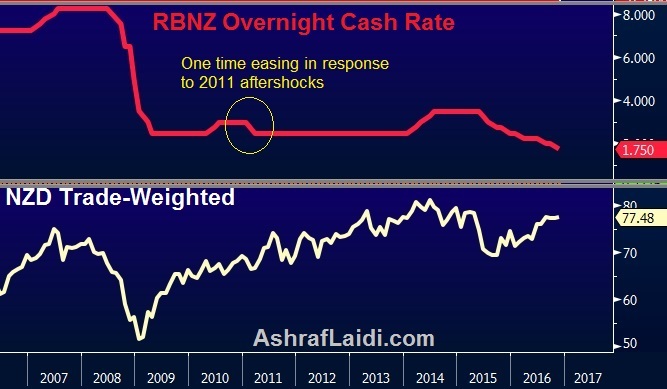
Making an assessment about the NZD remains partly dependent on the extent of any subsequent aftershocks impacting urban areas as well as the subsequent response from the RBNZ. The Sep 2010 earthquake was extreme in scale rather than in casualties, but the more devastating damage to human lives and infrastructure did not occur until Feb 2011. The RBNZ responded with a 50-bp rate cut in March 2011.

How was 2011 different from today? The March 2011 rate cut was a one-time policy easing, occurring in the midst of a policy tightening cycle, which targeted mainly damage from the quake rather than a prevailing economic slowdown. Any policy action today would coincide with rates at a record low of 1.75% but with a trade-weighted NZ rate at 16% higher than in 2011. A new NZD trade has been issued earlier this evening to Premium subscribers.

Author

Ashraf Laidi

Ashraf Laidi

AshrafLaidi.com

Ashraf Laidi is an independent global markets strategist with over 15 years' experience. He is author of "Currency Trading & Intermarket Analysis", and founder of AshrafLaidi.com.


More from Ashraf Laidi
Share:

Editor's Picks

EUR/USD hits two-day highs near 1.1820

EUR/USD picks up pace and reaches two-day tops around 1.1820 at the end of the week. The pair’s move higher comes on the back of renewed weakness in the US Dollar amid growing talk that the Fed could deliver an interest rate cut as early as March. On the docket, the flash US Consumer Sentiment improves to 57.3 in February.

GBP/USD reclaims 1.3600 and above

GBP/USD reverses two straight days of losses, surpassing the key 1.3600 yardstick on Friday. Cable’s rebound comes as the Greenback slips away from two-week highs in response to some profit-taking mood and speculation of Fed rate cuts. In addition, hawkish comments from the BoE’s Pill are also collaborating with the quid’s improvement.

Gold climbs further, focus is back to 45,000

Gold regains upside traction and surpasses the $4,900 mark per troy ounce at the end of the week, shifting its attention to the critical $5,000 region. The move reflects a shift in risk sentiment, driving flows back towards traditional safe haven assets and supporting the yellow metal.

Crypto Today: Bitcoin, Ethereum, XRP rebound amid risk-off, $2.6 billion liquidation wave

Bitcoin edges up above $65,000 at the time of writing on Friday, as dust from the recent macro-triggered sell-off settles. The leading altcoin, Ethereum, hovers above $1,900, but resistance at $2,000 caps the upside. Meanwhile, Ripple has recorded the largest intraday jump among the three assets, up over 10% to $1.35.

Three scenarios for Japanese Yen ahead of snap election

The latest polls point to a dominant win for the ruling bloc at the upcoming Japanese snap election. The larger Sanae Takaichi’s mandate, the more investors fear faster implementation of tax cuts and spending plans. 

XRP rally extends as modest ETF inflows support recovery

Ripple is accelerating its recovery, trading above $1.36 at the time of writing on Friday, as investors adjust their positions following a turbulent week in the broader crypto market. The remittance token is up over 21% from its intraday low of $1.12.














