November flashlight for the FOMC blackout period

Summary
We expect that the Federal Open Market Committee (FOMC) will leave the target range for the federal funds rate unchanged at 5.25%-5.50% at the conclusion of its next meeting on November 1. Financial markets are essentially priced for no change as well.
Although the rate of real GDP growth in the U.S. economy remains strong, inflation is moving back toward the FOMC's target of 2%. That noted, we believe that the post-meeting statement will continue to characterize inflation as “elevated”, while also noting that recent geopolitical events add uncertainty to the outlook.
Recent comments by Fed officials suggest that most Committee members are comfortable leaving the stance of monetary policy unchanged at the upcoming meeting. That said, most policymakers indicated at the September FOMC meeting that they thought another 25 bps rate hike would be appropriate by the end of this year.
We believe the FOMC will want to keep its options open for further tightening. Therefore, we think the post-meeting statement will maintain the language that signals some additional policy tightening may be appropriate.
We do not expect the FOMC will make any changes to the pace at which it is allowing Treasury securities and mortgage-backed securities (MBS) to run off the Fed's balance sheet.
We expect the FOMC will leave rates unchanged on November 1
We share the widespread expectation that the Federal Open Market Committee (FOMC) will leave the target range for the federal funds rate unchanged at its upcoming meeting on October 31-November 1. Since the Committee last met, underlying inflation has shown continued signs of slowing. The core PCE deflator, which is the FOMC's preferred measure of consumer price inflation, edged up just 0.1% in August relative to the previous month. Over the three-month period ending in August, core PCE inflation rose at a 2.2% annualized rate, not far from the Committee's 2% target (Figure 1). Over the 12-month period ending in August, core PCE inflation was 3.9%, its first reading below 4% since June 2021.
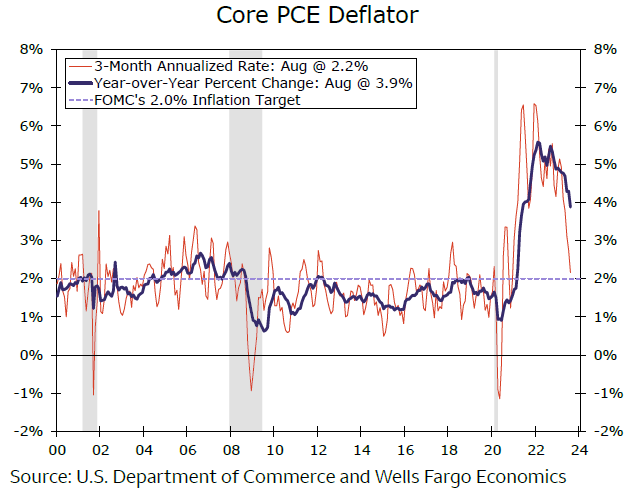
These are welcome developments for a Committee that has been fighting to combat high inflation since early 2022. That said, it remains far from certain that inflationary pressures are fully in check. Data for PCE inflation in September are not yet available and will be released on October 27. Recently released data on the Consumer Price Index (CPI) and Producer Price Index (PPI) suggest that core PCE inflation strengthened a bit in September. As we wrote in our most recent CPI report, we think this monthly bounce is more noise than signal, and we believe the downward trend in inflation remains in place despite the periodic bumps in the road. However, we think the Committee will be sensitive to any upward surprises on the inflation front, and the September inflation data argue for the FOMC remaining cautious about how quickly inflation can return to target on a sustained basis.
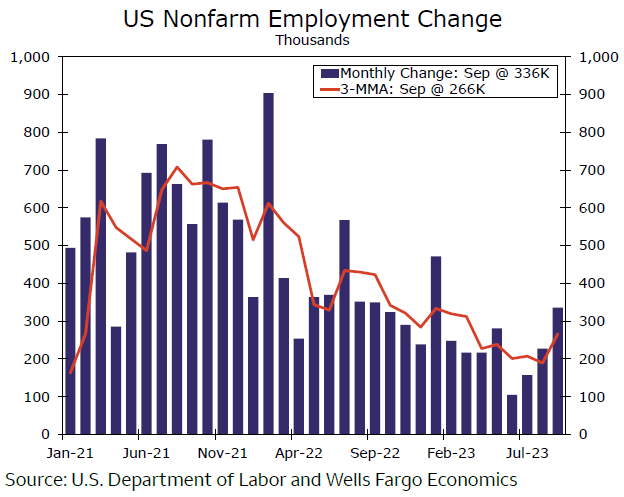
Data on economic output and employment have remained rock solid. Real GDP appears to have grown at roughly a 5% annualized rate in Q3-2023. A pickup in employment growth—nonfarm payrolls rose at an average monthly rate of 266K in Q3 relative to the average monthly rate of 201K in the second quarter—is consistent with this acceleration in real GDP (Figure 2). Moreover, the drivers of economic growth appear to have been broad-based in the third quarter.
Author

Wells Fargo Research Team
Wells Fargo