Nonfarm Payrolls Preview: US economy getting closer to full employment

Time has come again for the release of the monthly US employment report. The US Nonfarm Payrolls will be released this Friday, and economists are expecting the US to have added around 172,000 new jobs in September following a 151,000 increase in August. Also, the unemployment rate is forecast to remain at 4.9%, while average hourly earnings, year-on-year, are predicted to rise 2.6% year-on-year in September after a 2.4% gain the previous month, and to advance up to 0.3% in the month from the disappointing 0.1% in August.
Employment data released over the last month have not been particularly encouraging during the past month, with the ADP survey showing that US businesses added 154,000 jobs in September, the slowest pace of hiring since April, suggesting hiring is slowing now that the sector has stabilized near full employment. But that is good news, and a moderate advance won't harm much the greenback.
Indeed, the main question here is how the report can affect FED's decision of rising rates, or not, before year end. Given that the market is heading into the report with limited expectations this time, it may not take much to see it as FED's supportive, particularly if wages grow as expected or more, accompanying a headline reading in line with expectations.
A headline reading below 150K and poor wages' growth, however, will be seen as a new excuse for the FED for another delay.
The greenback is stronger heading into the report, with the GBP and the JPY being particularly weak at the time being, which means that a good report should fuel the declines of those particular currencies. Commodity-related currencies are following the lead of stocks and base metals, and only stronger oil prices are preventing them from falling sharply this Thursday.
And what about the EUR/USD?
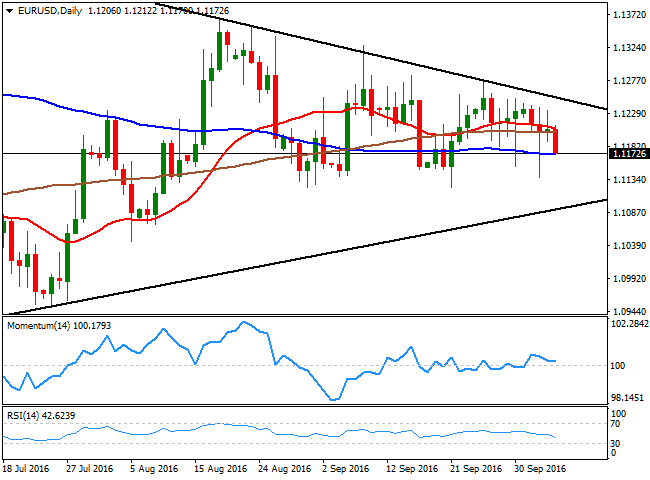
As for the common currency, investors are as side-lined as Central Banks these days, and there are limited chances that the US employment report will be able to take the pair out of its comfort zone. Trading lower in range, the EUR/USD pair heads into the report near the lower end of its latest range, but with technical readings in the daily chart lacking enough downward momentum to confirm a bearish breakout. In fact, there is a daily ascendant trend line coming from 1.0505, around 1.1080 for this Friday and it will take a downward acceleration below it to confirm a steeper decline afterwards.
To the upside, the first level to watch is a daily descendant trend line coming from 1.1615, now at 1.1245, where the pair has also found intraday resistance multiple times during the past few weeks, followed by another strong one at 1.1280. Above this last the EUR may extend its advance up to 1.1366, August monthly high, although gains beyond this last are not seen at this point.
Author

Valeria Bednarik
FXStreet
Valeria Bednarik was born and lives in Buenos Aires, Argentina. Her passion for math and numbers pushed her into studying economics in her younger years.

















