Nonfarm Payrolls Preview: Could employment become a new headache for the Fed?
- The US Nonfarm Payrolls report should confirm the Federal Reserve is on the right path.
- Job creation is likely to hold within Fed parameters, attention will then turn to wage growth.
- The American Dollar is likely to benefit from an upbeat employment reading.

The US will release its April employment figures on Friday, May 6. The Nonfarm Payrolls report is expected to show that the economy added 391K new jobs, below the previous 431K but still a good figure. The unemployment rate is expected to have contracted to 3.5% from 3.6% in the previous month. Also, Average Hourly Earnings are expected at 5.5% YoY.
US Federal Reserve worried about inflation, for now
Employment is one of the two pillars of the US Federal Reserve’s mandate. The other is inflation, which is far more concerning these days. Back in January, Fed Chair Jerome Powell said that US labor market conditions were consistent with maximum employment. On Wednesday, and following the May meeting, the statement noted that “job gains have been robust in recent months, and the unemployment rate has declined substantially.”
The central bank raised the Fed Funds rate by 50 bps to a range of 0.75% to 1% and announced the balance sheet would start being reduced on June 1. Policymakers said they would begin with a $47.5 billion cap on the monthly runoff rising to $95 billion after three months.
On employment, chair Powell said that job creation would slow amid less supportive fiscal and monetary policy. Still, he expects the unemployment rate to remain around 3.5%, according to March´s economic projections.
A stronger job sector, however, is not a cause of relief for central bank officials. On the contrary, record job openings are pushing wages higher, which in turn, adds to inflationary pressure. The March JOLTS Job Openings report hit a new record high of 11.549 million, while the number of people leaving their old jobs was 6.32 million, with 4.53 million voluntarily leaving their jobs.
Also, Q1 Unit Labor Costs soared 11.6% while Nonfarm Productivity plunged 7.5% in the same period. The ADP survey showed that the private sector added just 247K new positions in April, missing the 395K expected. On a positive note, Continuing Jobless Claims for the week ended April 22 were down to 1.38 million, hinting at substantiated job creation.
Possible market reactions
The American dollar has quickly recovered the ground shed after the Fed’s announcement, as despite holding back on a more aggressive monetary policy, the central bank is way ahead of its major counterparts. This week, the Reserve Bank of Australia and the Bank of England announced modest 0.25% hikes, while the European Central Bank is yet to pull the trigger.
An upbeat report may confirm the US Federal Reserve is on the right path and further boost the greenback. Market participants may not be too concerned if the headline figure misses the market’s expectations.
As usual, commodity-linked currencies will likely follow the lead of equities, while GBP/USD could post a limited reaction to the headline.
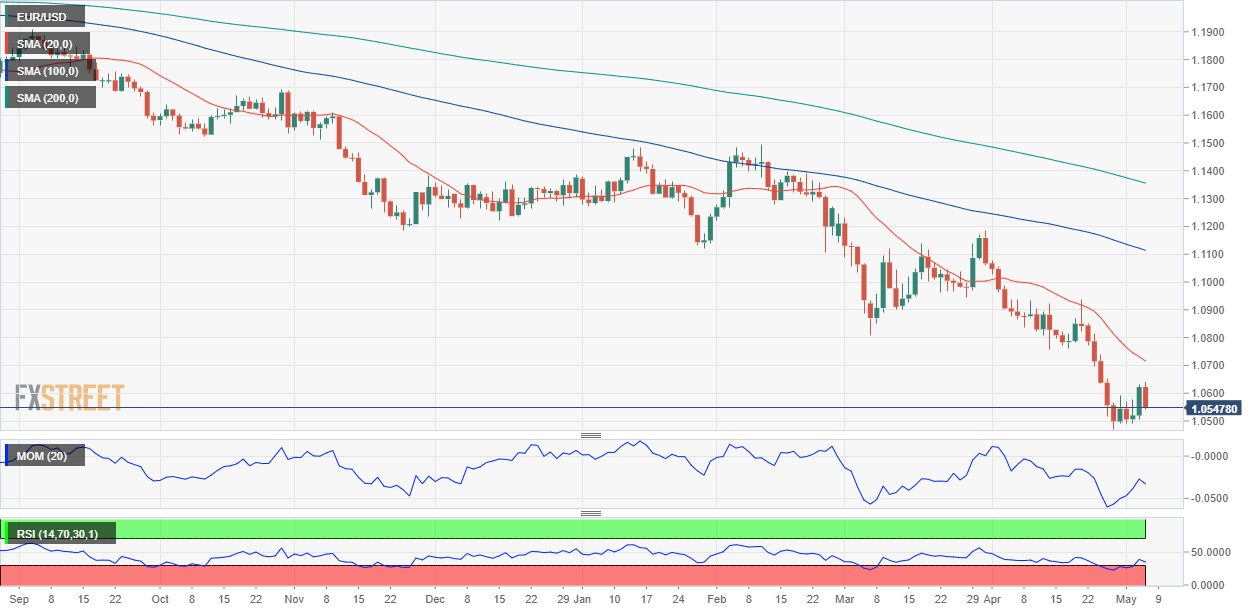
The shared currency is among the weakest dollar’s rivals, weighed by Eastern Europe developments and the correlated energy crisis. The EUR/USD pair has room to decline towards the year low of 1.0470 and even lower. Advances within the NFP release will likely attract sellers once the dust settles, although an advance beyond 1.0640 may trigger stops and result in an approach to the 1.0700 figure.
Author

Valeria Bednarik
FXStreet
Valeria Bednarik was born and lives in Buenos Aires, Argentina. Her passion for math and numbers pushed her into studying economics in her younger years.















