|

Nonfarm Payrolls Preview: An upbeat outcome could play against the greenback

  • US Federal Reserve’s head Powell said that data had shown signs of improvement.
  • The US is expected to show that it recovered 3 million jobs in June.
  • The American dollar could fall with a positive report, mainly if Wall Street keeps running.

Amid a shortened week, the US will publish its June employment figures this Thursday. The Nonfarm Payrolls report is expected to show that the country recovered 3 million jobs in the month, while the unemployment rate is seen contracting from 13.3% to 12.3%.  Average Hourly Earnings are still seen well above average, although returning to pre-pandemic levels. The yearly figure is seen at 5.3% from 6.7% in the previous month. Monthly Average Hourly Earnings are foreseen at -0.7% from -1.0%.

Earlier this week, the US Federal Reserve chief, Jerome Powell, said that macroeconomic indicators, included those related to employment, have shown signs of improvement amid the economy entering a new stage sooner than expected. Indeed, the US has lifted lockdowns as soon as the situation in New York improved.

However, the epicenter moved to the Southern States, with the country reporting record new cases above 40,000 per day for over a week already. The country has over 2.7 million reported cases, and Trump’s medical advisor said that they may reach 100,000 new cases per day if they can't control the disease. Multiple businesses are going back into lockdown, beyond governmental orders. The situation is worsening, not improving, and the market may not be willing to cheer an improvement in June’s employment data, considering that there could be a major setback in the upcoming months.

Leading indicators offer positive hints

Overall, Powell’s words were based on May/June figures, released these last few weeks, which also point to a positive monthly employment report. Starting with the previous Nonfarm Payroll report, which surprised by showing the economy added over 2.5 million positions against another drop expected.

Also, the Challenger Job Cuts showed that US-based employers’ cuts totaled 170,219 in JUNE, down 57% from May’s total of 397,016. However, cuts were over 1.2 million jobs in the second quarter of the year, the highest on record. Meanwhile, the ADP survey showed that the private sector added 2.3 million jobs in June, below the 3 million expected, although May’s reading was revised from -2.76M to +3.06M.

On a down note, Initial Jobless Claims seem to have stabilized at over 2 million. Far from the levels seen at the beginning of the pandemic, the figures related to unemployment are falling at quite a slow pace.

US jobs report pre-release checklist – Jul 2nd, 2020

Previous Non-Farm PayrollsPositiveAfter the worst US jobs report in history printed in April, NFP numbers bounced big in May showing a +2.5M number of jobs added.
Challenger Job CutsPositiveThe number of corporate layoffs fell down from 397K to 170K in June, the best number since the COVID-19 outbreak. 
Initial Jobless Claims NegativeInitial Jobless Claims figures are falling very slowly, still printing consistent numbers way above 1 million a week. Not showing a V-shaped recovery there.
Continuing Jobless Claims NeutralThe number of unemployment benefit receivers is also slowing down but failing to do so sharply, with a whooping 19.522M being registered on June 12th week. 
ISM Non-Manufacturing PMI NegativeOld data from May, as the June figure will be released next week, didn't show much life on the service sector employment sub-component.
ISM Manufacturing PMI NeutralEmployment sub-component in the US flagship manufacturing survey recovered from 32.1 to 42.1 in June, but disappointed expectations, still not showing a V-shaped recovery.
University of Michigan Consumer Confidence Index NeutralUMich consumer survey index in June has shown some signs of life, bouncing from 72.3 to 78.1, but it is still way below pre-pandemic numbers.
Conference Board Consumer Confidence Index PositiveCB consumer survey index bounced more notably in June, printing a much-better-than-expected 98.1 number.
ADP Employment Report PositiveADP private employment report showed a gain of 2.369 million jobs in June, a bit lower than expected, but the May figure was revised way up higher: from -2.76M to 3.06M.
JOLTS Job Openings NeutralThe lagging job openings indicator collapsed to 5M in April, still showing a more modest fall than expected. Numbers in May expected to tread waters around that level. 

Dollar’s possible reaction to different scenarios

The American dollar is heading into the event with a negative tone, as regardless of the coronavirus-related uncertainty, equities keep rallying. Just this week, the Nasdaq hit a record high, while the S&P 500 is less than 70 points away from its all-time high. An encouraging outcome could further fuel equities and keep the safe-haven dollar under pressure.

The greenback has then more chances of advancing against the JPY and the CHF while rallying equities will favor the most commodity-linked currencies.

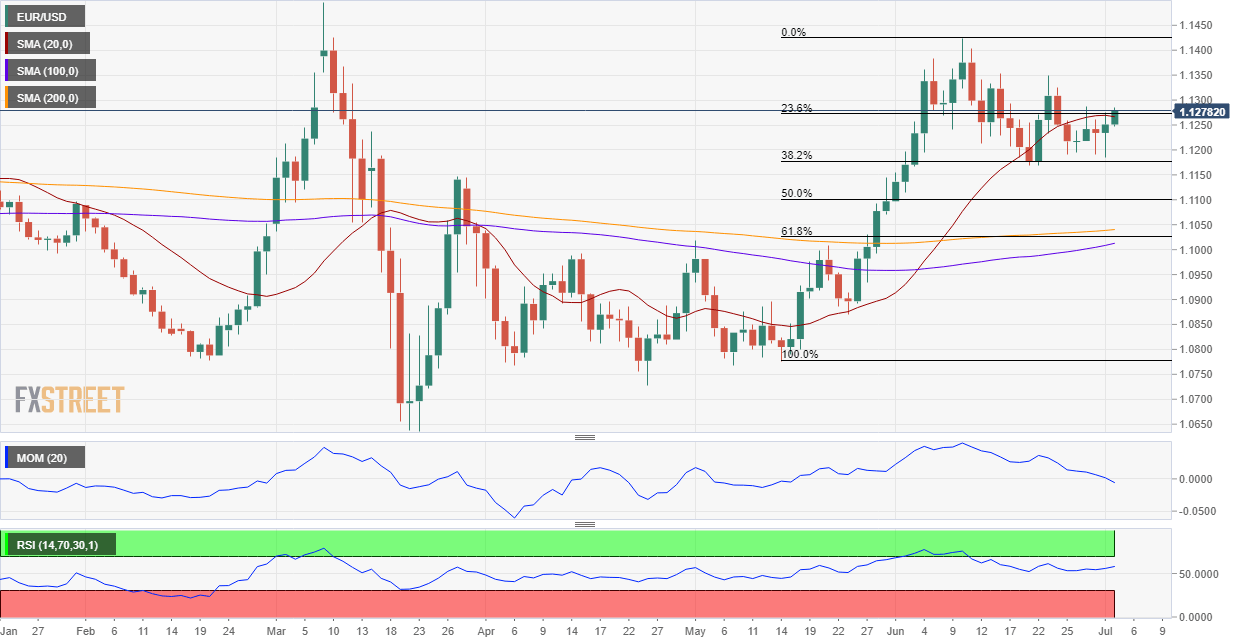
The EUR/USD pair has been ranging for these last three weeks, unable to attract investors, confined between 1.1170 and 1.1330. It could happen that speculative interest turns to re-buy the greenback with upbeat numbers, but there are little chances that the pair could pierce the base of the mentioned range.
Author

Valeria Bednarik

Valeria Bednarik was born and lives in Buenos Aires, Argentina. Her passion for math and numbers pushed her into studying economics in her younger years.


More from Valeria Bednarik
Share:

Editor's Picks

GBP/USD bounces off lows, back above 1.3200

After bottoming out near 1.3160, GBP/USD manages to regain a bit of shine and reclaim the 1.3200 mark and beyond at the end of the week. Stronger-than-expected UK Retail Sales data seem to be helping the British Pound limit its losses, while the chaotic UK political environment keeps the bulls at bay for now.

EUR/USD looks consolidative around 1.1460

EUR/USD stages a modest rebound after slipping to a three-month low below 1.1420 at the end of the week. That said, the pair now looks to consolidate humble gains just above 1.1460 despite growing uncertainty surrounding the next round of US-Iran negotiations, which keeps the US Dollar’s downside contained.

Gold slips back to six-day lows, targets $4,100

Gold retreats for the third consecutive day on Friday, eroding gains seen in the first half of the week and approaching the key $4,100 mark per troy ounce. Indeed, the precious metal continues to face headwinds from the Fed's hawkish stance and renewed uncertainty surrounding the next round of US-Iran negotiations.

Solana extends correction despite ETF inflows, RWA adoption

Solana (SOL) price edges below $70 extending its losses for the fourth straight day this week. The institutional demand for Solana is building, with steady inflows so far this week and Morgan Stanley’s amended S-1 filing for a Solana-focused Exchange-Traded Fund.

The Iran war didn't break the US economy, but what happens next?

Nearly four months after the start of the Iran war, the US economy remains remarkably resilient. While the conflict initially triggered a severe disruption to global energy markets and a sharp rise in Oil prices, recent diplomatic progress between Washington and Tehran has eased concerns about a prolonged supply shock.

Regime change: Inside Kevin Warsh's first move to make the Fed unreadable on purpose

The rate did not move. That was the least interesting thing about Kevin Warsh's first meeting in charge of the Fed. The FOMC held its benchmark at 3.50%-3.75% for the fourth straight meeting, exactly as priced, and then the new chair used his first press conference to dismantle the machinery the market has leaned on for a decade.














