|

Non-performing loans in the European Union: Sharp decline and lower dispersion since 2019

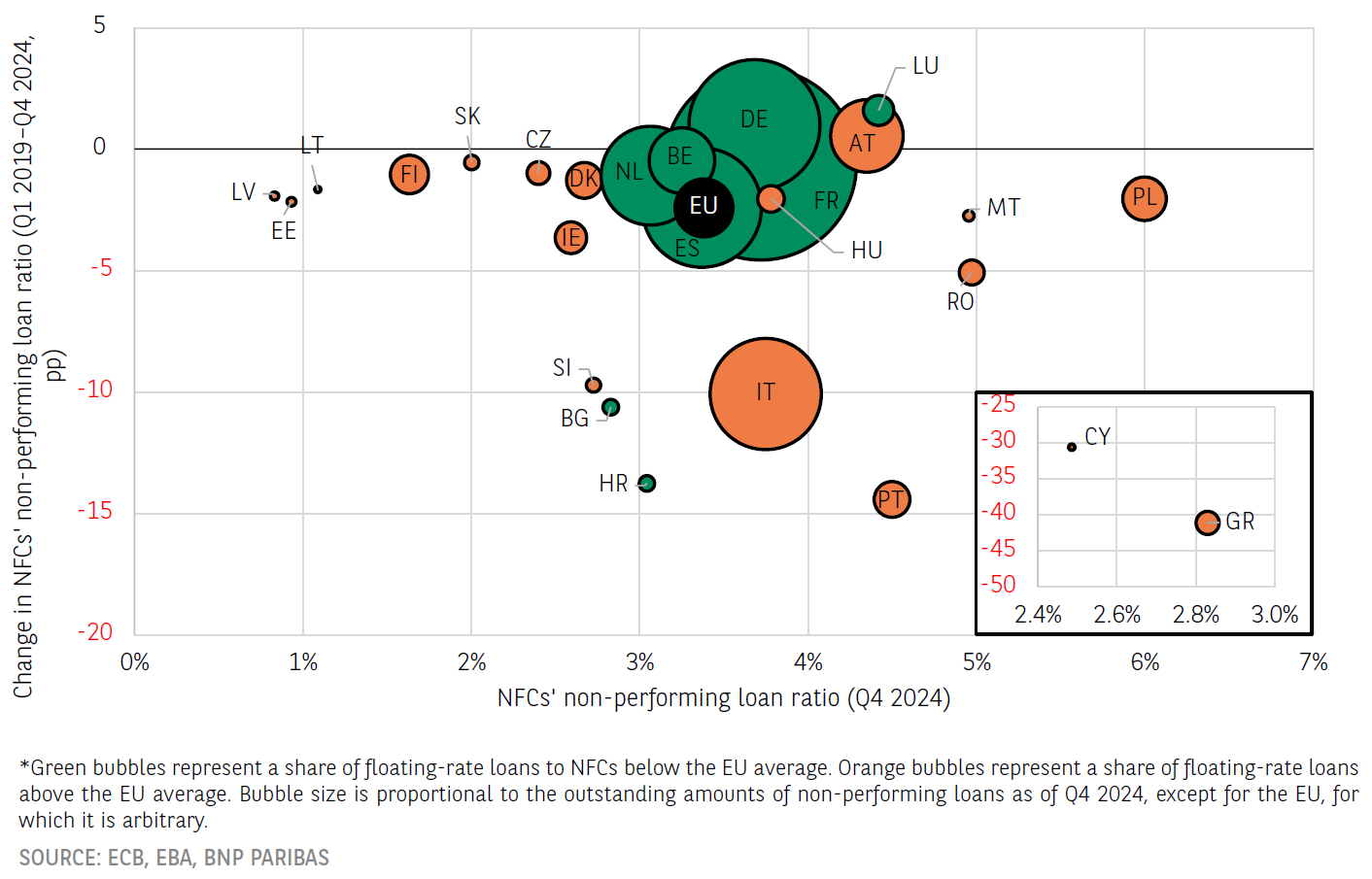
Non-performing loan (NPL) ratios of non-financial corporations declined in most EU/EEA banking systems between 2019 and 2024. On average, the ratio fell significantly to 3.38% in Q4 2024 (-2.4 percentage points since Q1 2019). Only the German, Austrian and Luxembourg banking systems recorded an increase, but they started from a level significantly below the EU/EEA average NPL ratio.

RATIOS AND CHANGES IN NON-PERFORMING LOANS IN EU BANKING SYSTEMS
Regional homogeneity is emerging

A dichotomy can be observed between banking systems located in the north east of Europe and those located in the south. The NPL ratios of the former were initially quite low and declined only slightly between 2019 and 2024, while the ratios of the latter were both historically higher and fell more sharply over the period. Finally, banking systems in core Europe not only had ratios close to the Eurozone average but also showed more moderate variations (increase or decrease) between 2019 and 2024; these geographically central countries are also notable for their significantly higher proportion of fixed-rate loans. This illustrates the protective nature of fixed rates for borrowers and, consequently, the lower impact of interest rate rises on non-performing loan ratios.

Download the Full Report!

Author

BNP Paribas Team

BNP Paribas Team

BNP Paribas

BNP Paribas Economic Research Department is a worldwide function, part of Corporate and Investment Banking, at the service of both the Bank and its customers.


More from BNP Paribas Team
Share:

Editor's Picks

EUR/USD remains depressed below mid-1.1800s; downside potential seems limited

The EUR/USD pair attracts some sellers for the second consecutive day on Tuesday and hovers below mid-1.1800s amid a relatively quiet trading action during the Asian session. The broader fundamental backdrop, however, warrants some caution for bearish traders before positioning for deeper losses.

GBP/USD trades with negative bias, eyes 1.3600 ahead of UK jobs data

The GBP/USD pair trades with a negative bias for the second straight day, though it lacks bearish conviction and holds above the 1.3600 mark through the Asian session on Tuesday. Traders now look forward to the release of the UK monthly jobs report, which will influence the British Pound and provide some impetus to the currency pair.

Gold declines as trading volumes remain subdued due to holidays in China

Gold price extends its losses for the second successive session, trading around $4,930 per troy ounce during the Asian hours on Tuesday. Gold price is trading nearly 0.7% lower at the time of writing as trading volumes stayed thin due to market holidays across China, Hong Kong, and other parts of Asia.

Top Crypto Gainers: Stable, MemeCore and Nexo rally test critical resistance levels

Stable, MemeCore, and Nexo are among the leading gainers in the crypto market over the last 24 hours, while Bitcoin remains below $70,000, suggesting renewed interest in altcoins among investors.

The week ahead: Key inflation readings and why the AI trade could be overdone

It is likely to be a quiet start to the week, with US markets closed on Monday for Presidents Day. European markets are higher across the board and gold is clinging to the $5,000 level after the tamer than expected CPI report in the US reduced haven flows to precious metals.

XRP steadies in narrow range as fund inflows, futures interest rise

Ripple is trading in a narrow range between $1.45 (immediate support) and $1.50 (resistance) at the time of writing on Monday. The remittance token extended its recovery last week, peaking at $1.67 on Sunday from the weekly open at $1.43.