Natural Gas commodity Elliott Wave technical analysis [Video]
![Natural Gas commodity Elliott Wave technical analysis [Video]](https://editorial.fxsstatic.com/images/i/Commodities_Gas-2_XtraLarge.jpg)

Natural Gas Elliott Wave analysis
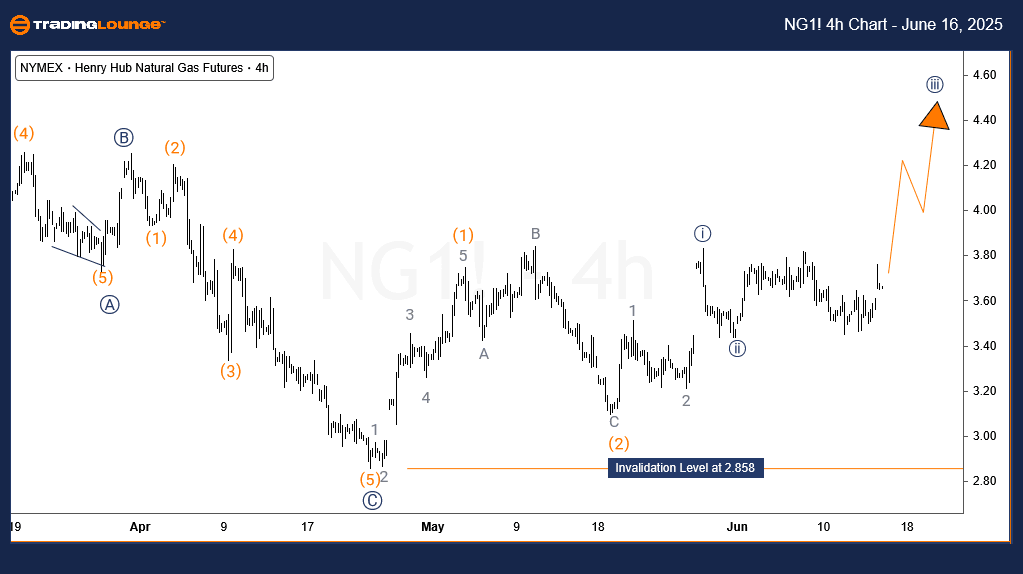
Since late May, Natural Gas prices have remained volatile. However, the upward trend that began on April 24 is expected to extend towards the early April price range of $4.00 to $4.25 in the near term. The bias remains bullish as long as the price stays above the April 24 low of $2.858.
Natural Gas daily chart analysis
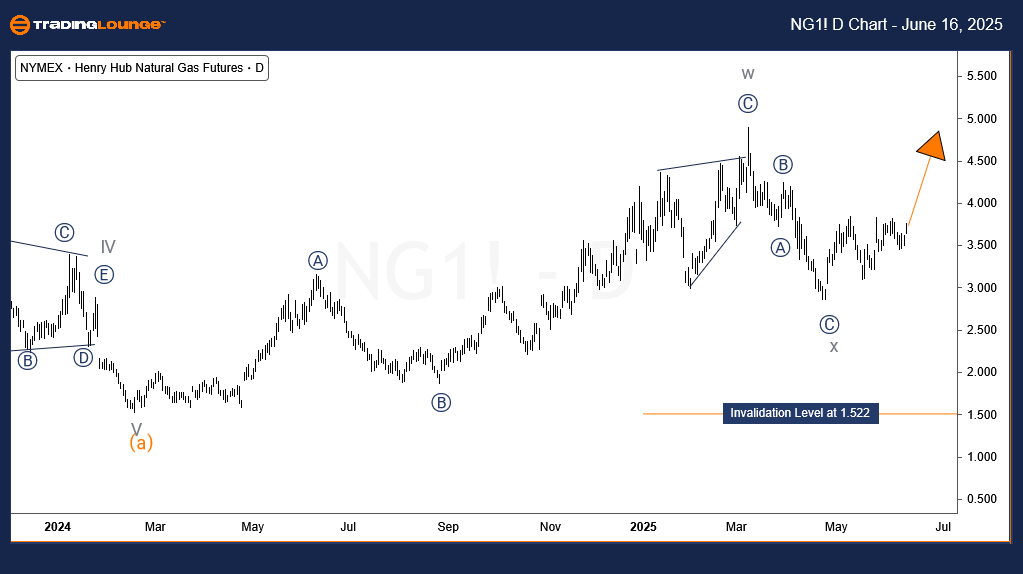
Natural Gas completed a significant bearish impulse cycle between August 2022 and February 2024. Based on Elliott Wave principles, a 5-wave trend is typically followed by a 3-wave correction. This correction began in February 2024.
The initial 3-wave upward structure from February ended in March 2025, which may have completed the correction phase. Under typical wave theory, another 5-wave bearish move would be expected to resume the larger downtrend. However, what followed was another 3-wave decline that ended on April 24, 2025, marking the beginning of a new upward phase.
This suggests that the February correction may not be complete and could evolve into a double correction, possibly reaching as high as $6.23. Yet, the current bounce from April has not confirmed whether it will form a full 5-wave or another 3-wave move upward, making both outcomes plausible.
In the short to medium term, at least a 3-wave rally from the April low is anticipated, with targets in the $4.09 to $4.47 range.
Natural Gas H4 chart analysis
The 4-hour chart highlights the smaller wave structures forming since the April 2025 low. Two swings, labeled as wave (1) and (2), have completed, and the third—wave (3)—is currently underway.
If this move is part of a 5-wave impulse, it could rise beyond $4.70, suggesting a double correction is developing from the February low. Alternatively, if it concludes within the $4.09–$4.47 range, it may indicate only a 3-wave corrective pattern, potentially leading to a continuation of the downtrend from March 2025.
Natural Gas Elliott Wave analysis [Video]
Author
Peter Mathers
TradingLounge
Peter Mathers started actively trading in 1982. He began his career at Hoei and Shoin, a Japanese futures trading company.

















