Money on the sidelines


S2N spotlight
Financial commentators are currently pushing the narrative about “money on the sidelines”; they present an image of a giant pile of cash waiting to rush into markets. It’s a comforting thought — and a misleading one. The truth lies in understanding how modern monetary plumbing works and why the idea of sidelined money is more about psychology than balance sheets.
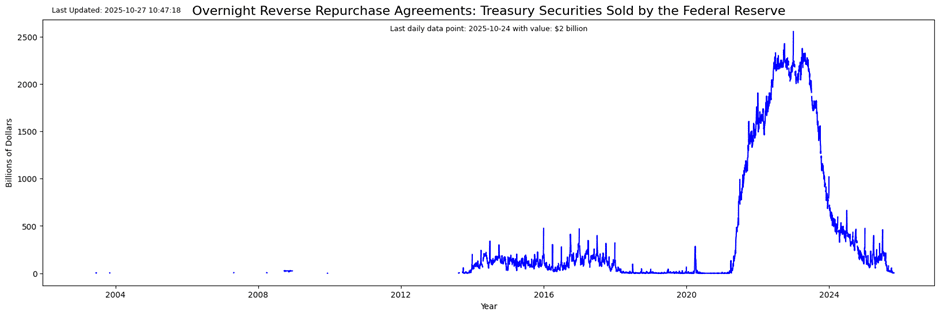
At the centre of this story is the Federal Reserve’s Overnight Reverse Repo Facility (ON RRP) — a mechanism used to manage short-term interest rates by absorbing liquidity from the system. Money-market funds lend cash to the Fed overnight and receive Treasury collateral plus interest in return. It’s the ultimate safe parking lot for excess cash. After the pandemic stimulus and quantitative easing, the facility ballooned to $2.5 trillion in 2021, acting as a holding tank for surplus liquidity. As the Fed shifted to quantitative tightening, letting bonds mature without replacement, that figure collapsed to near zero last week— effectively draining the facility. I could not get over the amount of hype on X talking of the next big wave of liquidity.
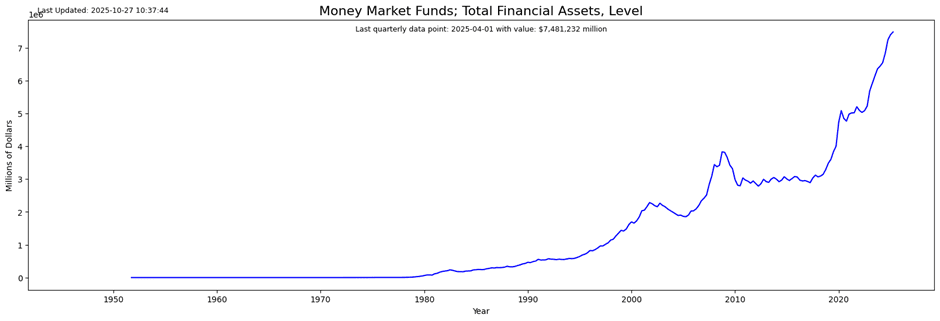
On the other side of this equation, money-market fund assets have surged to around $7.5 trillion, prompting a new wave of excitement among bullish commentators who see it as a wall of cash about to be deployed. But is it really?
Economist Dr John Hussman one of my favourite thinkers, argues otherwise. He famously said, “There is no such thing as money going into or out of the market—only a change in who holds it.” His point is based on balance-sheet logic: for every buyer, there’s a seller; money never leaves the system, it merely changes hands. When money-market funds placed cash into the RRP, they simply swapped one claim (bank reserves) for another (a Fed reverse repo). Both are money-like assets. So, as the RRP drains, we are merely witnessing a swap of claims, not the creation of new money.
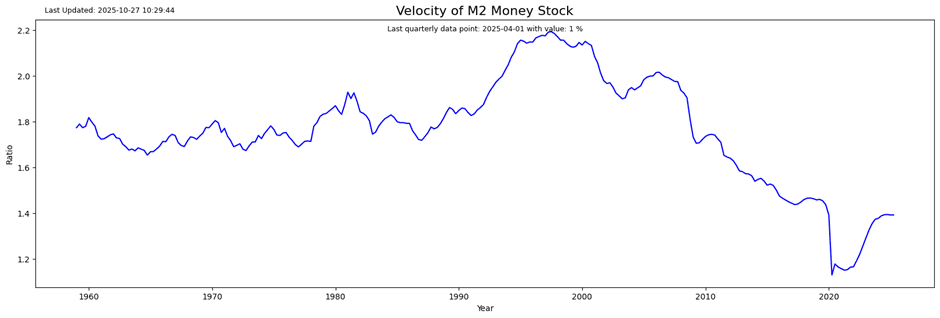
That’s an accounting identity — true by definition — but it doesn’t tell the whole story. I feel Hussman overidentifies with the identity. It is a mistake I am prone to make as well, as I love to live in a world of sound logic. The real economy lives in the space between theory and behaviour. Even if total money supply (M2) remains unchanged, its velocity, or rate of circulation, determines how stimulative it is. M2 includes currency, deposits, and retail money-market funds, but not the institutional funds that dominate RRP activity. So the draining of the RRP back into institutional MMFs doesn’t raise M2 – it may increase the speed at which existing money moves.
Since 2000, money velocity has fallen even as markets soared, a reflection of debt-driven growth. Post-COVID, velocity has rebounded somewhat but remains subdued. The point is that liquidity’s location and momentum matter as much as its size.
Hussman is correct that there are no sidelines in a strict sense, yet money can still shift from idle to active, from sitting to circulating. That movement — not the headline figure — is what drives real economic stimulation. So while there’s no magical cash pile waiting to flood the market, there’s always potential energy within the system, ready to move when confidence and opportunity align.
My view is that there are several constraining factors, such as the size of the current government debt and the effect of servicing the interest on it, as well as inflationary forces that have affected the cost of living for the majority of people and highly inflated asset valuations. So I am not buying the headlines; in fact, I am selling them.
S2N observations
Today is an observation-free day.
S2N screener alert
Today is an alert-free day.
S2N performance review


S2N chart gallery
S2N news today

Author
Michael Berman, PhD
Signal2Noise (S2N) News
Michael has decades of experience as a professional trader, hedge fund manager and incubator of emerging traders.

















