|

Mid-Terms: Democrats' chances hit record highs in the FiveThirtyEight forecast, USD could suffer

  • The US Mid-Term elections are due tomorrow and the tension is mounting.
  • The closely watched models on FiveThirtyEight show record chances for Democrats. 
  • The US Dollar could suffer already ahead of the results.

Americans go to the polls tomorrow, November 6th and the tension in markets is growing. While Brexit headlines try to steal the show, the outcome of the House elections is causing a lot of speculation. 

Recent updates on Nate Silver's FiveThirtyEight website point to record chances for Democrats to gain control of the House of Representatives. According to the Classic Model, the probability of a Democratic win has risen to 87.5%, the highest on record.
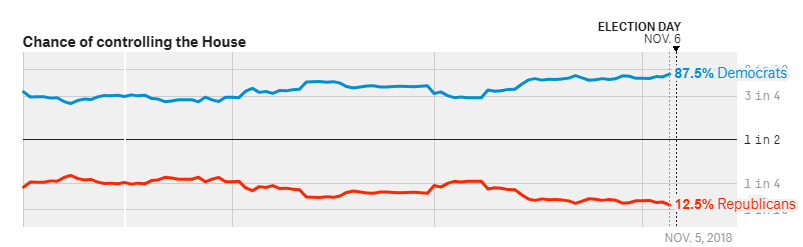
FiveThirtyEight November 5 classic model record chance for Democrats

The probability ranged around 84-86$ earlier. According to the model, the average gain for Democrats is 39 seats, above the 23 needed. This model considers fundraising, past voting, historical trends, etc.

The bare-bones "Lite" model looks only at polls and also here we see a record probability of 80%, the highest so far. 
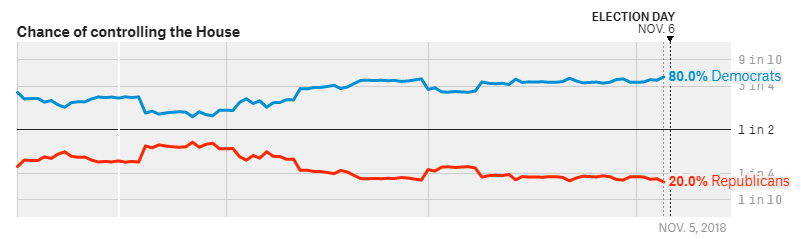
Lite Model FiveThirtyEight November 5 2018 peak Democrat win

USD

Markets liked Trump's tax cuts and deregulation and all this will come to a halt if Democrats win the House. They are also likely to open investigations into Trump's business dealings. The US Dollar will likely suffer if Democrats win and jump if Republicans retain the House.

With growing chances for the opposition party, the US Dollar may start retreating before results are known. It is important to stress that the level of uncertainty is quite high.

More:  What the US mid-term elections mean for currencies: everything you need to know

Author

Yohay Elam

Yohay Elam

FXStreet

Yohay is in Forex since 2008 when he founded Forex Crunch, a blog crafted in his free time that turned into a fully-fledged currency website later sold to Finixio.


More from Yohay Elam
Share:

Editor's Picks

AUD/USD turns south toward 0.6900 as USD firms up

AUD/USD sees fresh selling and drops toward 0.6900 in late Asian trading on Monday, as renewed US Dollar strength weighs on the pair amid lingering Middle East and Russia-Ukraine geopolitical tensions. Focus remains on Oil prices, Treasury bond yields, and RBA expectations for fresh trading impetus in the major.

USD/JPY retakes 158.00 amid hawkish BoJ bets, firmer USD

USD/JPY erases losses and retakes 158.00 in the Asian session on Monday, trading within a one-week-old range. Geopolitical uncertainty continues to underpin the US Dollar, despite fading Fed rate hike hopes, supporting the pair's rebound. However, further upside could be capped by hawkish BoJ expectations and looming intervention risks that could support the Japanese Yen.

Gold languishes below $4,200 amid high US yields

Gold trims some losses on Monday, but remains trapped within previous ranges, with upside attempts limited below $4,200 and with two-month lows of $4,110 at a short distance. The recent pullback on the US Dollar Index has provided some support for precious metals although the high US Treasury yields are keeping a floor on US Dollar dips so far.

Pi Network risks a steeper decline as bearish momentum builds

Pi Network extends losses below $0.090 maintaining a steady decline for the fifth consecutive day. The retail demand remains firm, with the notional value of active perpeutals holding above $10 million. The technical outlook for PI remains bearish as bearish momentum mounts.

ISM Services PMI expected to show robust US economy in September

The US ISM Services PMI is expected to improve marginally in September. The US services sector is expected to remain well into expansionary territory. Bets of further Fed tightening appear to have lost traction in the last few days.

The Euro is near a one-year low: Inflation could trigger its rebound, not its fall

EUR/USD has fallen to its lowest level since May 2025. The pair hit 1.1312 on Wednesday and trades well below the January peak of 1.2082. The decline reflects a powerful combination of US Dollar strength, geopolitical uncertainty and renewed concerns about Europe's exposure to higher energy prices.