May employment: Two surveys diverged

Summary
Nonfarm payroll growth bounced back strongly in May, rising 272K in the month relative to the 165K pace that was registered in April. Job growth over the past year has been concentrated in industries that are less cyclically sensitive, and this was once again true in May with employment growth led by health care (+84K), government (+43K) and leisure & hospitality (+42K). Average hourly earnings also topped expectations, rising 0.4% in the month and 4.1% over the past year.
However, the separate household survey was more underwhelming. A 408K decline in employment as measured by the household survey, when paired with a 250K drop in the labor force, pushed the unemployment rate up to 4.0%, its highest reading since January 2022.
On balance, we suspect the truth lies somewhere in between the robust establishment survey and the faltering household survey. We think employment growth is continuing at a solid pace, but there are ample signs that the heat in the labor market over the past few years largely has been removed. Declining job openings, a falling quit rate, narrowing employment growth and decelerating wages all point to a labor market that is coming into better balance. Policymakers will need to see a few slower inflation reports over the summer in order to start cutting rates by the fall, and all eyes now turn to next week's CPI report, to be released on the same day as the conclusion of the FOMC meeting. Our preview of next week's CPI report can be found here.
Headline job growth jumps, but details not quite as strong
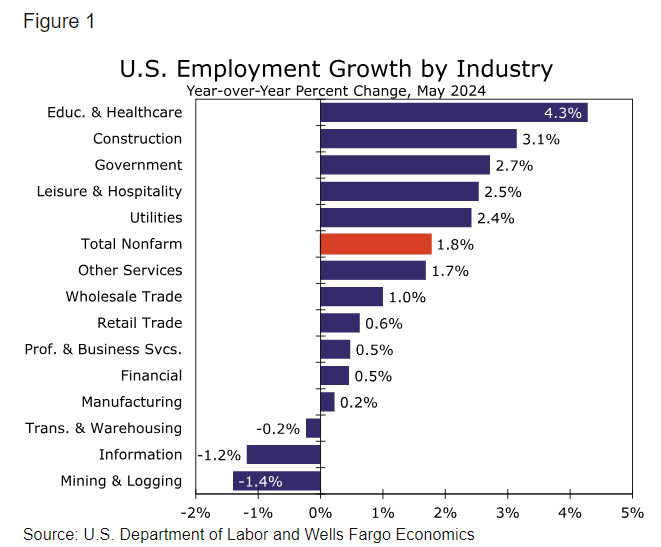
Nonfarm payrolls surprised to the upside in May, rising by 272K in the month compared to a consensus forecast of 180K. Revisions to job growth in the prior two months were modest and lowered employment growth by 15K in total. The industries seeing the largest job gains over the month were health care (+84K), leisure & hospitality (+42K) and government (+43K). Employment growth has been concentrated in less cyclically sensitive industries such as government and health care over the past year (Figure 1). An exception to this is the construction industry, which saw employment rise 21K in May and 251K over the past 12 months. Hiring in the construction sector seems to have powered through the interest rate headwinds via the tailwinds from higher infrastructure spending, booming construction of technology-related manufacturing facilities and still solid single-family home construction.
Author
Wells Fargo Research Team
Wells Fargo

















