Markets remain jittery as AI fears, credit concerns and tariff risks bite

Risk sentiment is jittery on Tuesday as President Trump’s 10% global tariff rate comes into effect. European stocks have opened lower, but US indices are making a cautious recovery after a sharp sell off on Monday.
Markets remain resilient in the face of multiple risks
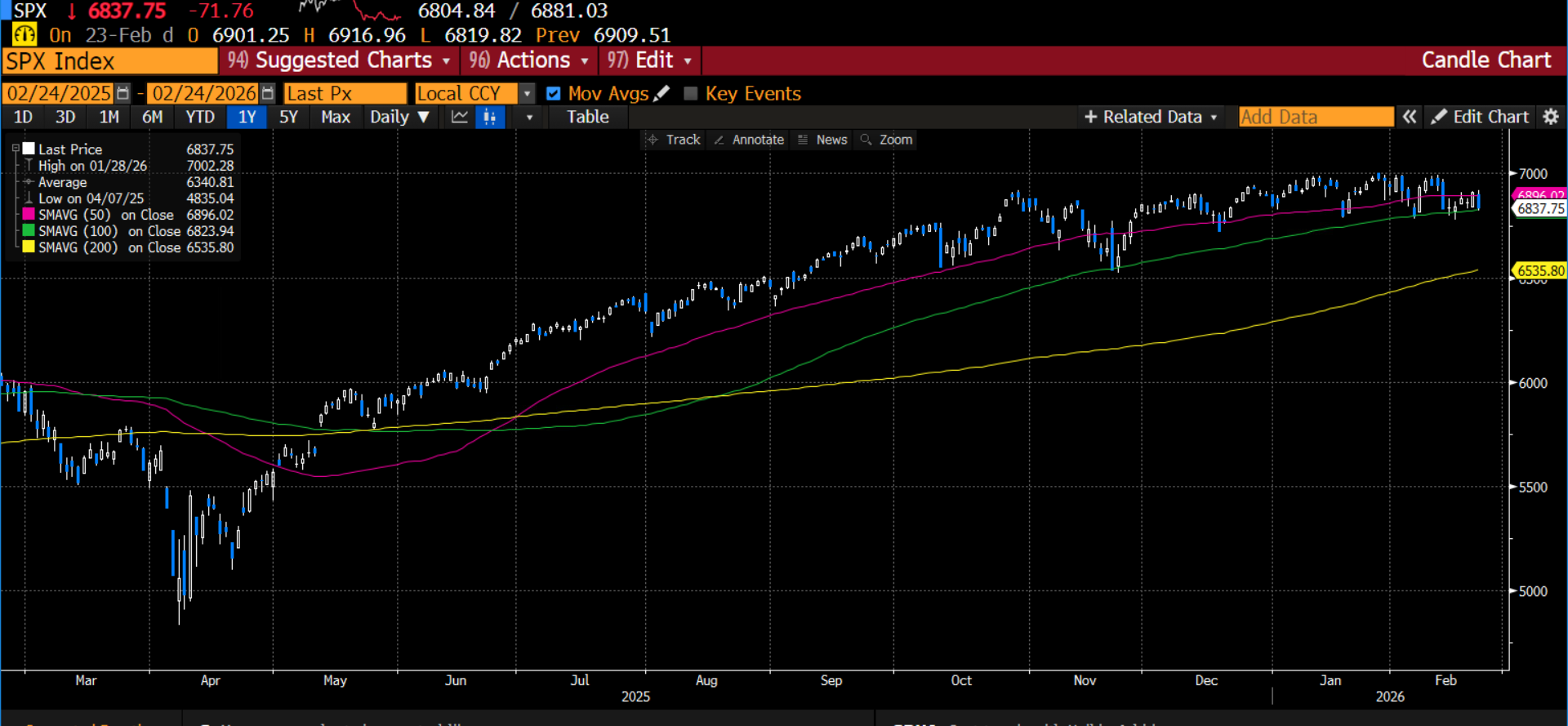
US stock indices are struggling to find direction right now, and the S&P 500 fell below its 50-day sma on Monday, which suggests that short term momentum is to the downside. This is to be expected, as investors find themselves in a confusing risk environment: tariffs, AI fears and credit concerns are battering markets all at once. So far the effects have been mild, the S&P 500 is only down a touch YTD, and more than 60% of S&P 500 members are posting gains so far this year, even amongst all of the risks swirling around markets.
Fresh wave of tariff risk needs to be priced into markets
Tariffs are the latest blow to affect markets. The White House is pushing to increase the current 10% rate to 15%, which suggests that a fresh wave of tariff risk needs to be priced into markets. The effective global tariff rate is now 10.2%, down from 13.6%, but this is likely to increase in the coming months if the President gets his way.
Credit risk fears trigger bank stock sell off
A narrative around credit concerns and a potential 2008 scenario forming is also starting to gain traction. Jamie Dimon, the CEO of JP Morgan, sounded a warning about the risks of bad loans in the banking system. He said that rival banks are doing ‘dumb things’ to boost net interest income. He added that AI disruption could cause a souring in the credit cycle as multiple industries come under pressure from AI concerns. This did not save JP Morgan from a sharp sell off across the banking sector on Monday, and JPM’s share price dipped more than 4% on Monday. In pre-market trading on Tuesday, JPM’s share price has stabilized as the broader market attempts to recover. #
Dimon’s fears echo across the Atlantic
Fears about credit quality are also weighing on banks in Europe and is it is dragging the index lower. HSBC, Barclays, Lloyds and NatWest are all sharply lower today, as Dimon’s fears echo across the Atlantic. Intesa San Paolo, ING Group and Allianz are also weighing heavily on the European index. We will need to see if this sell off continues, or if a recovery in US banks helps to calm credit fears in Europe.
Are credit fears overdone?
It is worth noting that the default rate across European corporates was very low at 4.4% at the end of 2025, this is expected to fall this year. There were only $3.9bn of defaults in European high yield debt last year, and only $9bn in defaults in leveraged European loans. While this could change this year, it is hopeful that it comes off a low base. Trying to guess a credit collapse might make good headlines, but it may not become a reality, and the markets could be overreacting to what Dimon had to say.
The risk off tone to markets is bashing crypto again. Bitcoin is tanking and is testing the $63,000 level, the low from early Feb, gold is also down more than 1% and sovereign bonds are rising.
IBM gets caught in AI scare trade with biggest sell off in 25 years
Tariff concerns have combined with AI fears to leave a grey cloud above markets this week. On Monday, IBM was the victim of choice, its share price plunged by 13%, the most in 25 years, after Claude announced a new coding tool that can modernize programming language mainly run on IBM systems. IBM is in the cross hairs of the AI software sell off right now, and the stock’s price has dropped by more than a quarter so far this year.
The AI scare trade is back, and more victims like IBM are being targeted as investors try to pick out companies that are most vulnerable to AI disruption. IBM is now the most sold software stock on the S&P 500, following large declines for Microsoft, Amazon and Tesla. These companies are still generating billions of dollars in revenues, and the new AI tools have no history of sales revenues. While AI tools are disruptive for the global economy, we have no idea yet whether they will replace traditional software firms, who have sales and marketing teams behind them that generate the cash flow. Could the sell off that we have seen across the tech space be an overreaction? Definitely, but that does not mean that the sell off will end, as more AI tools come on board in the coming months, investors are likely to remain jittery.
S&P 500 falls below 50-day sma
Source: XTB and Bloomberg
Author

Kathleen Brooks
XTB UK
Kathleen has nearly 15 years’ experience working with some of the leading retail trading and investment companies in the City of London.